PHSC 211 Chapter 3 (A grade)
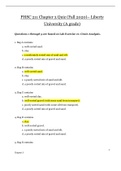
PHSC 211 Chapter 3 Quiz (Fall 2020)– Liberty University (A grade) Questions 1 through 5 are based on Lab Exercise #1: Grain Analysis. 1. Bag A contains a. well-sorted sand. b. clay. c. a moderately sorted mix of sand and silt. d. a poorly sorted mix of gravel and sand. 2. Bag B contains a. well-sorted sand. b. clay. c. a poorly sorted mix of sand and silt. d. a poorly sorted mix of gravel and sand. 3. Bag C contains a. well-sorted clay. b. well-sorted gravel (with some sand from transport). c. poorly sorted sand (with some silt from transport). d. a poorly sorted mix of gravel and sand. 4. Bag D contains a. clay. b. well-sorted gravel. c. a poorly sorted mix of sand and silt. d. a poorly sorted mix of gravel and sand. 5. Bag E contains a. well-sorted sand. b. well-sorted gravel. c. a poorly sorted mix of sand and silt. d. a poorly sorted mix of gravel, sand, and silt. Questions 6 through 20 are based on Lab Exercise #2: Identification of Sedimentary Rocks. 6. The mineral grains in Specimen #11 are a. biotite mica. b. feldspar. c. quartz. d. hornblende. 7. Specimen #11 is a. chert. b. shale. c. quartz sandstone. d. arkose. 8. Specimen #12 has black carbonized plant remains. What is specimen #12? a. fossiliferous limestone b. bituminous coal c. graywacke d. rock salt 9. Based on the clasts in Specimen #13, the deposition environment might have been a. sand dunes. b. a warm, shallow lagoon. c. a lake bottom. d. a river channel. 10. The largest grain-size dimension for Specimen #13 is a. greater than 2 mm in diameter. b. between 1/16 mm and 2 mm in diameter. c. between 1/256 mm and 1/16 mm in diameter. d. less than 1/256 mm in diameter. 11. Specimen #13 is a. chert. b. shale. c. fossiliferous limestone. d. conglomerate. 12. Specimen #14 contains obvious a. plant material. b. mammalian fossils. c. fossil molds from tiny invertebrates. d. mollusk fossils. 13. Specimen #14 is a. sandstone. b. conglomerate. c. fossiliferous limestone. d. gyprock. 14. Specimen #15 a. is fissile. b. contains visible shell fragments. c. fizzes during an acid test. d. feels gritty to the touch. 15. Specimen #15 is a. quartz chert. b. shale. c. limestone. d. conglomerate. 16. Which of the following is a diagnostic feature of Specimen #17? a. It fizzes when tested with acid. b. It is a very coarse-grained sedimentary rock. c. It is a fissile sedimentary rock. d. It is obviously the product of a high-energy depositional environment. 17. Specimen #17 is a. conglomerate. b. gyprock. c. quartz chert. d. shale. 18. Specimen #16 is composed of a. silica. b. calcium carbonate. c. grains of sand-sized particles. d. gypsum. 19. Which of the following is a diagnostic feature of Specimen #16? a. It effervesces when tested with acid. b. It is a very coarse-grained sedimentary rock. c. It is a fine-grained sedimentary rock. d. It is amorphous. 20. Specimen #16 is a. shale. b. chalk. c. sandstone. d. chert. 21. __________________ gives quartz sandstone its color. a. The mineral content of its clasts b. The mineral content of its cement c. Fossils d. Plant remains 22. The most common chemical sedimentary rocks are largely composed of what type of mineral? a. calcite and silica b. gypsum and halite c. borax and gypsum d. quartz and borax 23. The process that breaks rock down into particles or its chemical components is called a. compaction. b. cementation. c. weathering. d. lithification. 24. The process by which soluble minerals are dissolved by water is called a. mechanical weathering. b. chemical weathering. c. precipitation. d. lithification. 25. The two processes by which chemical sedimentary rocks are deposited are a. compaction and cementation. b. evaporation and precipitation. c. erosion and transportation. d. weathering and lithification. 26. The fine sediments that form shale are typically deposited a. by the surf at a beach. b. as a glacier retreats. c. in a high-energy environment like a rushing stream. d. in a low-energy environment like a calm lake. 27. How can one distinguish breccia from conglomerate? a. Breccia contains angular clasts and conglomerate contains rounded clasts. b. Breccia contains rounded clasts and conglomerate contains angular clasts. c. Different minerals cement breccia than cement conglomerate. d. Breccia contains sand and conglomerate contains silt.
Escuela, estudio y materia
- Institución
- Liberty University
- Grado
- PHSC 211
Información del documento
- Subido en
- 26 de junio de 2022
- Número de páginas
- 6
- Escrito en
- 2020/2021
- Tipo
- Examen
- Contiene
- Preguntas y respuestas
Temas
-
grain analysis
-
sorted gravel
-
clay
-
the largest grain size dimension for specimen 13 is
-
which of the following is a diagnostic feature of specimen 17

Documento también disponible en un lote