

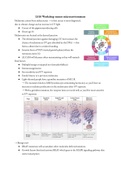
LS10 Workshop tumor microenvironment
Melanoma comes from melanocytes → is skin cancer is most diagnosed,
due to climate change and an increase in UV light
● Cancer of the pigment-producing cells
● Onset age 25
Melanocytes are located at the dermal junction
● The dermal junction against damaging UV, but increases the
chance of melanoma as UV gets absorbed by the DNA → this
forms a dimer due to covalent bonding
● Invasive front of VGP (vertical growth phase) where the
metastasis starts (¾)
● ALCAM will decrease often metastasizing as they will reattach
Risk factors
● Multiple benign or atypical nevi (moedervlekken)
● Immunosuppression
● Sun sensitivity and UV exposure
● Family history or a previous melanoma
● Light-skinned people have a germline mutation of MC1R
→ The mutation binds to MSH (melanocyte-stimulating hormone), so you’d have an
increase in melanin production in the melanocytes after UV exposure
→ With a germline mutation, the receptor does not work well, so you’d be more sensitive
to UV exposure
→ Benign nevi
● BRAF mutations will accumulate other molecules defects/mutations
● Growth factors bind and activate BRAF which goes to the MAPK signaling pathway that
starts transcription
, MAPK signaling pathway
● Ras can mutate Raf, this leads to Mek and Erk towards the transcription factor →
proliferation
● So, there is an overexpression of Raf, this blocks gain of function mutations with
transforming activity that can prevent tumor formation
● Self-sufficiency hallmark
There is no difference in BRAF mutation frequency between benign nevi and metastatic
melanomas
● After too much proliferation the cell goes into apoptosis or cell cycle inhibition → so
they’d need another hallmark!
→ Dysplastic nevus
CDKN2a and PTEN loss
● CDKN2a transcripts for 2 tumor suppressors: P14ARF and P16 INK4A
● Arf induces p53, if it does not bind to MDM2 it will degrade → if not it will go into
apoptosis
● When Arf is mutated it allows it to bind to MDM2 as there is no p53 → So no cell cycle
arrest → more proliferation
● INK4A is in the cell cycle pathway
● If mutated the cyclin B and CDK4 will not be degraded and will go to the nucleus to start
transcription in the G1/S phase
● P16 INK4A normally inhibits the cell cycle progression, so when mutated there will be no
inhibition!
● INK4A and Arf both need to be accumulated
● Evading apoptosis hallmark (ARF) + limitless replicative potential hallmark (INK4A)
Melanoma comes from melanocytes → is skin cancer is most diagnosed,
due to climate change and an increase in UV light
● Cancer of the pigment-producing cells
● Onset age 25
Melanocytes are located at the dermal junction
● The dermal junction against damaging UV, but increases the
chance of melanoma as UV gets absorbed by the DNA → this
forms a dimer due to covalent bonding
● Invasive front of VGP (vertical growth phase) where the
metastasis starts (¾)
● ALCAM will decrease often metastasizing as they will reattach
Risk factors
● Multiple benign or atypical nevi (moedervlekken)
● Immunosuppression
● Sun sensitivity and UV exposure
● Family history or a previous melanoma
● Light-skinned people have a germline mutation of MC1R
→ The mutation binds to MSH (melanocyte-stimulating hormone), so you’d have an
increase in melanin production in the melanocytes after UV exposure
→ With a germline mutation, the receptor does not work well, so you’d be more sensitive
to UV exposure
→ Benign nevi
● BRAF mutations will accumulate other molecules defects/mutations
● Growth factors bind and activate BRAF which goes to the MAPK signaling pathway that
starts transcription
, MAPK signaling pathway
● Ras can mutate Raf, this leads to Mek and Erk towards the transcription factor →
proliferation
● So, there is an overexpression of Raf, this blocks gain of function mutations with
transforming activity that can prevent tumor formation
● Self-sufficiency hallmark
There is no difference in BRAF mutation frequency between benign nevi and metastatic
melanomas
● After too much proliferation the cell goes into apoptosis or cell cycle inhibition → so
they’d need another hallmark!
→ Dysplastic nevus
CDKN2a and PTEN loss
● CDKN2a transcripts for 2 tumor suppressors: P14ARF and P16 INK4A
● Arf induces p53, if it does not bind to MDM2 it will degrade → if not it will go into
apoptosis
● When Arf is mutated it allows it to bind to MDM2 as there is no p53 → So no cell cycle
arrest → more proliferation
● INK4A is in the cell cycle pathway
● If mutated the cyclin B and CDK4 will not be degraded and will go to the nucleus to start
transcription in the G1/S phase
● P16 INK4A normally inhibits the cell cycle progression, so when mutated there will be no
inhibition!
● INK4A and Arf both need to be accumulated
● Evading apoptosis hallmark (ARF) + limitless replicative potential hallmark (INK4A)

