Populations and Sustainability
24.1 Population Size
24.1 Population size
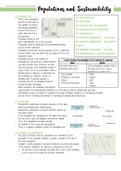
- There is slow population
growth to start with as 24.2 competition
the number of mature, 24.3 predator-prey relationships
reproducing individuals is
low and they may be 24.4 conservation and preservation
widely dispersed. This is 24.5 Sustainability
the lag phase.
24.6 Ecosystem management – masai mara
- Population speeds up and
grows exponentially. This is the log phase. 24.7 ecosystem management – terai region
- Population starts to decelerate as environmental limiting of napal
factors become dominant.
- Population reaches the carrying capacity and it is stable and 24.8 ecosystem management – peat bogs
constant. Birth rate and death rate are balanced. This is the 24.9 environmentally sensitive ecosystems
stationary phase.
- Population density is the number of Factors limiting the population from reaching its maximum
individuals per unit area and is determined by Biotic Abiotic
carrying potential, biotic potential, and time. Has more impact as a Affect populations equally, there is
- Carrying capacity is the maximum number of population gets denser the same effect on a dense
species which can be accommodated within a population as a sparse one
defined space or habitat. It is determined by
- Food available - Water
the availability of nutrients, shelter, or
- Predators or parasites - Oxygen
breeding sites. If carrying capacity is
- Disease - Light
increased, the size of population tends to
- Territorial interactions - Toxins
increase to take advantage.
- Pollution
- Biotic potential is the maximum reproductive
capacity given no environmental resistance. It is affected by male to female ratio, age that
reproduction occurs at, number of progenies from each breeding, frequency of reproductive episodes,
survival rate of offspring and number of reproductive episodes per mature pair.
24.2 Competition
- Intraspecific competition is between members of the same
species e.g., breeding sites, mating rights
- Interspecific competition is between different species e.g.,
food, light, shelter
- If two organisms are competing for the same food source,
the one that is least well adapted will decline in number.
This is the competitive exclusion principle.
- An example of this is grey and red squirrels.
- There is a negative feedback system for population size.
24.3 Predator-Prey Relationships
- The sizes of predator and prey populations are interlinked, as the
population of one organism changes, it causes a change in the size of
the other population.
- Numbers in both populations fluctuate. Generally, the peaks and troughs
in the predator population are delayed in comparison to the prey.
1. An increase in prey population provides more food for the predators,
so more survive increasing the predator population.