

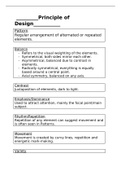
_________Principle of
Design___________
Pattern
Regular arrangement of alternated or repeated
elements.
Balance
- Refers to the visual weighting of the elements.
- Symmetrical, both sides mirror each other.
- Asymmetrical, balanced due to contrast in
elements.
- Radically symmetrical, everything is equally
based around a central point.
- Axial symmetry, balanced on any axis.
Contrast
Juxtaposition of elements, dark to light.
Emphasis/Dominance
Used to attract attention, mainly the focal point/main
subject.
Rhythm/Repetition
Repetition of any element can suggest movement and
is often seen in Patterns.
Movement
Movement is created by curvy lines, repetition and
energetic mark-making.
Variety
,Using different elements in a image to create interest.
Similarity
Creates unity and dynamic interest.
Unity/Harmony
- Arrangement of elements that give viewers the
impression of a coherent whole.
- All parts work unity to be seen as a whole.
Scale
Relationship between objects with respect to size and
number.
__________Elements of
Design___________
Line
Foundation of all drawings and the most versatile
element used to suggest shape, pattern, form,
structure, growth, depth, distance, rhythm, movement
and range of emotions.
_______________________________________________________
Freehand suggests personal mood/energy of the
artist.
_______________________________________________________
Mechanical Line expresses a rigid control.
_______________________________________________________
Continuous Line leads the eye in a certain direction.
_______________________________________________________
,Broken Line expresses the ethereal or insubstantial.
_______________________________________________________
Thick Line expresses strength.
_______________________________________________________
Thin Line Expresses delicacy.
_______________________________________________________
Curved Line shows comfort and ease.
_______________________________________________________
Horizontal Line represents distance and calamity.
_______________________________________________________
Vertical Line emphasises height and strength.
_______________________________________________________
Jagged Line shows turmoil and anxiety.
_______________________________________________________
Outlines create the subject and is always the same
thickness.
Shape
_______________________________________________________
Organic Shape is irregular, seen in nature and doesn’t
contain corners or sharp angles.
_______________________________________________________
Geometric Shape is easily measured, regularly curved
and mathematically correct.
_______________________________________________________
Figurative Shape shows something recognizable.
_______________________________________________________
, Amorphous Shape is abstract and unrecognizable.
_______________________________________________________
Complete Shape occurs when the beginning meets
the end and there is no gaps or breaks.
_______________________________________________________
Incomplete Shape occurs when the outline isn’t
continuous has gaps and breaks.
Form
Form is 3-Dimensional and is geometric or freeform.
Texture
Surface of an object and how it feels to the touch.
_______________________________________________________
Real Texture is the feel of an object.
_______________________________________________________
Literal Texture is texture made by the artist.
_______________________________________________________
Implied Texture is what you imagine the object to feel
like.
_______________________________________________________
Illusion of Texture is the creation of texture that isn’t
there.
Tone
Tone is the change from light to dark and is used to
create form.
Design___________
Pattern
Regular arrangement of alternated or repeated
elements.
Balance
- Refers to the visual weighting of the elements.
- Symmetrical, both sides mirror each other.
- Asymmetrical, balanced due to contrast in
elements.
- Radically symmetrical, everything is equally
based around a central point.
- Axial symmetry, balanced on any axis.
Contrast
Juxtaposition of elements, dark to light.
Emphasis/Dominance
Used to attract attention, mainly the focal point/main
subject.
Rhythm/Repetition
Repetition of any element can suggest movement and
is often seen in Patterns.
Movement
Movement is created by curvy lines, repetition and
energetic mark-making.
Variety
,Using different elements in a image to create interest.
Similarity
Creates unity and dynamic interest.
Unity/Harmony
- Arrangement of elements that give viewers the
impression of a coherent whole.
- All parts work unity to be seen as a whole.
Scale
Relationship between objects with respect to size and
number.
__________Elements of
Design___________
Line
Foundation of all drawings and the most versatile
element used to suggest shape, pattern, form,
structure, growth, depth, distance, rhythm, movement
and range of emotions.
_______________________________________________________
Freehand suggests personal mood/energy of the
artist.
_______________________________________________________
Mechanical Line expresses a rigid control.
_______________________________________________________
Continuous Line leads the eye in a certain direction.
_______________________________________________________
,Broken Line expresses the ethereal or insubstantial.
_______________________________________________________
Thick Line expresses strength.
_______________________________________________________
Thin Line Expresses delicacy.
_______________________________________________________
Curved Line shows comfort and ease.
_______________________________________________________
Horizontal Line represents distance and calamity.
_______________________________________________________
Vertical Line emphasises height and strength.
_______________________________________________________
Jagged Line shows turmoil and anxiety.
_______________________________________________________
Outlines create the subject and is always the same
thickness.
Shape
_______________________________________________________
Organic Shape is irregular, seen in nature and doesn’t
contain corners or sharp angles.
_______________________________________________________
Geometric Shape is easily measured, regularly curved
and mathematically correct.
_______________________________________________________
Figurative Shape shows something recognizable.
_______________________________________________________
, Amorphous Shape is abstract and unrecognizable.
_______________________________________________________
Complete Shape occurs when the beginning meets
the end and there is no gaps or breaks.
_______________________________________________________
Incomplete Shape occurs when the outline isn’t
continuous has gaps and breaks.
Form
Form is 3-Dimensional and is geometric or freeform.
Texture
Surface of an object and how it feels to the touch.
_______________________________________________________
Real Texture is the feel of an object.
_______________________________________________________
Literal Texture is texture made by the artist.
_______________________________________________________
Implied Texture is what you imagine the object to feel
like.
_______________________________________________________
Illusion of Texture is the creation of texture that isn’t
there.
Tone
Tone is the change from light to dark and is used to
create form.

