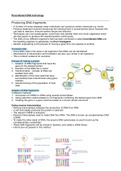
Recombinant DNA technology
Producing DNA fragments
• A number of human diseases mean individuals can't produce certain chemicals e.g. insulin
• Previous treatment involved introducing the chemical from a human/animal donor however this
can lead to rejection, immune system issues and infection
• Techniques can now isolate genes, clone them and transfer them into micro-organisms which
are then grown to produce the required protein continuously
• The DNA of two different organisms that has been combined is called recombinant DNA and
the resulting organism is genetically modified/ transgenic
• Genetic engineering is the process of moving a gene from one species to another
Universal code
• Since DNA code is the same in all organisms then DNA can be transferred
• Mechanisms of transcription and translation are also very similar in all organisms
• This is indirect evidence for evolution
Process of making a protein:
1. Isolation of DNA fragments that have the
gene for the desired protein
2. Insertion of the DNA into a vector
3. Transformation - transfer of DNA into
suitable host cells
4. Identification of the host cells that have
successfully been transformed using gene
markers
5. Growth/cloning of the population of host
cells
Isolation of DNA fragments:
3 different methods:
1. Conversion of mRNA to cDNA using reverse transcriptase
2. Using restriction endonuclease to cut fragments containing the desired gene from DNA
3. Creating the gene in a gene machine based on a known protein structure
Using reverse transcriptase
• Reverse transcriptase catalyses the production of DNA from RNA
• A cell that readily produces the protein is selected
• The relevant mRNA is extracted
• Reverse transcriptase used to make DNA from RNA. The DNA is known as complementary DNA
(cDNA)
• To make the other stand of DNA, the enzyme DNA polymerase is used to build up the
complementary nucleotides
• These DNA fragments will be cloned in bacteria, and called a cDNA library
• Introns are not present in this method
, Using restriction endonuclease enzymes
• These enzymes are found in bacteria to defend themselves from viruses by cutting up the viral
DNA
• Each restriction endonuclease cuts a DNA double strand at a specific sequence of bases known
as the recognition sequence. It cuts at a specific point due to a specific active site that is
complementary to one base sequence.
• The recognition sequence is a palindromic sequence which means that the enzymes can cut
from either direction.
• Cuts in the DNA can form blunt ends or sticky ends
• Sticky ends: can forms hydrogen bonds with complementary sticky ends.
• To get complementary sticky ends, the same restriction endonuclease must be used
• Introns are present in this method
Fragments:
• This technique leaves you with many fragments, one containing the gene you want
• Smaller recognition sequences have a higher probability of occurring in the DNA so the
fragments will be shorter
• Different lengths of fragments from a different species due to the recognition sequences being
in different places as they have different genes
DNA types Plasmid Linear DNA
Picture
1 cut 1 fragment 2 fragments
2 cuts 2 fragments 3 fragments
Using a gene machine
• Desired sequence of bases determined from the protein’s primary structure and from this you
can deduce the mRNA codons and the complementary DNA triplets
• Desired sequence of nucleotide bases given to computer
• Computer designs small overlapping single strand of nucleotides (oligonucleotides)
• Each of the oligonucleotides are joined together to make a gene and this gene is replicated and
created into a double strand using the polymerase chain reaction
• Genes are checked and those with errors are rejected
Producing DNA fragments
• A number of human diseases mean individuals can't produce certain chemicals e.g. insulin
• Previous treatment involved introducing the chemical from a human/animal donor however this
can lead to rejection, immune system issues and infection
• Techniques can now isolate genes, clone them and transfer them into micro-organisms which
are then grown to produce the required protein continuously
• The DNA of two different organisms that has been combined is called recombinant DNA and
the resulting organism is genetically modified/ transgenic
• Genetic engineering is the process of moving a gene from one species to another
Universal code
• Since DNA code is the same in all organisms then DNA can be transferred
• Mechanisms of transcription and translation are also very similar in all organisms
• This is indirect evidence for evolution
Process of making a protein:
1. Isolation of DNA fragments that have the
gene for the desired protein
2. Insertion of the DNA into a vector
3. Transformation - transfer of DNA into
suitable host cells
4. Identification of the host cells that have
successfully been transformed using gene
markers
5. Growth/cloning of the population of host
cells
Isolation of DNA fragments:
3 different methods:
1. Conversion of mRNA to cDNA using reverse transcriptase
2. Using restriction endonuclease to cut fragments containing the desired gene from DNA
3. Creating the gene in a gene machine based on a known protein structure
Using reverse transcriptase
• Reverse transcriptase catalyses the production of DNA from RNA
• A cell that readily produces the protein is selected
• The relevant mRNA is extracted
• Reverse transcriptase used to make DNA from RNA. The DNA is known as complementary DNA
(cDNA)
• To make the other stand of DNA, the enzyme DNA polymerase is used to build up the
complementary nucleotides
• These DNA fragments will be cloned in bacteria, and called a cDNA library
• Introns are not present in this method
, Using restriction endonuclease enzymes
• These enzymes are found in bacteria to defend themselves from viruses by cutting up the viral
DNA
• Each restriction endonuclease cuts a DNA double strand at a specific sequence of bases known
as the recognition sequence. It cuts at a specific point due to a specific active site that is
complementary to one base sequence.
• The recognition sequence is a palindromic sequence which means that the enzymes can cut
from either direction.
• Cuts in the DNA can form blunt ends or sticky ends
• Sticky ends: can forms hydrogen bonds with complementary sticky ends.
• To get complementary sticky ends, the same restriction endonuclease must be used
• Introns are present in this method
Fragments:
• This technique leaves you with many fragments, one containing the gene you want
• Smaller recognition sequences have a higher probability of occurring in the DNA so the
fragments will be shorter
• Different lengths of fragments from a different species due to the recognition sequences being
in different places as they have different genes
DNA types Plasmid Linear DNA
Picture
1 cut 1 fragment 2 fragments
2 cuts 2 fragments 3 fragments
Using a gene machine
• Desired sequence of bases determined from the protein’s primary structure and from this you
can deduce the mRNA codons and the complementary DNA triplets
• Desired sequence of nucleotide bases given to computer
• Computer designs small overlapping single strand of nucleotides (oligonucleotides)
• Each of the oligonucleotides are joined together to make a gene and this gene is replicated and
created into a double strand using the polymerase chain reaction
• Genes are checked and those with errors are rejected