[PRIN
MAT-136-T2129 20EW2 Intro to Quantitative Analysis, 4-2 Problem Set: Module Four
Angie Mann, 11/29/20 at 7:57:26 PM EST
Question1: Score 0/5
f
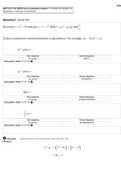
Given f(x) = x 2 + 9x and g(x) = 1 − x 2, find f + g, f − g, fg, and g .
Enclose numerators and denominators in parentheses. For example, (a − b) / (1 + n).
(f + g)(x) =
Your response Correct response
No answer 9*x+1
Auto graded Grade: 0/1.0 F 0%
(f − g)(x) =
Your response Correct response
No answer 2*x^2+9*x-1
Auto graded Grade: 0/1.0 F 0%
fg(x) =
Your response Correct response
No answer -x^4-9*x^3+x^2+9*x
Auto graded Grade: 0/1.0 F 0%
f
g
(x) =
Your response Correct response
No answer (x^2+9*x)/(1-x^2)
Auto graded Grade: 0/1.0 F 0%
Total grade: 0.0×1/4 + 0.0×1/4 + 0.0×1/4 + 0.0×1/4 = 0% + 0% + 0% + 0%
Feedback:
( ) (
f + g = x 2 + 9x + 1 − x 2 )
= 9x + 1
,Since both f(x) and g(x) have domains of (− ∞, ∞), the domain of f + g is (− ∞, ∞).
( ) (
f − g = x 2 + 9x − 1 − x 2 )
= 2x 2 + 9x − 1
Since both f(x) and g(x) have domains of (− ∞, ∞), the domain of f − g is (− ∞, ∞).
(
fg = x 2 + 9x )(1 − x )
2
= 1x 2 − x 4 + 9x − 9x 3
= − x 4 − 9x 3 + 1x 2 + 9x
Since both f(x) and g(x) have domains of (− ∞, ∞), the domain of fg is (− ∞, ∞).
f ( x + 9x )
2
= where x 2 ≠ 1
g
(1−x ) 2
Since the denominator equals zero whenever x 2 = 1, we must exclude ± 1 from the domain. Thus,
f
the domain of is (− ∞, − 1) ∪ (− 1, 1) ∪ (1, ∞).
g
Question2: Score 5/5
, Use the pair of functions to find f(g(x)) and g(f(x)). Simplify your answers.
f(x) = √x + 8, g(x) = x 2 + 1
Reminder, to use sqrt(() to enter a square root.
f(g(x)) =
Your response Correct response
√x 2
+1+8 sqrt(x^2+1)+8
Auto graded Grade: 1/1.0 A+ 100%
g(f(x)) =
Your response Correct response
x + 16√x + 65 x+16*sqrt(x)+65
Auto graded Grade: 1/1.0 A+ 100%
Total grade: 1.0×1/2 + 1.0×1/2 = 50% + 50%
Feedback:
Let's begin by substituting g(x) into f(x).
f(g(x)) = √ (x 2 + 1 ) + 8
= √x 2 + 1 + 8
Now we can substitute f(x) into g(x).
g(f(x)) = (√x + 8 )2 + 1
= x + 16√x + 64 + 1
= x + 16√x + 65