Multidimensional_Care_II_Exam_2_Study Guide
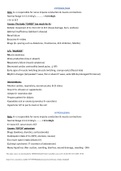
HYPERKALEMIA Role: K+ is responsible for nerve impulse conduc3on & muscle contrac3ons Normal Range 3.5-5.0 mEq/L…………. 5.0 mEq/L K+ in ECF Causes: The body “CARED” too much for K+ Cellular movement of K+ from ICF to ECF (3ssue damage, burn, acidosis) Adrenal insufficiency (Addison’s disease) Renal failure Excessive K+ intake Drugs (K+ sparing such as Aldactone, Triamterene, ACE inhibitors, NSAIDs) S/S: “MURDER” Muscle weakness Urine produc3on (low or absent) Respiratory failure (muscle weakness) Decreased cardiac contrac3lity (weak pulse, ↓ BP) Early signs of muscle twitching (muscle twitching, cramps-early) (flaccid-late) Rhythm changes (tall peaked T wave, flat or absent P wave, wide QRS & prolonged PR interval) IntervenLons: Monitor cardiac, respiratory, neuromuscular, & GI status Stop IV K+ infusion or supplements Ini3ate K+ restric3ve diet Prepare pa3ent for dialysis Kayexalate oral or enema (promotes K+ excre3on) Hypertonic IVF to put K+ back in the cell HYPOKALEMIA Role: K+ is responsible for nerve impulse conduc3on & muscle contrac3ons Normal Range 3.5-5.0 mEq/L………. 3.5 mEq/L K+ loves ICF; serum test is ECF Causes: “DITCH” potassium Drugs (laxa3ves, diure3cs, cor3costeroids) Inadequate intake of K+ (NPO, anorexia, nausea) Too much water intake (dilutes K+) Cushing’s syndrome (↑ secre3on of aldosterone) Heavy liquid loss (Na+ suc3on, vomi3ng, diarrhea, wound drainage, swea3ng - DKA
Información del documento
- Subido en
- 16 de marzo de 2022
- Número de páginas
- 7
- Escrito en
- 2022/2023
- Tipo
- Examen
- Contiene
- Preguntas y respuestas