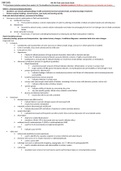
NR 545 Final Exam Study Guide
The final exam includes content from weeks 1-8. The deadline for this exam is Saturday evening at 11:50 pm. Week 8 closes on Saturday not Sunday. Week 7 : renal and urological disorders • Questions can include pathophysiology, health assessment (normal and abnormal), and pharmacologic treatment • Review required readings, course lectures, case study and learning activity. Fluid and electrolyte balance- processes in the kidney Hormones controls reabsorption of fluid and electrolytes o Antidiuretic hormone From posterior pituitary; controls reabsorption of water by altering permeability of distal convoluted tubule and collecting duct o Aldosterone Secreted by adrenal cortex; controls sodium reabsorption and water by exchanging Na ions for K or hydrogen ions in distal convoluted tubule o Atrial natriuretic hormone From heart; 3rd hormone controlling fluid balance by reducing Na and fluid reabsorption in kidneys Renal circulation process Laboratory testing- purpose and interpretation ; Age related urinary changes ; Conditions/diagnoses associated with urine color changes Diagnostic test Urinalysis o Constituents and characteristics of urine may vary w/ dietary intake, drugs, and care w/ which specimen is handled o Urine is normally: clear, straw colored and has mild color o Urine pH is 4.5-8.0 o Appearance Cloudy indicate presence of large amounts of protein, blood cells or bacteria and pus Dark color indicate hematuria (blood), excessive bilirubin content or highly concentrated urine Unpleasant or unusual odor indicate infection or result from certain dietary components or medications o Abnormal constituents (present in significant quantities) Blood (hematuria) small (microscopic) amounts of blood indicates infection, inflammation, or tumors in urinary tract large numbers of RBC (gross hematuria) indicates increased glomerular permeability or hemorrhage in tract protein (proteinuria, albuminuria) indicates leakage of albumin or mixed plasma proteins into filtrate d/t inflammation and increased glomerular permeability bacteria (bacteriuria) and pus (pyuria) indicates infection in urinary tract urinary casts (microscopic sized molds of tubules, consisting of one or more cells (bacteria, protein, and so on)) indicates inflammation of kidney tubules specific gravity indicates ability of tubules to concentrate the urine very low specific gravity= dilute urine; related to renal failure glucose and ketones (ketoacids) found when DM is not well controlled blood test o elevated serum urea (BUN and Cr) indicate failure to excrete nitrogen wastes d/t decreased GFR results from protein metabolism o metabolic acidosis (decreased pH and Bicarb) indicate decreased GFR and failure of tubules to control acid-base balance o anemia (low hgb) indicated decreased erythropoietin secretion and/or bone marrow depression d/t accumulated wastes o electrolytes depend on related fluid balance retention of fluid= GFR is decreased and may result in dilution effect o antibody level antistreptolysin O (ASO) or antistreptokinase (ASK) used for dx of post-streptococcal glomerulonephritis o renin indicate cause of HTN other test o culture and sensitivity on urine specimens used to identify the causative organism in urinary infection and select drug tx o clearance test such as Cr or insulin clearance or radioisotopestudy used to assess GFR o radiologic test such as radionuclide imagining, angiography, US, CT, MRI and IV pyelography(IVP) used to visualize structures and abnormalities in urinary system o cystoscopy visualizes lower urinary tract and may be used in performing a biopsy or removing kidney stones
Información del documento
- Subido en
- 25 de febrero de 2022
- Número de páginas
- 11
- Escrito en
- 2021/2022
- Tipo
- Examen
- Contiene
- Preguntas y respuestas