
NSG 6320 AGNP Board Exam – Gastroenterology Assessment Exam
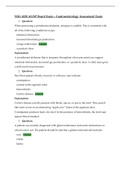
NSG 6320 AGNP Board Exam – Gastroenterology Assessment Exam 1. Question: When percussing a protuberant abdomen, tympany is audible. This is consistent with all of the following conditions except: intestinal obstruction. increased intestinal gas production. a large solid tumor. Correct a paralytic ileus. Explanation: A protuberant abdomen that is tympanic throughout when percussed can suggest intestinal obstruction, increased gas production, or a paralytic ileus. A solid mass gives a dull sound on percussion. 2. Question: Stool that appears bloody, mucoid, or with pus, may indicate: constipation. a lesion in the sigmoid colon. hemorrhoids. Crohn's disease. Correct Explanation: Crohn's disease usually presents with blood, mucus, or pus in the stool. Thin, pencil-like stool occurs in an obstructing “apple-core” lesion of the sigmoid colon. Constipation produces hard, dry stool. In the presence of hemorrhoids, the stool may appear blood streaked. 3. Question: A patient was recently diagnosed with gluten intolerance and needs instructions on what foods to eat. The patient should be told that a gluten restricted diet includes: corn. Correct wheat. barley. rye. Explanation: A gluten-free diet is a diet that excludes the protein gluten. Gluten is found in grains such as wheat, barley, rye and triticale (a cross between wheat and rye). Corn and rice, and soybean products are allowed but processed foods are not. 4. Question: A patient presents with symptoms of bloody stools, new onset constipation, and weight loss. These symptoms could be associated with: hemorrhoids. colon cancer. Correct ischemic colitis. adenomatous polyps. Explanation: Colon cancer can cause bloody stools but usually presents with changes in bowel habits and weight loss. Lower abdominal pain accompanied by fever or shock in older adults could be consistent with ischemic colitis. Generally, the abdomen is soft on palpation. Hemorrhoids typically present with noticeable blood on the tissue paper, surface of stool, or dripping in the toilet. Blood in the stool is usually the only symptom seen with adenomatous polyps. 5. Question: Spider angiomas, palmar erythema, and Terry's nails can be associated with: chronic renal failure. leukemia. liver disease. Correct infective endocarditis. Explanation: Jaundice, spider angiomas and other telangiectasias, palmar erythema, Terry’s nails, pruritus, purpura, and caput medusae are skin conditions associated with liver disease. These skin conditions are not seen in patients who have chronic renal failure, leukemia, or infective carditis. 6. Question: Which is NOT a mode of transmission for hepatitis C? Intravenous (IV) drug use Transfusion of unscreened blood Sexual intercourse Breast milk Correct Explanation: Hepatitis C is not spread through breast milk, food, water or by casual contact such as hugging, kissing and sharing food or drinks with an infected person. Hepatitis C is transmitted by intravenous drug use, sexual intercourse, and transfusion of unscreened contaminated blood. 7. Question: In the abdominal assessment of a 2-year-old, which one of the following would be considered abnormal? A pot belly. Tinkling sounds audible every 10-20 seconds on auscultation. The liver palpable 4 cm below the right costal margin (RCM). Correct A palpable spleen 2 cm below the left costal margin (LCM). Explanation: The normal findings for a 2-year-old are a pot belly, spleen located 2 cm below the LCM, and tinkling sounds heard every 10-30 seconds. The liver should be approximately 1-3 cm palpable below the RCM; 4 cm is considered abnormal. 8. Question: Percussion of the abdomen should be avoided when: trying to determine if the bladder is full. trying to detect the size of an abdominal organ. assessing for feces-filled intestines. an abdominal aneurysm is suspected. Correct Explanation: If an abdominal aneurysm is suspected, percussion of the abdomen could cause the aneurysm to rupture, a catastrophic event. The finding of a pulsatile mass in the center of the abdomen is highly suspicious of an abdominal aneurysm. Listening with a stethoscope may also reveal a bruit produced by turbulent blood flow within the aneurysm. Percussion is not a contraindication for the other choices. 9. Question: Abdominal percussion is performed to assess: local inflammation. generalized tenderness. density of tissues and organs. Correct size and placement of the kidneys. Explanation: Indirect percussion can be performed to evaluate borders and sizes of abdominal organs and masses. Because percussion produces sounds of varying loudness and pitch, these sounds can also assist in identifying density of tissues and organs. Percussion could assess the size but palpation determines the position. 10. Question: When assessing the liver, have the patient inhale while palpating: approximately 3 cm below the right costal region in the midclavicular line. Correct the lower left rib cage and adjacent soft tissue. behind the patient just below and parallel to the twelve rib on the right side. deep in the left upper quadrant. Explanation: If the patient inhales, the liver can be palpated about 3 cm below the right costal margin in the midclavicular line. The liver is not palpated posterior or on the left side of the body.
Información del documento
- Subido en
- 16 de febrero de 2022
- Número de páginas
- 38
- Escrito en
- 2022/2023
- Tipo
- Examen
- Contiene
- Preguntas y respuestas

