
AGNP Board Exam – Endocrinology Assessment Exam
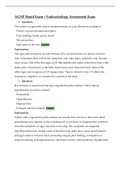
AGNP Board Exam – Endocrinology Assessment Exam 1. Question: The earliest recognizable clinical manifestation(s) of cystic fibrosis in an infant is: History of poor intestinal absorption Foul smelling, frothy, greasy stools Meconium ileus Salty taste on the skin Correct Explanation: The signs and symptoms of cystic fibrosis (CF) vary from person to person and over time. Sometimes there will be few symptoms and other times, symptoms may become more severe. One of the first signs of CF that parents may notice is that their baby's skin tastes salty when kissed, or the baby doesn't pass stool when first born. Most of the other signs and symptoms of CF happen later. They're related to how CF affects the respiratory, digestive, or reproductive systems of the body. 2. Question: If a newborn is suspected of having congenital hypothyroidism, which clinical manifestation would be evident? Prematurity Hyperthermia Hyperactivity Enlarged anterior fontanel Correct Explanation: Infants with congenital hypothyroidism are usually born at term or after term. Most practitioners now depend on the screening test in newborns to diagnose this condition since the symptoms or signs take time to develop. The symptoms of congenital hypothyroidism may include some of the following: puffy face, coarse facial features, enlarged anterior fontanel, thick protruding tongue, poor feeding, constipation or reduced stooling, prolonged jaundice, decreased activity with hypotonia, hypothermia and cool and pale skin, goiter, birth defects (e.g., heart valve abnormality), poor weight gain due to poor appetite, and swollen hands, feet and genitals. 3. Question: The appearance of breast development in girls before the age of 8 years is termed: amenorrhea. gynecomastia. adrenarche. precocious puberty. Correct Explanation: Puberty that begins before age 8 in girls and before age 9 in boys is considered precocious puberty. Amenorrhea is the absence of menstruation. Gynecomastia is swelling of the breast tissue in boys or men. Adrenarche is the early presence of pubic hair in girls aged 5-8 years old. 4. Question: A butterfly-shaped gland located in the middle of the neck below the larynx and above the clavicles is the: parathyroid gland. thyroid gland. Correct hypothalamus gland. thymus gland. Explanation: The thyroid gland is a butterfly-shaped gland located in the middle of the neck below the larynx and above the clavicles. The parathyroid glands are small endocrine glands located in the neck behind the thyroid gland. The thymus gland is rectangular and located in the mediastinum of the thoracic cavity anterior and superior to the heart and posterior to the sternum. The hypothalamus is located in the brain. 5. Question: When auscultating the enlarged thyroid with a stethoscope, a bruit is suggestive of: a carotid aneurysm. a normal finding. hyperthyroidism. Correct a thyroid malignancy. Explanation: A systolic or continuous bruit auscultated with a stethoscope over an enlarged thyroid may be heard in hyperthyroidism. This is not a normal finding. A bruit is not usually associated with a thyroid malignancy. 6. Question: During assessment of the thyroid, a fixed, firm, nontender large mass is noted. These findings describe: a cyst. a nodule. Correct a goiter. hyperplasia. Explanation: A thyroid nodule presents as a fixed, firm, nontender large mass. Thyroid cysts are fluid-filled. A goiter causes visible swelling at the base of the neck. Hyperplasia is an abnormal increase in the volume of a tissue or organ caused by the formation and growth of new normal cells 7. Question: A hormonal disorder in adults resulting from the overproduction of growth hormones is known as: gigantism. prolactinoma. acromegaly. Correct congenital adrenal hyperplasia. Explanation: Gigantism refers to an abnormally high linear growth due to the excessive action of insulin-like growth factor I (IGF-I) while the epiphyseal growth plates are open during childhood. Acromegaly is the same disorder of IGF-I excess but occurs after the growth plate cartilage fuses in adulthood. Excessive growth hormone is almost always caused by a noncancerous (benign) pituitary tumor. A prolactinoma is a benign tumor (adenoma) of the pituitary gland that produces excessive prolactin resulting in decreased levels of some sex hormones. The term congenital adrenal hyperplasia (CAH) encompasses a group of autosomal recessive disorders, each of which involves a deficiency of an enzyme involved in the synthesis of cortisol, aldosterone, or both. 8. Question: Hyperpigmentation of the skin and mucous membranes can be seen in patients who: acquired immunodeficiency syndrome (AIDS). Addison's Disease. Correct Cushing's Disease. diabetes. Explanation: Hyperpigmentation of skin and mucous membranes is usually seen in patients who have Addison's Disease. Hairy leukoplakia can be seen in patients who have AIDS. Cushing's disease can present with any of the following skin lesions: striae, skin atrophy, purpura, ecchymosis, telangiectasias, acne, moon facies, buffalo hump, or hypertrichosis. Diabetes may produce any of these skin conditions: necrobiosis lipoidica diabeticorum, diabetic bullae, diabetic dermopathy, granuloma annulare, acanthosis nigricans, candidiasis, neuropathic ulcers, eruptive xanthomas, and peripheral vascular disease. 9. Question: Women with hyperthyroidism often experience: oligomenorrhea. Correct normal menstruation. amenorrhea. menorrhagia. Explanation: Women diagnosed with hyperthyroidism usually present with oligomenorrhea or infrequent menstrual periods. Menstruation is normal vaginal bleeding. Amenorrhea is an absence of menstruation. Menorrhagia is prolonged or heavy vaginal bleeding. 10. Question: A 20-year-old with acanthosis nigricans should be evaluated for: acute renal failure. diabetes mellitus. Correct alcohol-induced cirrhosis. hypothyroidism. Explanation: Acanthosis nigricans is a skin condition characterized by dark velvety patches in the body folds and creases. It is typically noted in patients who are obese or who have diabetes. 11. Question: Which one of the following groups of symptoms would be more consistent in a child with type 2 diabetes mellitus? Blood glucose levels on two separate occasions between 75 mg/dL and 110 mg/dL, weight loss, and frequent urination Complaints of being hungry all the time, hyperactivity, and frequent urination Blood glucose levels on two separate occasions greater than 126 mg/dl, enuresis, and complaints of being tired Correct Polyphagia, polydipsia, and polyuria Explanation: Classic S/S of type 2 diabetes mellitus include: non-fasting blood glucose levels 200 (especially with other symptoms of diabetes), overweight, fatigue, frequent infections, and enuresis. Polyphagia, polydipsia, and polyuria are classic signs and symptoms of type 1 diabetes mellitus. 12. Question: A 30-year-old woman is taking phenytoin (Dilantin) for seizures. She has recent hair loss and anorexia but is craving salty foods. Her lab results show abnormally high cortisol levels. These symptoms suggest: hyperparathyroidism. Addison's disease. Correct anorexia nervosa celiac disease. Explanation: Addison's disease, also known as primary adrenal insufficiency and hypercortisolism, is a long-term endocrine disorder in which the adrenal glands do not produce adequate steroid hormones. Classic symptoms of Addison's disease include fatigue, anorexia, chronic diarrhea, salt craving, mucosal pigmentation, and hair loss. Lab tests for adrenal function shows a subnormal rise in cortisol levels. 13. Question: Based on the 2-hour glucose tolerance test (GTT), a positive result for gestational diabetes is: 120 mg/dL. 150 mg/dL 180 mg/dL 200 mg/dL Correct Explanation: Gestational diabetes mellitus (GDM) is diagnosed based on a glucose tolerance test
Información del documento
- Subido en
- 16 de febrero de 2022
- Número de páginas
- 21
- Escrito en
- 2022/2023
- Tipo
- Examen
- Contiene
- Preguntas y respuestas

