
CLA1503 Notes
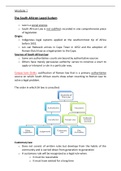
Module 1 The South African Legal System o Law is a social science. o South African Law is not codified: recorded in one comprehensive piece of legislation. Origin: o Indigenous legal systems applied at the southernmost tip of Africa before 1652. o Jan van Riebeeck arrives in Cape Town in 1652 and the adoption of Roman-Dutch law as a legalsystem to the Cape. Sources of South African law o Some are authoritative: courts are bound by authoritative sources o Others have merely persuasive authority: serves to convince a court to apply or interpret a rule in a particular way. Corpus Iuris Civilis: codification of Roman law that is a primary authoritative source on which South African courts draw when reverting to Roman Law to solve a legal problem. The order in which SA law is consulted: Customary law o Does not consist of written rules but develops from the habits of the community and is carried down from generation to generation o A customary rule will be recognized as a legal rule when: o It must be reasonable o It must have existed for a long time o It must be generally recognized and observed by the community o It must be certain and clear The Courts in the Republic SA Courts is devided in: Superior Courts 1. Constitutional Court 2. Supreme Court of Appeal 3. High Court Full Bench - Two Judge Bench - Single Judge Lower Courts - 4. Magistrate Court 5. Small Claims Court The Doctrine of Stare Decisis o The judgments of the superior courts are one of the most important sources of the law. o The function of a judge is to state, interpret and apply the existing law but not to make a new law. o Nevertheless, the effect of a judicial decision which gives new interpretation to a statutory provision or which abstracts, extends or adapts a common law principle, is in many cases to create law. Persuasive Power: High courts in other areas of jurisdiction o - not depart lightly from the decisions of an earlier court, this judge-made law becomes established legal rule. o The court or judge does not purposefully set out to create a law. Application of the Doctrine Stare Decisis: The decision stands. o Obviously, when a court gives a decision, the parties to the dispute will be bound by the decision. o The doctrine of Stare Decisis would mean that a later court would be bound by the earlier decision regardless of whether or not the earlier decision could be regarded as correct. o South African courts follow a middle course. A court is bound by its own decisions unless and until they are overruled by a superior court. The doctrine of stare Decisis and the hierarchy of courts o Every court is bound by the decisions of the superior court within its area of jurisdiction. Thus a High Court regardless of the amount of judges is bound by the decisions of the Supreme Court of Appeal; a bench of 2 judges is bound by a decision of the full bench and a single judge by the decisions either of the two just mentioned. o Every court is bound by the decision of a court of concurrent status within its own area of jurisdiction. Thus the Supreme Court of Appeal is bound by its previous judgments (even a bench of 5 judges by a bench of 3). A full bench of a High Court is similarly bound by an earlier full bench decision, a 2 bench by a 2 bench and a single judge by an earlier decision by a single judge. o One High Court is not bound to follow the decisions of another High Court since they belong to different jurisdictions. The High Court from another jurisdiction will, however, serve as a persuasive authority. o the judgments of the Supreme Court of Appeal and the High Courts. If the judgments of the High Courts are conflicting, a magistrate should follow the decision of the High Court in whose jurisdiction it falls. Ratio Decidendi: The reason for the decision which is binding and which is the subject of the doctrine of stare Decisis.
Información del documento
- Subido en
- 12 de febrero de 2022
- Número de páginas
- 18
- Escrito en
- 2021/2022
- Tipo
- Examen
- Contiene
- Preguntas y respuestas

