
MEDSURG: HESI STUDY GUIDE
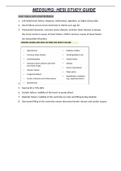
Heart Failure with Atrial Fibrillation:
1. Left sided heart failure; dyspnea, restlessness, agitation, or slight tachycardia.
2. Heart failure occurs most commonly in clients over age 60.
3. Myocardial infraction, coronary artery disease, ischemic heart disease is among
the most common causes of heart failure. MOST common causes of heart failure
are myocardial infraction.
4.
5. Normal EF is 55%-60%
6. Systolic failure; inability of the heart to pump blood.
7. Diastolic failure; inability of the ventricles to relax and filling during diastole.
8. Decreased filling of the ventricles means decreased stroke volume and cardiac output.
, MEDSURG: HESI STUDY GUIDE
9. Right sided heart failure; peripheral edema, abdominal ascites, hepatomegaly, &
jugular venous distention.
10. Acute decompensated heart failure; can manifest as pulmonary edema. The lung
alveoli become filled with serosanguineous fluid.
11. Pulmonary edema most common in left sided heart failure.
12. HF symptoms; think of FACES (Fatigue, limitation of activities, chest congestion/ cough
& shortness of breath.
13.
14. Right sided heart failure; Always think edema, JVD, enlarged liver, abdominal ascites,
& WEIGHT GAIN.
15. Sinus tachycardia; distinguished by heart rate greater than 100 BPM, regular
rhythm present & P waves
16. Atrial fibrillation; inability to see clear P-waves on ECG. Irregular ventricular response.
This appears as IRREGULAR QRS complexes (ventricular response)
17. Asystole; flat line
18. Chest x-ray; good for diagnosis of heart failure
19. Electrocardiograph; MI
20. Echocardiography; cardiac valvular defects, chamber enlargement
, MEDSURG: HESI STUDY GUIDE
21. Pulmonary artery catherization; allows measurements of the pressure within the
right atrium. (Inserted through the femoral vein)
22. ACE Inhibitors; (captopril) works by lowering blood pressure so you want to
always assess patient’s blood pressure,
23. Cardiac problem patient; avoid bearing down (pooping)

