

NR 602 MIDTERM Exam Full STUDY GUIDE
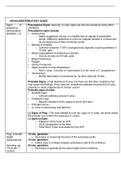
NR 602 MIDTERM Exam Full STUDY GUIDE Signs of pregnancy. (presumptive, probable, (+)) Presumptive Signs: least obj. or subj. signs;can also be caused by many other conditions Presumptive signs include: • Amenorrhea: o Highly suggestive of preg. in a healthy fem w/ regular & predictable period. Difficult to determine in a fem w/ irregular periods or in those who do not keep track of their menstrual cycles • Nausea & vomiting: o Common symptom (~50% of pregnancies) typically occurring between 2- 16 wks. gest • Breast engorgement & darkening of areolas: o Occurs as early as 6-8 wks. gest • Breast tenderness • Fatigue • Urinary Frequency • Slight increase in body temperature: o Rise in temp. coincides w/ luteal phase & is the result of progesterone • “Quickening”: o Mother feels baby’s movements for 1st time; starts @ 16 wks. Probable Signs: a high likelihood of preg. but there are still other conditions that may cause the findings. Preg. tests are considered probable because β-hCG also presents in molar pregnancies & ovarian cancer Probable signs include: • Goodell’s sign: o Cervical softening (around 4 wks.) • Chadwick’s sign: o Blueish coloration of the vagina & cervix (6-8 wks.) • Enlarged uterus • (+) urine or blood preg. test (β-hCG) [+] Signs of Preg.: The most reliable & most obj. signs of (+) preg. are those where the provider can confirm the presence of a fetus (+) signs include: o Palpation of the fetus by HCP o US & visualization of the fetus o Fetal Heart Tones auscultated by the HCP Preg. & fundal height measurement Schuiling, pg. 774 & Wk. 1 Lecture 12 wks. gestation: • the fundus is located @ the level of the symphysis pubis. 16 wks. gestation: • fundus rises to midway between symphysis pubis & the umbilicus 20 wks. gestation: • the fundus is typically @ the same height as the umbilicus 20 wks. gestation: the fundus enlarges approx. 1cm/wk. As the time for birth approaches, the fundal height drops slightly. • This process, which is commonly called lightening, occurs for a woman who is a primigravida around 38 weeks’ gestation but may not occur for the woman who is a multigravida until she goes into labor 25-35 wks. gestation: Measure the distance between the upper edge of pubic symphysis & the top of the uterine fundus w/ a tape measure. Fundal height in centimeters equals the number of gestational weeks (+/- 2cm). For example, a 28- wk. gestation fetus should have a fundal height that measures between 26 & 30cm. Naegele’s rule The due date or expected date of confinement (EDC) can be calculated using Naegele’s Rule • Begin on the 1st day of the last menstrual period (LMP), subtract 3 mos., add 7 days, & then add 1 yr. Example LMP: February 14, 2015 Subtract 3 mos. (Great Scott x 3): November 14, 2014 Add 7 days (N-A-E-G-E-L-E): November 21, 2014 Add 1 bear (year): November 21, 2015 Hematological Nonpregnant Fem., Ages 19–65 changes during preg. Schuiling, pg. 778 TABLE 29-3 Lab Value Changes in Preg. o Hgb: 12–16 g/dL o Hct: 37–47% o RBC: 3.5–5.5/mm3 o WBC: 4.5–11/mm3 1st Trimester o Hgb: 11.6–13.9 g/dL o Hct: 31–41% o RBC: 3.4–5.2/mm3 o WBC: 4–13/mm3 2nd Trimester o Hgb: 9.7–14.8 g/dL o Hct: 30–39% o RBC: 2.8–4.5/mm3 o WBC: 6–14/mm3 3rd Trimester o Hgb: 9.5–15 g/dL o Hct: 28–40% o RBC: 2.7–4.4/mm3 o WBC: 6–17/mm3 Indications & contraindications for prescribing combined estrogen vs. progesterone- only birth control Combined Hormonal Contraceptives (COCs) • Most COCs contain 10-35 mcg of ethinyl estradiol & 1 of several different progestins. • Drospirenone has a mild K+-sparing diuretic effect; K+ levels checked during the 1st cycle in fem. using ACE inhibitors, chronic daily NSAIDs, angiotensin-II receptor antagonists, K+-sparing diuretics, heparin, or aldosterone antagonists. • Fem. w/ conditions that predispose them to hyperkalemia should not use drospirenone. COC Disadvantages: • Increase the risk of VTE. • May BP in some through an in plasma angiotensin. • HTN is a cofactor in the dev of CV disease • development of benign hepatocellular adenomas, this SE is very rare w/ low-dose pills. • a slightly risk of develop breast cancer; in the incidence of cervical cancer • Mood changes, depression, anxiety, irritability • Decreased libido & anorgasmia is unusual, but possible • No protection against STDs or HIV • N/V especially in the first few cycles • Breast tenderness or pain; HA may increase Estrogen Specific SEs include: • nausea • cervical ectopy & leukorrhea • telangiectasis • chloasma (darkening of sun-exposed skin) • growth of breast tissue (ductal tissue or fat deposition) • increased cholesterol content w/in the bile (can lead to gallstones) • benign hepatocellular adenomas/changes in the clotting cascade. Effects specific to the androgenic impact of progestins include • appetite & subsequent weight gain; mood changes & depression • fatigue; complexion changes; changes in carb metabolism • LDL & HDL cholesterol; libido; pruritus. Effects that can be either estrogen or progestin related include • HA; HTN; breast tenderness. COC Benefits • risk of ovarian cancer (by 20% for each 5 yrs. of COC use) • risk of endometrial cancer by approximately 50%. • rates of PID requiring hospitalization, fewer ectopic pregnancies, & incidence of endometriosis. • may Tx or improve anemia; Increased bone mineral density • Decreased pain & frequency of sickle cell disease crises • Reduces risk of ectopic preg. • Effective to treat acne, hirsutism & other androgen excess/sensitivity states • Reduced vasomotor symptoms & effective contraception in perimenopausal fem. • Decreased menstrual cramps & pain w/ more predictable menses • Can be used to manipulate the timing of menses • Effective Tx for mittelschmerz, dysmenorrhea, endometriosis, premenstrual symptoms, Progestin-only contraceptives: include the progestin-only pill (POP), injection/implant/ 3 progestin-IUD • are used continuously; no hormone-free interval • Minimal effects on coagulation factors, BP, or lipid levels & are generally considered safer for fem. w/ contraindications to estrogen, such as CV risk factors, migraine w/ aura, or a hx of VTE • do not provide the same cycle control as methods containing estrogen, & unscheduled bleeding is common w/ all progestin-only methods. • unscheduled bleeding occurs most frequently during the first 6 mos., w/ a substantial number of users becoming amenorrheic by 12 mos. • Overall blood loss decreases over time • protective against iron-deficiency anemia. • All are likely to improve menstrual symptoms, including dysmenorrhea, menorrhagia, premenstrual syndrome, & anemia • The thickening of cervical mucus is protective against PID. Progestin-Only-Pills (POP) • contain 0.35 mg of norethindrone. Each pill contains active ingredients; there is no hormone-free interval • Must be taken @ the same time each day; BC effect ends immediately upon d/c • have the fewest contraindications of all hormonal methods. • combo w/ rifampin or rifabutin effectiveness • POPs are a safe method for many fem. who cannot take estrogen for medical reasons. Similarly, fem. who are sensitive to even low estrogen pills, as manifested by nausea, breast tenderness, or HTN, but who still want an ORAL contraceptive, may do well on POPs. Progestin Injection • DMPA is safer than combo products overall & can be used by fem. who are not candidates for estrogen contraceptives • associated w/ an incidence of wt. change & irregular menstrual bleeding. • risk for osteoporosis r/t low estrogen. • Black-Box Warning for Depo-Provera: caution use 2yrs when other methods available; Bone density loss may extend beyond the duration of Tx. • Delays to return to fertility may also occur w/ IM progestin use. Intrauterine Progestin • Mirena: releases 20 mcg of levonorgestrel daily & can be left in place for 5 yrs. • many fem. experience a notable difference in menstrual flow or amenorrhea that may be more pronounced over time. • Normal endometrial function typically returns w/in 1-3 mos. after d/c Progestin Implants • Implanon provides contraception for up to 3 yrs. Menstrual cycle physiology The highest risk of preg. is in the 48 hrs. immediately preceding ovulation Vaccines during preg. Recommended Each Preg. • Influenza (flu)a o Rationale: Pregnant fem. @ risk for flu-related complications. o Timing: Anytime in preg. when vaccine available • Tetanus, diphtheria, pertussis (Tdap) o Rationale: After maternal vaccination, antibodies cross the placenta & decrease the risk of pertussis infection in the newborn. o Timing: 3rd trimester (ideally 27–36 wks.’ gestation) Advised If @ Risk • Hepatitis B o Rationale: If the woman is @ risk for acquiring HBV, she should be vaccinated. Indications include risk of occupational exposure to blood, Tx for a STI, 1 sex partner in the past 6 mos., recent IV drug use, & HBsAg + sex partner. o Timing: 3 injections beginning @ any point in gestation
Información del documento
- Subido en
- 3 de febrero de 2022
- Número de páginas
- 44
- Escrito en
- 2022/2023
- Tipo
- Examen
- Contiene
- Preguntas y respuestas

