
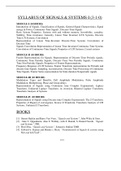
SYLLABUS OF SIGNALS & SYSTEMS-I (3-1-0)
MODULE-I (10 HOURS)
Introduction of Signals, Classification of Signals, General Signal Characteristics, Signal
energy & Power, Continuous-Time Signals , Discrete-Time Signals
Basic System Properties, Systems with and without memory, Invertibility, casuality,
Stability, Time invariance, Linearity, Linear Time Invariant (LTI) Systems, Discrete
Time LTI Systems, Convolution
Representation of Linear Time-Invariant Discrete-Time Systems Convolution of
Discrete-Time
Signals Convolution Representation of Linear Time-Invariant Continuous-Time Systems
Convolution of Continuous-Time Signals, Properties of LTI Systems, Casual systems
MODULE-II (10 HOURS)
Fourier Representations for Signals: Representation of Discrete Time Periodic signals,
Continuous Time Periodic Signals, Discrete Time Non Periodic Signals, Continuous
Time Non-Periodic Signals, Properties of Fourier Representations,
Frequency Response of LTI Systems, Fourier Transform representation for Periodic and
discrete time Signals, Sampling, reconstruction, Discrete Time Processing of Continuous
Time Signals, Fourier Series representation for finite duration Nonperiodic signals.
MODULE-III (10 HOURS)
Modulation Types and Benefits, Full Amplitude Modulation, Pulse Amplitude
Modulation, Multiplexing, Phase and Group delays
Representation of Signals using Continuous time Complex Exponentials: Laplace
Transform, Unilateral Laplace Transform, its inversion, Bilateral Laplace Transform,
Transform Analysis of Systems
MODULE-IV (10 HOURS)
Representation of Signals using Discrete time Complex Exponentials: The Z-Transform,
Properties of Region of convergence, Inverse Z-Transform, Transform Analysis of LTI
Systems, Unilateral Z Transform.
BOOKS
[1] Simon Haykin and Barry Van Veen, “Signals and Systems”, John Wiley & Sons.
[2] Alan V. Oppenheim, Alan S. Willsky, with S. Hamid, S. Hamid Nawab, “Signals
and Systems”, PHI.
[3] Hwei Hsu, “Signals and Systems”, Schaum's Outline TMH
[4] Edward w. Kamen and Bonnie s. Heck, “Fundamentals of Signals & systems using
Web and MATLAB”,
***
, Disclaimer
This document does not claim any originality and cannot be used as a
substitute for prescribed textbooks. The information presented here is
merely a collection by the committee members for their respective teaching
assignments. Various sources as mentioned at the end of the document as
well as freely available material from internet were consulted for
preparing this document. The ownership of the information lies with the
respective authors or institutions. Further, this document is not intended to
be used for commercial purpose and the committee members are not
accountable for any issues, legal, or otherwise, arising out of this
document. The committee members make no representations or warranties
with respect to the accuracy or completeness of the contents of this
document and specially disclaim any implied warranties of
merchantability or fitness for a particular purpose. The committee
members shall not be liable for any loss or profit or any other commercial
damages, including but not limited to special, incidental, consequential, or
other damages.
, Contents
Lecture 1- Introduction of Signals and system
Lecture 2- Classification of Signals
Lecture 3- Classification of Signals (continued)
Lecture 4- General Signal Characteristics
Lecture 5- Operation on signals
Lecture 6- Fundamentals of Systems
Lecture 7- System properties
Lecture 8- System properties (continued)
Lecture 9- Linear Time Invariant System
Lecture 10- Convolution of Linear Time-Invariant Discrete-Time Signals
Lecture 11- Convolution Representation of Linear Time-Invariant Continuous-Time
Systems
Lecture 12- Properties of LTI Systems, Casual systems
Lecture 13- Fourier Representations for Signals:
Lecture 14- Fourier Representations of Continuous Time Periodic Signals
Lecture 15- Fourier Representations of Discrete Time Periodic signals
Lecture 16- Fourier Representations of Continuous Time Non Periodic Signals
Lecture 17- Fourier Representations of Discrete Time Non Periodic Signals
Lecture 18- Properties of Fourier Representations
Lecture 19- Properties of Fourier Representations (continued)
Lecture 20- Frequency Response of LTI Systems
Lecture 21- Fourier Transform representation for Periodic and discrete time Signals
Lecture 22- Sampling
Lecture 23- Reconstruction
Lecture 24- Discrete Time Processing of Continuous Time Signals
Lecture 25- Fourier Series representation for finite duration Nonperiodic signals.
, Lecture 26- Modulation Types and Benefits
Lecture 27- Full Amplitude Modulation
Lecture 28- Pulse Amplitude Modulation
Lecture 29- Multiplexing
Lecture 30- Phase and Group delays
Lecture 31- Representation of Signals using Continuous time Complex Exponentials:
Laplace Transform
Lecture 32- Unilateral Laplace Transform, its inversion
Lecture 33- Laplace Transform Properties
Lecture 34- Representation of Signals using Discrete time Complex Exponentials:
The Z-Transform
Lecture 35- Properties of Region of convergence
Lecture 36- Inverse Z-Transform
Lecture 37- Inverse Z-Transform (continued)
Lecture 38- Z-Transform Properties
Lecture 39- Z-Transform Properties (continued)
Lecture 40- Transform Analysis of LTI Systems

