
Introduction to Toxicology TOX01
Paracelsus (1493-1541): “everything is toxic, depending on the dose”.
Subdisciplines of toxicology: there are different categories in toxicology. We can distinguish
them in many categories, like food, occupational, developmental and environmental.
The phases in toxic response:
1. exposure: external (air), the dose (ug/kg bodyweight) and internal (ug/kg fat)
2. toxicokinetic: what does the body do with the compound. Can be 4 things:
absorption and distribution (AD) and metabolism and elimination (EM)
3. toxicodynamic: what does the compound do to the body? like irritation,
inflammation. There are different kinds of compounds (metals, PCBs)
There are a few exposure routes to these compounds: oral (via food), dermal (through skin),
respiratory (lungs) or special routes (injection).
Classification of toxic response, depending on:
Rate: can be acute effect (inhibition) of chronic (carcinogenesis)
Possibility for repair: Reversible (DNA damage) or irreversible (tumor progression)
Site of action: local effect at side of contact (skin) or systemic effect (targeting organs
or unborn embryo)
An example of systemic toxicity in developmental is the thalidomide case. Mothers took the
drug for better sleeping, and the baby’s got absence of limps by reduction of long bones.
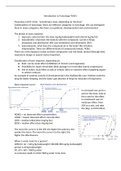
Dose response curve:
In a forward use: go to x-
axis for the dose, look at
the y-axis for the effect
In a backward use: for
minimum effect, from
50% to x-axis, and take
the (log), so LD50 effect.
NOAEL = no observed effect concentration
LOAEL = lowest observed effect concentration
LD50 = median lethal dose (mg/kg bw)
ED50 = median effect dose (mg/kg bw)
The more the curve is to the left, the higher the potency, the
quicker the harm. The more the curve is to the right, the
higher the effectiveness
When is water toxic for a person?
LD50 for rat = 160 g/kg bodyweight (160.000.000 ug/kg bodyweight)
person is 60 kg bodyweight
SO, 60 x 160 = 9600 g water
so someone needs to drink 9600 g water to be toxic.
, Absorption and distribution TOX02
Compounds can pass the cell membrane via an active and passive transport:
Active transport: requires energy. Can be direct (process itself cost ATP) or indirect (recovery
process costs ATP)
Passive energy: simple diffusion (without the help of membrane proteins) or facilitated
diffusion (with the help of membrane proteins).
Active bulk transport of macromolecules via endocytosis (can be non-specific and specific via
receptor mediated) and exocytosis.
Intake vs uptake:
Intake is not uptake. Only the part of the intake that is ultimately absorbed is the uptake.
Can be via oral intake or via inhalation. The absorption = f x intake (f = absorption efficiency)
Absorption after oral intake: Enterohepatic circulation = repeated absorption via small
intestine > lever > gal > small intestine. Presystemic elimination = via small intestine, gal,
liver, large intestine. So not whole body. Portal vein = takes up nutrients that are brought to
the liver.
Absorption after intake inhalation via gasses: via lungs > bronchia > absorbed. Some
compounds can be absorbed very quickly, that depends on the Henry coefficient. This all
goes via diffusion and can go quick because there is all the time clean blood.
Absorption after intake inhalation via particles: depends on the size where the particles are
taken up. The smaller the lower. Big particles are swallowed out after inhalation.
Distribution volume: math example:
Distribution volume body water: concentration = dose / volume
blood plasma 3,5 liter someone gets 1 mg/kg injection
extracellular water 16,1 liter of compound called X
intracellular water 24,5 liter that person is 70 kg
total body water 39,0 liter what is the distribution?
blood plasma: C = D/V = (70*1)/3,5 = 20 mg/L
extracellular water: C = D/V = (70*1)/16,1 = 4,3 mg/L
total body water: : C = D/V = (70*1)/39 = 1,8 mg/L
BUT! the measures concentration is lower, how? accumulation!!
Lipophilic compounds:
Some compounds are not distributed homogenic in the body but are lipophilic (fat loving).
They accumulate in fat tissue. Excretion of these compounds via blood > urine = slow.
Quickly is via breastmilk. Can be measured via Kow = Coct / Cw
Barriers in distribution:
Blood-brain-barrier: via tight junction not all chemicals can go in the brain via the blood. But
there are exceptions: the methylmercury MeHg problem: mercury added to cysteine (amino
acid), looks a lot like methionine, and was therefore able to pass the blood-brain-barrier.
Placenta: not a true barrier, bc many lipophilic compounds can diffuse through the placenta.
It is a defense by: active transport and has the capacity of metabolism (biotransformation).

