NR 509 Final Exam Study Guide.
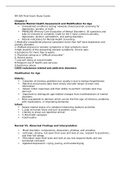
NR 509 Final Exam Study Guide. Chapter 5 Behavior/Mental Health Assessment and Modification for Age Unexplained conditions lasting 6weeks should prompt screening for depression, anxiety, or both PRIME-MD (Primary Care Evaluation of Mental Disorders). 26 questions and take 10 minutes to complete. Used for the 5 most common=anxiety, depression, alcohol, somatoform, and eating disorders. Patient indications for Mental Health Screening: 1.Medically unexplained physical symptoms-more than half have depression and anxiety disorders 2. Multiple physical or somatic symptoms or high symptom count 3.High severity of the presenting somatic symptoms, chronic pain 4.Symptoms for more than 6 weeks 5. Physician rating as a “difficult encounter” 6. Recent stress 7.Low-self rating of overall health 8.Frequent use of health care services 9.Substance abuse. CAGE=substance-related and addictive disorders Modification for Age Elderly: -Complain of memory problems but usually is due to benign forgetfulness -Retrieve and process data more slowly and take longer to learn new information -Slower motor responses and their ability to perform complex task may diminish -Important to distinguish age-related changes from manifestations of mental disorders More susceptible to delirium which can be the first sign of infection, problems with medications, or impending dementia Infant: Assess mental status of a newborn=observing newborn activities 1.Look at human faces and turn to parents voice 2.Ability to shout out repetitive stimuli 3. Bond with caregiver 4.Self-soothe Normal VS. Abnormal Findings and Interpretation Mood disorders: compulsions, obsessions, phobias, and anxieties -Lethargic: drowsy, but open their eyes and look at you, respond to questions, and then fall asleep. -Obtunded: open their eyes and look at you but respond slowly and are somewhat confused. -Agitated depression: crying, pacing, and handwringing -Depression: the hopeless slumped posture and slowed movements. -Grooming and personal hygiene may deteriorate: Depression, schizophrenia, and dementia -Manic Episode: the agitated and expansive movement of a manic episode -Obsessive-Compulsive Disorder: Excessive fastidiousness -Lesion parietal cortex: one side neglect in the opposite parietal cortex, usually in the nondominant side -Parkinsonism: facial immobility -Paranoia: anger, hostility, suspiciousness, or evasiveness -Mania: Elation and euphoria Schizophrenia: flat affect and remoteness Apathy (dull affect with detachment and indifference): dementia, anxiety, and depression Hallucination: schizophrenia, alcohol withdrawal, and systemic toxicity Amnestic Disorders: impaired memory or new learning ability and reduce social or occupational functioning but lack the global features of delirium and or dementia. Anxiety and depression, and intellectual disability may also cause recent memory impairment. Calculating ability: poor performance = dementia or aphasia Variations and abnormalities in thought processes: 1.Circumstantiality: The mildest thought disorder, consisting of speech with unnecessary detail, indirections, and delay in reaching the point. Some topics may have a meaningful connection Occurs in people with obsessions 2. Derailment: Tangential, speech with shifting from topics that are loosely connected or unrelated. The patient is unaware of the lack of association. Schizophrenia, manic episodes, and other psychotic disorders 3.Flight of ideas: an almost continuous flow of accelerated speech with abrupt changes from one topic to the next. Changes are based on understandable associations, play on words, or distracting stimuli, but ideas are not well connected. Manic episodes 4.Neologisms: invented or distorted words, or words with new and highly idiosyncratic meanings -Schizophrenia: psychotic disorders, and aphasia 5.Incoherence: Speech that is incomprehensible and illogical, with lack of meaningful connections, abrupt changes in topic, or disordered grammar or word use. Flight of ideas, when severe, may produce incoherence -Schizophrenia 6.Blocking: Sudden interruption of speech in mid-sentence or before the idea is completed “losing the thought” -Schizophrenia 7.Confabulation: Fabrication of facts or events, to fill in the gaps from impaired memory -Korsakoff syndrome from alcoholism 8.Perseveration: persistent repetition of words or ideas -Schizophrenia or other psychotic disorders 9. Echolalia: Repetition of the words and phrases of others -Manic episodes or Schizo 10.Clanging: Speech with choice of words based on sound, rather than meaning, as in rhyming and punning. Example: “look at my eyes and nose, wise eyes and rosy nose. To to one, the ayes have it!” -Schizo and manic episodes Abnormalities of Perception 1. Illusions: misinterpretations of real external stimuli, such as mistaking rustling leaves for the sounds of voices -Grief, delirium, PTSD, Schizo 2.Hallucinations: Perception-like experiences that seem real but, unlike illusions, lack actual external stimulation. The person may or may not recognize the experiences as false. May be auditory, visual, olfactory, gustatory, tactile, or somatic. -PTSD, Schizo, delirium, dementia, alcoholism Abnormalities of Thought Content 1.Compulsions -repetitive behaviors feel driven to perform in response to an obsession (anxiety disorders) 2.Obessions -Recurrent persistent thoughts, images, or urges 3.Phobias -Persistent irrational thoughts, compelling desire to avoid provoking stimulus 4. Anxieties 5. Feelings of unreality 6.Feelings of Depersonalization 7.Delusions Erotomanic: the belief that another person is in love with the individual Somatic: involves body functions Unspecified: includes delusions of reference without a prominent persecutory or grandiose component Speech Patterns -Slow speech: depression -Accelerated speech: mania -Articulation: are the words clear and distinct: does the speech have a nasal quality -Dysarthria: defective articulation “slurred speech” -Dysphonia: results from impaired volume, quality, or pitch of voice. Difficulty speaking due to a physical disorder of the mouth, tongue, throat, or vocal cords. -Aphasia: the loss of ability to understand (receptive/Wernicke) or express speech (expressive/Broco aphasia) -Brocas aphasia: patients articulate very slowly and with a great deal of effort. Nouns, verbs, important adjectives are usually present and only small grammatical words are dropped from speech "Well…..cat and…..up……..um, well, um…forget it" -Wernicke's aphasia the patient can speak effortlessly and fluently, but his words often make no sense “the coffee cat looks crazy still” -Cerebrovascular infarction -Fluency: fluency reflects the rate, flow, and melody of speech and the content and use of words. Abnormalities -Hesitancies and gaps in the flow and rhythm of words -Disturbed inflections, such as monotone -Circumlocutions: phrases or sentences are substituted for a word the person cannot think of. Example “what you write with for “pen” -Paraphasia: malformed, wrong, or invented Testing for Aphasia -Word comprehension: ask the patient to follow one-stage commands such as “Point to your nose” -Repetition -Naming -Reading comprehension -Writing Mental Status Examinatio
Información del documento
- Subido en
- 15 de diciembre de 2021
- Número de páginas
- 52
- Escrito en
- 2021/2022
- Tipo
- Examen
- Contiene
- Preguntas y respuestas