Name: Date:
Student Exploration: Half-life
Vocabulary: daughter atom, decay, Geiger counter, half-life, isotope, neutron,
radiation, radioactive, radiometric dating
Prior Knowledge Questions (Do these BEFORE using the Gizmo.)
1. Have you ever made microwave popcorn? If so, what do you hear while the
popcorn is in the microwave?
it starts to pop
2. If you turn the microwave on for two minutes, is the rate of popping always
the same, or does it change? Explain.
It is always the same
Gizmo Warm-up
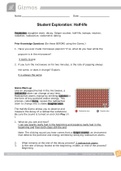
Like an unpopped kernel in the microwave, a
radioactive atom can change at any time.
Radioactive atoms change by emitting radiation in
the form of tiny particles and/or energy. This
process, called decay, causes the radioactive
atom to change into a stable daughter atom.
The Half-life Gizmo allows you to observe and
measure the decay of a radioactive substance.
Be sure the sound is turned on and click Play (
).
1. What do you see and hear?
I can see sparks really fast in the beginning and popping really fast in the
beginning and then both stops still the end
Note: The clicking sound you hear comes from a Geiger counter, an instrument
that detects the particles and energy emitted by decaying radioactive atoms.
2. What remains at the end of the decay process? 2 radioactive atoms
3. Is the rate of decay fastest at the beginning, middle, or end of the process?
Beginning
, Get the Gizmo ready:
Activity A: • Click Reset ( ). Be sure that User chooses
half-life and Random decay are
Decay curves selected.
• Check that the Half-life is 20 seconds and the
Number of atoms is 128.
Question: How do we measure the rate of radioactive decay?
1. Observe: Select the BAR CHART on the right side of the Gizmo and click Play.
A. What happens to the numbers of radioactive and daughter atoms as the
simulation proceeds? Radioactive decay goes down and the daughter atom
goes up
B. Do the numbers of radioactive and daughter atoms change at the same
rate throughout the simulation? Explain. Yes as the radioactive goes
down daughter
goes up
2. Experiment: Click Reset, and select the GRAPH tab. Run a simulation with the
Half-life set to 5 seconds and another simulation with the Half-life set to 35
seconds. Sketch each resulting decay curve graph in the spaces below.
Half-life = 5 seconds Half-life = 35 seconds
3. Interpret: How does the Half-life setting affect how quickly the simulated substance
decays?
The lower the half-life setting the faster it stops
(Activity A continued on next page)