Summary book ‘psychology and behavior’
Chapter 2: structure and functions of cells of the nervous system
Activity of cells of the nervous system perceive, think, learn, remember and act
Neurons
Central nervous system = brain and spinal cord
Peripheral nervous system = nerves
Sensory neurons
Interneurons
- local = nearby neurons and analyze small pieces of info
- relay = connect circuits of local interneurons
Motor neurons
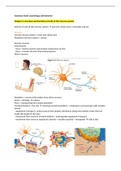
Dendrites = receive information from other neurons
Soma = cell body nucleus
Axon = transporting info (action potential)
Terminal buttons = the end chemical neurotransmitters = releasing to communicate with another
neural
- axoplasmic transport = active process that propels substances along microtubule tracks that run
inside the length of the axon
- movement from soma to terminal buttons = anterograde axoplasmic transport
- movement from soma to axoplasmic (dynein = another protein) = retrograde half as fast
,Cell structures
- membrane = boundary of neuron = double layer of lipid (fat) molecule
- cytoskeleton = matrix of protein microtubules
- cytoplasm = fills the space, semiliquid substance
- nucleus = in the soma, production of ribosomes (protein synthesis)
chromosomes consist of DNA, active: production of mRNA = receives a copy of the info
Proteins produced through a 2-step process:
- transcription = info from DNA is transcribed into a portable (draagbare) form = mRNA
- translation = the ribosomes use the info from mRNA and create proteins
Proteins serve as enzymes = controlling chemical reactions (break apart) , catalyst
Cell endomembrane system:
- endoplasmic reticulum = ribosomes
- Golgi exocytosis, lysosomes (enzymes that break)
- Mitochondria energy: ATP
Supporting cells
Glia = surround neurons to:
- hold them in place
- controlling nutrients and massages
- insulate neurons from one another so that neural messages do not get scrambled
- destroy and remove carcasses of neurons that are killed
1. Astrocytes = star cell physical support and clean up + chemicals, phagocytosis = astrocytes
contact a piece of debris from a dead neuron, they push themselves against it finally engulfing it
2. oligodendrocytes support to axons to produce myelin
3. Microglia smallest, protecting the brain from invading microorganism
Blood-Brain barrier
- Some substances can cross and some not = selectively permeable
- prevents the brain from chemicals
Communication within a neuron
Role of inhibition by reflex interneuron release inhibitory NT, which decreases the activity of the
motor neuron
,Membrane potential
- diffusion if there is no barrier = high concentration to low concentration
- Electrostatic ions: cations = positive, anions = negative: - - and + + repels, + - attract = moving
ions to place to place
- sodium-potassium pump = natrium-kalium pomp: that is the reason that na+ can remain the
greatest concentration in the extracellular fluid = continuedly pomp Na+ outside the cell, intra = low
Na +
- membrane is not very permeable to Na+
Action potential all or none
- membrane potential must reach threshold
- sodium channels open Na+ goes in cell by forces of diffusion and electrostatic pressure =
depolarization
- sodium channels only open by changes in membrane potential = voltage-dependent ion channels
- membrane of axons also contains voltage-dependent also open
- sodium channels blocked = refractory, cannot open until once more reaches the resting potential
no more na+ goes to cell
- potassium (k+) channels are open outflow of k+ by diffusion and electric (because inside is + and a
lot of +)
, Saltatory conduction = hopping from node to node (myelin)
- economic, less energy
- speed
Communication between neurons
= synaptic transmission
- Neurotransmitters then produce postsynaptic potentials that increase or decrease the rate of firing
of the axon of the postsynaptic neuron binding on receptor = binding site
- A chemical that attaches to a binding site is called a ligand.
- synaptic cleft, a gap that varies in size from synapse to synapse but is usually around 20 nm wide.
The synaptic cleft contains extracellular fluid, through which the neurotransmitter diffuses.
Transport proteins fill vesicles with the neurotransmitter, and trafficking proteins are involved in the
release of neurotransmitters and recycling of the vesicles.
Release of neurotransmitters
When action potentials terminal buttons: Several small synaptic vesicles located just inside the
presynaptic membrane fuse with the membrane and then break open, spilling their contents into the
synaptic cleft. synaptic vesicles become “docked” against the presynaptic membrane, ready to
release their neurotransmitter into the synaptic cleft.
When the membrane of the terminal button is depolarized by an arriving action potential, the
calcium channels open flows in the cell. Calcium ions can bind with various types of proteins