
NURS 8022 Patho - Exam #5 Study Guide.
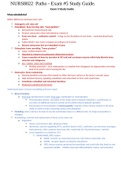
Musculoskeletal Define differences between bone cells Osteogenic cell: stem cell Osteoblasts: bone forming cells, “bone-builders” o Derived from mesenchymal cells o Produce osteocalcin when stimulated by vitamin D o Form new bone – synthesize osteoid – brings on the formation of new bone – nonmineralized bone matrix o Follow Wolfe’s law: bone is shaped according to its function o Become osteocytes that are imbedded in bone Osteoclasts: bone resorbing, “bone-crushers” o Large, multinucleated cells o Attached to integrins by podosomes (helps bind to bone) o Cause resorption of bone by secretion of HCl acid and a protease enzyme which help dissolve bone minerals and collagenase o Are “resting” when not resorbing Resting osteoclast = once reabsorption is complete then disappears by degeneration reverting back to its parent cell or leaving the site Osteocytes: bone maintaining o Develop dendritic processes that extend to either the bone surface or the bone’s vascular space o Help maintain bone by signaling osteoblasts and osteoclasts to form and resorb bone o Coordinate osteoblast and osteoclast functions o Respond to parathyroid hormone Understand basics of bone remodeling and bone repair Bone formation: o First step: develop bone matrix; Final step: calcification or mineralization Mineralization phases: formation of the initial mineral deposit (initiation) - proliferation of accretion of additional mineral crystals on the initial mineral deposits (growth) End-product of mineralization is hydroxyapatite: majority of the mineral content in the body made of small crystals containing calcium and phosphate Modeling: when a bone is formed at one site and broken down in a different site, its shape and position is changed Remodeling: removal and replacement of bone at the same site o Regulation Genes, environment, diet, physical activity Hormones: calcium regulating (PTH, calcitriol [active vit.D], calcitonin); sex hormones (estrogen, testosterone); other systemic hormones (GH, insulin-like GF, thyroid hormone, cortisol) Local regulation via cytokines, GF’s RANK/RANKL/OPG system o RANK: receptor on osteoclast precursor and mature osteoclast cells o RANKL: receptor ligand; secreted by osteoblasts o OPG: decoy receptor produced by osteoblasts and stroll cells that binds to and sequesters RANKL – inhibits osteoclast differentiation, fusion, and activation NURS8022 Patho - Exam #5 Study Guide. o Bone-remodeling units o Repair of microscopic injuries and maintenance of bone integrity o Phases: Activation of the remodeling cycle Resorption Formation of new bone (secondary bone) Takes 3-4 months Repair: bone heals itself o Hematoma formation – clot forms o Procallus formation – produces granulation tissue o Callus formation – forms membranous or woven bone o Callus replacement – replaces the callus with lamellar bone or trabecular bone o Remodeling – periosteal and endosteal surfaces are remodeled to the size and shape of the bone before the injury Understand difference between compact and spongy bone Bone matrix: 35% organic; 65% inorganic; 5-8% water o Organic: collagen fibers, proteoglycans, glycoproteins, osteocalcin, osteonectin, osteopontin, cytokine, growth factors; inorganic: calcium and phosphate minerals Collagen: essential for strength, form fibrils that twist, synthesized by osteoblasts Proteoglycans: strengthen bone by forming compression-resistant networks between collagen, help calcium deposit in bone - act as a pump – permit fluid to be pressed out to ensure that fluid film is always present on the surface of cartilage even after hours of weight bearing Glycoproteins: carb-protein complexes of bone, play a role in calcification Osteocalcin: most abundant non-collagenous protein, produced by osteoblasts, promotes mineralization and formation of bone, attracts osteoclasts, signals vitamin D, inhibited by PTH; marker of bone turnover, can be measured in urine or serum Osteonectin: secreted by platelets & osteoblasts, role in regulating calcium, organizing matrix Osteopontin: cell binding protein Cytokine and growth factors: aid in bone cell differentiation, activation, growth, and turnover Compact bone: cortical bone – outer bone, rigid o 85% of skeleton o Solid and extremely strong o Haversian system: basic structural unit in compact bone Spongy bone: cancellous bone – inner bone, porous o 15% of skeleton o Filled with red bone marrow o Trabeculae: plates or bars instead of Haversian system Periosteum: double-layered connective tissue that covers all bones o Outer layer: contains blood vessels and nerves, some of which penetrate to inner bone structures through channels called Volkmann canals o Inner layer: anchored to the bone by collagenous fibers (Sharpey fibers) that penetrate the bone and help hold or attach tendons and ligaments to the periosteum of bones Characteristics of bone Long bones Diaphysis: medullary cavity contains fat = yellow marrow Metaphysis: broad neck Epiphysis: epiphyseal plate – epiphysis is separated from metaphysis by cartilaginous growth plate; after puberty, epiphyseal plate calcifies and the epiphysis and metaphysis merge o Medullary cavity helps with blood formation = red marrow Endosteum: lines medullary cavities o Flat bones Two plates of compact bone, parallel to each other – spongy bone is between the compact bone o Short bones (cuboidal bones) Consist of spongy bone covered by a thin layer of compact bone o Irregular bones Thin part: two plates of compact bone with spongy bone between the plates Thick part: consists of spongy bone surrounded by a layer of compact bone Describe different joint classifications Joints: the sites where two or more bones meet o Promote stability and mobility of the skeleton – help move bones and muscles o Classifications: based on movement Synarthrosis: immovable Amphiarthrosis: slightly movable Diarthrosis: freely movable o Classifications: based on structure Fibrous: directly united to bone by dense fibrous connective tissue Usually are synarthroses (immovable) but most allow some movement o Degree of movement depends on distance between the bones and the flexibility of the fibrous connective tissue o Ex: sutures Cartilaginous: connected by fibrocartilage or hyaline cartilage Symphysis: bones are united by a pad or disk of fibrocartilage o Ex: symphysis pubis and intervertebral disks Synchondrosis: bones are united by hyaline cartilage (costal cartilage) o Ex: joints between ribs and the sternum Synovial: most movable, most complex, diarthrosis Fibrous joint capsule: articular capsule Synovial membrane: lines the inner surface of the joint capsule Joint cavity (synovial cavity): space is formed by the capsule Synovial fluid: fills the joint cavity and lubricates the joint surface Articular cartilage: hyaline cartilage - covers and pads the articulating bony surfaces o Reduces friction in the joint and distributes forces of weight bearing o Composed of chondrocytes (cartilage cells) and an intercellular matrix (collagen, polysaccharides and mostly water)
Información del documento
- Subido en
- 7 de diciembre de 2021
- Número de páginas
- 52
- Escrito en
- 2021/2022
- Tipo
- Examen
- Contiene
- Preguntas y respuestas

