NRNP 6566 WEEK 8 KNOWLEDGE CHECK WITH ANSWERS (Graded A+) LATEST UPDATE
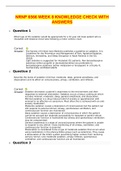
NRNP 6566 WEEK 8 KNOWLEDGE CHECK WITH ANSWERS • Question 1 What type of ICU sedation would be appropriate for a 32 year old male patient who is intubated with bilateral chest tube following a motor vehicle crash. Correct Answer: The Society of Critical Care Medicine publishes a guideline on sedation. It is: Guidelines for the Prevention and Management of Pain, Agitation/Sedation, Delirium, Immobility, and Sleep Disruption in Adult Patients in the ICU (2018). Light sedation is suggested for intubated ICU patients. Non-benzodiazepine sedatives (either propofol or dexmedetomidine) are preferable to benzodiazepine sedatives (either midazolam or lorazepam) in critically ill, mechanically ventilated adults. • Question 2 Describe the levels of sedation (minimal, moderate, deep, general anesthesia, and dissociation) and its affect on consciousness, airway, ventilation, and reflexes. Correct Answer: Sedation decreases a patient’s awareness to the environment and their responses to external stimulation. Sedation occurs a long a continuum which includes minimal, moderate, deep, general anesthesia, and dissociation. Minimal sedation is a drug induced relief of anxiety or apprehension with minimal to no affection on sensorium. Most often this is achieved with an anti-anxiety medication. Moderate sedation causes a depression of consciousness but the patient can still respond to external stimuli. Airway, spontaneous ventilation, and cardiovascular function are maintained. Deep sedation causes a depression of consciousness in which the patient cannot be aroused but responds purposefully to repeated or painful stimuli. Cardiovascular function is maintained but airway and spontaneous ventilation may be compromised. General anesthesia is a state of unconsciousness where the patient is unable to respond to any stimuli. Close monitoring of all airway, ventilation, and cardiovascular function is essential. Dissociation is considered to be a type of moderate sedation that occurs when using medications in the phencyclidine group (such as ketamine). They cause a dissociation of the limbic system preventing higher centers from receiving sensory stimuli. Like moderate sedation, airway reflexes, spontaneous ventilation, and cardiovascular function are all maintained. • Question 3 The APRN has determined that a 21 year old motor vehicle crash victim needs a rapid sequence intubation. The patient weighs 77 kg. What medications are indicated to successfully achieve the rapid sequence intubation? Correct Answer: Rapid sequence intubation requires the use of induction agent to cause unresponsiveness and a neuromuscular blocking agent to cause muscular relaxation. It is the fast and most effective means of controlling the emergency airway. There are no contraindications to using Etomidate and Succinylcholine Etomidate 23 mg IV and Succinylcholine 115 mg IV Here are details about the different medications and their uses. INDUCTION AGENTS Etomidate • 0.3mg/kg IV • onset: 10-15 seconds • Use: good option for most situations including hemodynamically unstable patient. Avoid in sepsis or seizures • Can cause adrenal suppression, myoclonus, pain on injection Ketamine • Dose: 1.5 mg/kg IV (4mg/kg IM) • Onset: 60-90 sec • Duration: 10-20 min • Use: good option for any RSI,especially if hemodynamically unstable. May be used in TBI (no increase in ICP) and reactive airway disease (causes bronchodilation) • Can cause an increase in secretions, caution in hypertension and tachycardia, may cause laryngospasm and increased intra-ocular pressure. Thiopentone • Dose: 3-5 mg/kg IV TBW • Onset: 30-45 sec • Duration: 5-10 min • Use: good option in hemodynamically stable patients, also for status epilepticus • Causes histamine release, myocardial depression, vasodilation, hypotension Propofol • Propofol 1.5-2.5 mg/kg x TBW as the general guide • Onset: 15-45 seconds • Duration: 5 – 10 minutes • Use: should be used in hemodynamically stable patients, appropriate for patients with reactive airways disease or status epilepticus • Can cause hypotension, myocardial depression, reduced cerebral perfusion • muscular rigidity in high induction doses, bradycardia, tissue saturation at high doses PARALYTIC AGENTS Suxamethonium (aka succinylcholine) • Dose: 1.5 mg/kg IV (2 mg/kg IV if myasthenia gravis) and 4 mg/kg IM (in extremities) • Onset: 45-60 seconds • Duration: 6-10 minutes • Use: widely used unless contra-indicated; ideal if need to extubate rapidly following an elective procedure or to assess neurology in an intubated patient • Drawbacks: numerous contra-indications (hyperkalemia, malignant hyperthermia, >5d after burns/ crush injury/ neuromuscular disorder), bradycardia (esp after repeat doses), hyperkalemia, fasciculations, elevated intra-ocular pressure, will not wear off fast enough to prevent harm in CICV situations Rocuronium • Dose: 1.2 mg/kg IV IBW • Onset: 60 seconds • Use: can be used for any RSI unless contra-indication or require rapid recovery for extubation after elective procedure or neurological assessment; ensures persistent ideal conditions in CICV situation (i.e. immobile patient for cricothyroidotomy) – can be reversed by sugammadex • Drawbacks: allergy (Rare)
Escuela, estudio y materia
- Institución
- Walden University
- Grado
- NRNP 6566 WEEK 8 KNOWLEDGE CHECK WITH ANSWERS
Información del documento
- Subido en
- 30 de noviembre de 2021
- Número de páginas
- 5
- Escrito en
- 2021/2022
- Tipo
- Examen
- Contiene
- Preguntas y respuestas
Temas
-
nrnp 6566 week 8 knowledge check with answers • question 1 what type of icu sedation would be appropriate for a 32 year old male patient who is intubated with bilateral chest tube following a mot

Documento también disponible en un lote