
Mnp2601 - Notes
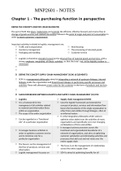
Chapter 1 – The purchasing function in perspective DEFINE THE CONCEPT LOGISTICS (MAIN ELEMENTS) The part of SCM that plans, implements and controls the efficient, effective forward and reverse flow in storage of goods services and related information between the point of origin and point of consumption in order to meet customers’ requirements. Important activities included in logistics management are: Traffic and transportation Inventory management Packaging and handling Warehousing The processing of returned goods. Customer service Logistics is therefore strongly focused on the physical flow of material goods and services, with a strong emphasis integrating all these activities so that the total cost in the logistics system is minimized. DEFINE THE CONCEPT SUPPLY CHAIN MANAGEMENT (SCM) (6 ELEMENTS) SCM is a management philosophy aimed at integrating a network of upstream linkages, internal linkages inside the organization and downstream linkages in performing specific processes and activities.These will ultimately create value for the customer in the form of products and services. MAIN DIFFERENCES BETWEEN LOGISTICS AND SUPPLY CHAIN MANAGEMENT (10) P20 Logistics Supply chain management (SCM) It is a framework for the managment of all activities related to material and information flows within an organisation. The scope is the entire organisation Uses the logistic framework and extends the concept of product, services and information flow beyon the boundaries of the single orgnaisation to other firms and entities through linkages, often of an informal nature Can be regarded as a “functional silo” of a particular organisation It si the integration philosophy which seeks to optimise value added over the activities of many organisations and specifically over ever-changing combinations of firms and entities It manages business activiteis in order to optimise customer service and to minimise cost for a particular organisation It manages business processes across the functional and organisational boundaries of a network of organisations, and aims at optimising customer satisfaction and eliminating activities and processes that add cost and not value over the entire supply chain The focus is on the management of the flow of products, services and information The focus is on the management of relationships across the entire supply chain Logistic management focusses on SCM is aimed at optimising benefits for all 1 MNP2601 - NOTES optimising wealth for a single firm participants in the entire supply chain Chapter 2 – The task of purchasing and supply management ADVANTAGES AND DISADVANTAGES OF CENTRALISED AND DECENTRALISED ORGANISATIONAL STRUCTURES FOR PURCHASING AND SUPPLY MANAGEMENT Type of struct ure Advantages Disadvantages Centr alise d 1. Materials and products are standardised 2. Negotiating power is increased and volume discounts are made possible 3. Staff are afforded the opportunity of becoming experts 4. Control is improved 5. Administrative costs are reduced 6. Supplier relations are enhanced 7. Information systems integration is facilitated 8. Duplication of effort is eliminated 1. There is a slow response time to regional plants 2. There is resentment from geographically dispersed business unit management 3. There is a tendency to bypass the central buying office 4. There is less integration with user departments 5. Staff structure is top heavy 6. There is lack of insight into the requirements of dispersed plant units Dece ntrali sed 1. There are better relations between decentralised purchasing and other functions 2. There is good service delivery to regional plants 3. There is faster reaction time to user departments in emergencies 4. Support of local suppliers generates goodwill 5. There is greater autonomy for profit centres 6. Interdivisional competition can improve purchasing performance
Información del documento
- Subido en
- 30 de noviembre de 2021
- Número de páginas
- 24
- Escrito en
- 2021/2022
- Tipo
- Examen
- Contiene
- Preguntas y respuestas

