
CrumpleZonesSE.pdf
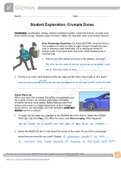
Introduction: Modern vehicles contain features designed to keep passengers safe in a crash. The crumple zone in the front of the car slows the car gradually and increases stopping time. The safety cell is a rigid cage that prevents passengers from being crushed. Inside, seat belts and airbags prevent the driver from hitting the windshield, steering wheel, or dashboard. Question: How does a crumple zone help protect a passenger? 1. Make a hypothesis: On the DESIGN tab, look at the parameters you can control. What settings do you think will make the safest car? Set up the Gizmo, and then fill in below. Crumple zone length: Crumple zone rigidity: Safety cell rigidity: Seat belt present? If present, seat belt stiffness: Air bag present? If present, air bag rigidity: 2. Test: On the CRASH TEST tab, check that the Car 1 speed is 16 m/s, or about 35 miles per hour (mph). Click Play. After the crash, select the RESULTS tab. A. By what percentage did the crumple zone deform? Safety cell? B. Did the dummy hit the steering wheel? C. What was the maximum force on the dummy? D. How likely was the dummy to survive? In this simulation, forces are measured in kilonewtons (kN). One kilonewton is equal to 1000 newtons, or the force of a 225-pound (102 kg) person standing on your chest. While many factors affect survival, only the maximum force and safety cell collapse are considered here.
Información del documento
- Año escolar
- 4
- Subido en
- 28 de noviembre de 2021
- Número de páginas
- 9
- Escrito en
- 2021/2022
- Tipo
- Examen
- Contiene
- Preguntas y respuestas

