
IOP 3703 Study Pack.
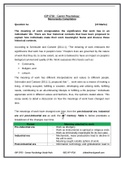
IOP 3703 – Career Psychology Memoranda Compilation Question 1a (15 Marks) The meaning of work encapsulates the significance that work has in an individuals’ life. There are four historical contexts that have been proposed to explain how individuals make their work meaningful. Name and discuss these historical contexts. According to Schreuder and Coetzee (2011:1), “The meaning of work embraces the significance that work has in people’s lives.” People’s lives are governed by the nature of work that they do, to some extent, as work is believed to have an impact on people’s biological survival and quality of life. Work surpasses life’s facets such as: Community, Religion, and Leisure. The meaning of work has different interpretations and values to different people. Schreuder and Coetzee (2011:1), propound that “… work seen as a means of making a living, of being occupied, fulfilling a vocation, developing and utilizing skills, fulfilling needs, contributing to an all-embracing lifestyle or fulfilling a life purpose.” Individuals appreciate work in different values and fashions, thus, the opinions stated above. This essay seeks to detail a discussion on how the meanings of work have changed over time. The meanings of work have changed over time, from the pre-industrial era, industrial era and post-industrial era as well, the 21st Century. Table 1, below postulates a breakdown of the changes over time. Period Meaning attached to work Pre-industrial era - Work as drudgery - Work as instrumental to spiritual or religious ends - Work as intrinsically meaningful for its own sake Industrial era - Mechanistic, mass productions lead to decline in the will to work. - Meaning sought outside sphere of work. Post-industrial era - Information technology and globalization lead to IOP 3703 – Career Psychology Study Pack P a ge2 multicultural viewpoints about the meaning of work. 21st Century - Boundary-less, service driven, technologyintensive work environments. - Work meaning is a socially constructed product, that is, dynamic and fluid and that expresses itself through the lenses of job meaning, role meaning and self-meaning in a particular sociocultural context. Table 1: The evolution of meanings associated with work. (Schreuder and Coetzee (2011) a) Pre-industrial era Schreuder and Coetzee (2011:2) notes that “The Greeks and Romans of antiquity viewed work as a burden that contaminates the mind.” Their belief was that work was meaningless and just a burden for the people. On the same view, the Hebrews saw work as drudgery but equally as instrumental to spiritual or religious ends such as regaining spiritual dignity. However, the Protestant, in the 16th century, viewed work as a duty, hence as intrinsically meaningful for its own sake. Some Protestants advocated the acquisition of wealth through morality. b) Industrial era According Schreuder and Coetzee (2011:3) probe that “With industrialization the meaning of work became a problem area, in that meaning was not self-evident.” In essence, this era has a basis on the mass production of objects in factories. There was the introduction of the division of labor on an extensive footing. This resulted in work tasks being broken down into smaller manageable units. c) Post-industrial era The gist of this era was on information rather than on industry. Production was associated with producing ideas in offices in addition to manufacturing objects in factories. The development of new technologies in areas such as computerization and communications, and interaction of different cultures involved heterogeneity in beliefs and tasks in society. IOP 3703 – Career Psychology Study Pack P a ge3 Hamilton-Attwell, (1998:80), assert that post-industrialization regards employees as being more enlightened with five characteristics: 1) Self-Actualisation: -behaving in accordance with one’s values, focusing on personal intellectual and emotional development and growth. 2) Hedonism: -the right to enjoy life and the benefits of one’s work: the job is just a means to an end. 3) Entitlementalism: -Being entitled to certain things such as having the right to choose to a dress code, to see sensitive organizational information and participate in strategic decisions. 4) Antiproductivism: Increasingly questioning the cost of economic growth versus the depletion of natural resources, pollution and the negative impact of the rising expectations of consumers on one’s quality of life. 5) Anti-authoritarianism: Having the right to question anybody who gives commands, even legitimate power and complying with a measure of reserve and suspicion. d) 21st Century The meaning of work and its characteristics changed to a shift from national markets to global markets, from technological to information, service-based to economies signaled some quick changes which eventually reflected the performance of work. According to Chen (2001), cited in Schreuder and Coetzee (2011:4), “People engage in continuous
Información del documento
- Subido en
- 16 de noviembre de 2021
- Número de páginas
- 51
- Escrito en
- 2021/2022
- Tipo
- Examen
- Contiene
- Preguntas y respuestas

