Eng2601 Exam Pack
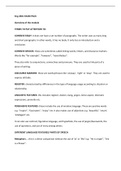
ENG260Eng 2601 EXAM PACK Overview of the module TERMS TO PAY ATTENTION TO: COHESIVE ESSAY: it does not have a set number of paragraphs. The writer uses as many long and short paragraphs. In other words, it has no body. It only has an introduction and a conclusion. COHESIVE DEVICES: these are sometimes called linking words, linkers, and discourse markers. Words like “for example”, “however”, “nevertheless”. They also refer to conjunctions, connectives and pronouns. They are used to link parts of a piece of writing. DISCOURSE MARKERS: these are words/phrases like ‘anyway’, ‘right’ or ‘okay’. They are used to express attitude. REGISTER: characterized by differences in the type of language usage according to situation or relationship. LINGUISTIC FEATURES: this includes register, dialect, slang, jargon, tense aspect, idiomatic expressions, proverbs etc. PERSUASIVE FEATURES: these include the use of emotive language. These are positive words e.g. “inspire”, “fascinates”, “enjoy” etc. It also makes use of adjectives e.g. ‘beautiful’, ‘smart’, ‘intelligent’ etc. It can also use contrast, figurative language, and hyperbole, the use of jargon/buzzwords, the use of questions, and use of irony among others. DIFFERENT LANGUAGE FEATURES/ PARTS OF SPEECH Metaphors…..this is a direct comparison without the use of ‘as’ or ‘like’ e.g. “He is a tiger”, “she is a flower”. Similes….this is also comparison but it uses words such as ‘like’ or ‘as’ e.g. “She is like a flower”, “he is like a baboon”. Conjunctions: these are words that are used to join sentences and phrases together. E.g. and, but, because, hence, since, also, therefore etc. Verbs…these are words of action or in basic terms, a verb is a doing word e.g. ‘walk’, ‘run’, ‘ ‘dance’ etc. Adverbs: these are words that tell us more about a verb, e.g. she ate HUNGRILY, He wept BITTERLY. Nouns: these are names of anything. We have 4 types of nouns which are, proper nouns, collective nouns, abstract nouns and common nouns Common nouns: refer to general things or objects, e.g. table, chair, car, house, donkey etc. Proper nouns: they refer to names of people and places Abstract nouns: they refer to people’s emotions e.g. anger, jealous, pride etc. They are things that we cannot see or touch but we just experience or feel them. Collective nouns: refers to a collection of1 EXAM PACK
Información del documento
- Subido en
- 15 de noviembre de 2021
- Número de páginas
- 16
- Escrito en
- 2021/2022
- Tipo
- Examen
- Contiene
- Preguntas y respuestas