
mng2601_exam_notes-summary.
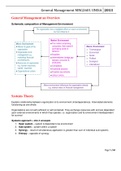
General Management an Overview Schematic composition of Management Environment Systems Theory Explains relationship between organization & its environment (interdependence). Interrelated elements functioning as one whole. Organisations are not self-sufficient or self contained. They exchange resources with and are dependent upon external environments in which they operate. i.e. organization and its environment interdependent for survival Systems approach ÷ into 4 concepts 1. Open system – system is dependant one environment 2. Sub-system – system within a system 3. Synergy – result of simultaneous application is greater than sum of individual sub-systems 4. Entropy – opposite of synergy Micro- Environment Mission & goals of the organization Organisation & its management e.g. marketing/ financial/ purchasing etc. Resources of organization e.g. human resources, capital , expertise Organisational culture Market- Environment The market comprising: consumers, their needs & purchasing power & behavior. Suppliers Intermediaries (bridge gap between consumer & producers) Competitors Substitute products Possible new entrants Labour unions. Macro- Environment o Technological o Economical o Social o Political o Ecological o international The organization has a negligible effect on macro environment, but can influence it. Macro-environment influences the organization directly e.g. interest rates on financial management General Management MNG2601 UNISA 2013 Page 2 of 64 Systems Approach: Management Process/ Function: Management Skills Technical Skills Necessary to accomplish specific task/ train & support subordinates Interpersonal Skills Ability to communicate/ understand/ motivate individuals/ teams Conceptual Skills Ability to see & understand business as a whole entity/ think strategically & see big picture Diagnostic Skills Ability to diagnose symptoms & develop solution Communication Skills Convey and receive ideas from and to others Decision Making Skills Ability to recognize problems/ opportunities and formulate alternative solution Time Management Skills Ability to prioritize work, effectively / efficiently & delegate tasks 4.PLANNING What? Vision, Mission and goals & strategy to achieve them 1.ORGANISING How? Group activities together, establish authority, allocate resources and delegate 2.LEADING When? Direct & motivate employees to achieve the mission & goals 3.CONTROLLING Whether? Monitor progress and take corrective steps to reach mission & goals FEEDBACK INPUTS (resources) Human (labour) Financial (capital) Physical (raw) Information (knowledge) Entrepreneurship TRANSFORMATION Physical Transformation Process Technology, expertise, information Management Process Planning, organizing, leading, controlling OUTPUTS (output environment = market place) Achievements of goals Products Services Productivity Job creation profit General Management MNG2601 UNISA 2013 Page 3 of 64 Chapter 1 Introduction to Management Def: Process of planning, organizing, leading, and controlling the resources of organization to predetermined stated organizational goals as productively as possible. Managers bring the resources together – decide which resources in what quantities are necessary to achieve organization goals. Plan & execute what must be done to attain those goals. Are responsible for success & sustainability of their organizations and level of need satisfaction in society. Good managers improve global competitiveness of organizations and improves standard of living of RSA. Management: Managers combine, allocate, coordinate and deploy resources (inputs) in such a way that organisation‟s goals are achieved as productively as possible by using management functions “process” Planning Organizing Leading Controlling Management Process: General Management MNG2601 UNISA 2013 Page 4 of 64 MANAGEMENT FUNCTIONS: Function PLANNING ORGANISING LEADING CONTROL Description Determine mission & goals of business & how to reach them in long term, resources required & the guidelines/ plans to get there Human/financial & physical resources must be allocated to relevant management departments. Duties must be defined, procedures fixed to enable its people to work effectively to reach its mission & goals Directing & motivating human resources. Collaborate with superiors, equals and subordinates to reach goals of business Ability to influence workforce to attaining organisation goals. NB influence, share purpose & organisational change Determine if business is still on track – activities and performances in line with reaching company goals. If deviations detected to correct them or reconsider its goals/plans a) Coordinating mechanism that links planning & control process in an organisation b) Ensures business’s resources deployed in such a way to attain its objectives c) Results in better quality & enable management to cope with environmental chance & uncertainty d) Control measures reduce costs & boost outputs e) Facilitates delegation & teamwork Principles Provides direction & forward thinking Participation within work environment Reduces impact of change & overlapping of activities Sets standards for control Unity of command/ direction Chain of command & span of control Standardisation/ Co-ordination Identification of activities Classification of grouping of activities Assignment of duties Delegation of authority Coordinating authority and responsibility relationships Supervision Act of watching & directing work & workers Motivation Inspiring, stimulating or encouraging sub-ordinates with zeal to work (incentives may be used) i. Content theories of motivation Maslow Needs Hierarchy Herzberg Two-factor motivation McCleland Achievement Motivation ii. Process Theory Expectancy theory Equity Theory Reinforcement Theory Leadership Process whereby manager guides & influences the work of subordinates in desired direction Communication Passing info, experience, opinion = bridge of understanding i. Intra-personal ii. Interpersonal iii. organisationa
Información del documento
- Subido en
- 14 de noviembre de 2021
- Número de páginas
- 64
- Escrito en
- 2021/2022
- Tipo
- Resumen

