
Physics Waves
Wave properties
- Transfer energy
- Reflect
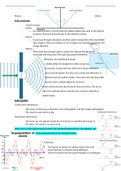
o For a plane surface (a mirror) then the angle is always the same as the angle of
incidence. Normal is perpendicular to the reflective surface
- Refract
o If waves go through a boundary and their speed changes then their wavelength
also changes. If they are incident at a no 0 angle to the boundary then they will
change direction.
- Diffract
o Waves that pass through a gap or around an obstacle will spread out.
Small gaps and long waves will cause the greatest diffraction.
Diffraction and satellite dish design
- satellite dishes are designed to reflect waves to a
focal point. A larger dish can collect more waves and hence
more powerful signals. The extra size creates less diffraction so
that the focal area will be smaller. This means that the larger dish
must be more carefully aligned to its source.
Waves refract towards the normal as they slow down. This occurs
with more optically dense materials such as dense materials or
shallow water.
Super Position
Constructive interference:
- The waves are lined up so that their crests add together, and the troughs add together.
The result is waves twice as big.
Destructive interference:
- The waves are mis aligned so that the crest of one is cancelling the trough of
the other. The result is no waves at all.
When two or more waves meet at a point, the resultant displacement is the algebraic sum
of the displacements of the individual waves.
………………………………………………………………………………………….
Coherence
Two sources of waves are coherent when they emit
waves that have a constant phase difference
only if the waves have the same frequency or wavelength.
Wave properties
- Transfer energy
- Reflect
o For a plane surface (a mirror) then the angle is always the same as the angle of
incidence. Normal is perpendicular to the reflective surface
- Refract
o If waves go through a boundary and their speed changes then their wavelength
also changes. If they are incident at a no 0 angle to the boundary then they will
change direction.
- Diffract
o Waves that pass through a gap or around an obstacle will spread out.
Small gaps and long waves will cause the greatest diffraction.
Diffraction and satellite dish design
- satellite dishes are designed to reflect waves to a
focal point. A larger dish can collect more waves and hence
more powerful signals. The extra size creates less diffraction so
that the focal area will be smaller. This means that the larger dish
must be more carefully aligned to its source.
Waves refract towards the normal as they slow down. This occurs
with more optically dense materials such as dense materials or
shallow water.
Super Position
Constructive interference:
- The waves are lined up so that their crests add together, and the troughs add together.
The result is waves twice as big.
Destructive interference:
- The waves are mis aligned so that the crest of one is cancelling the trough of
the other. The result is no waves at all.
When two or more waves meet at a point, the resultant displacement is the algebraic sum
of the displacements of the individual waves.
………………………………………………………………………………………….
Coherence
Two sources of waves are coherent when they emit
waves that have a constant phase difference
only if the waves have the same frequency or wavelength.

