
Emma Haye
EXCRETION
- metabolic processes in the human body produce waste products
- these waste products must not be allowed to accumulate in the tissue fluid
- in order to maintain homeostasis these wastes must constantly be removed
- excretory organs remove waste products from blood
EXCRETION: The elimination of metabolic waste products (eg. urea, water)
SECRETION: The production of useful substances by the body to perform useful
functions (eg. wax, enzymes)
EGESTION/DEFAECATION: Elimination of indigestible waste products
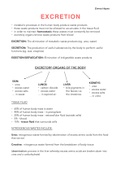
EXCRETORY ORGANS OF THE BODY
SKIN:
KIDNEYS:
- urea LUNGS: LIVER:
- urea
- excess water - carbon dioxide - bile pigments in
- excess water
- excess salts - excess water the faeces via
- excess salts
… in sweat … in expired air the intestines
… in urine
TISSUE FLUID
- 60% of human body mass is water
- 40% of human body mass - in protoplasm
- 20% of human body mass - extracellular fluid (outside cells)
- 5% - blood
- 15% - tissue fluid that surrounds cells
NITROGENOUS WASTES INCLUDE:
Urea: nitrogenous waste formed by deamination of excess amino acids from the food
that we eat
Creatine: nitrogenous waste formed from the breakdown of body tissue
(deamination: process in the liver whereby excess amino acids are broken down into
urea and a carbohydrate)
s
, Emma Haye
Deamination in the liver:
1. Excess amino acids reach liver
2.amino group (-NH2) is removed
3. this amino group forms ammonia NH3
4. ammonia rapidly converted into a less toxic form - urea
5. urea removed fro the blood by kidneys
6. remaining organic acid is converted into glucose - used for
respiration
Also in the liver:
- red blood cells are broke down after their lifespan of 120 days
- products of this breakdown include bile salts, bile pigments and bilirubin
- the bile pigments and bilirubin give faeces the characteristic brown colour and give
urine its yellow colour
FUNCTION OF THE KIDNEY:
1) Excrete excess water and soluble metabolic waste (uric acid, urea, creatine, excess
acid/alkali)
2) Maintain concentration of soluble constituents of body fluids e.g. water
(osmoregulation), inorganic mineral ions.
3) Regulating chemical composition of body fluids ( osmoregulation, pH)
Result = produce urine
s

