
EDSP 300 Study Guide
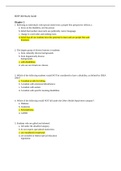
Referring to individuals with special needs from a people-first perspective reflects a: a. focus on the disability, not the person. b. belief that teachers must only use politically correct language. c. change in word order and nothing more. d. belief that all our students have the potential to learn and are people first and foremost. 2. The largest group of diverse learners is students: a. from culturally diverse backgrounds. b. from linguistically diverse backgrounds. c. with disabilities. d. who are not American citizens. 3. Which of the following students would NOT be considered to have a disability, as defined by IDEA 2004? a. A student at-risk for failing b. A student with emotional disturbances c. A student with autism d. A student with specific learning disabilities 4. Which of the following would NOT fall under the Other Health Impairment category? a. Diabetes b. Leukemia c. Schizophrenia d. ADHD 5. Students who are gifted and talented: a. fall under the disabled category. b. do not require specialized instruction. c. are considered exceptional. d. are included in federal special education legislation. 6. Any child who is exposed to experiences such as domestic violence, substance abuse, child abuse, poverty, and/or homelessness: a. will become an at-risk student in time. b. is an at-risk student. c. has an increased likelihood of becoming an at-risk student. d. has the same chance of becoming an at-risk student as a child who was not exposed to such experiences. 7. A continuum or cascade of service delivery: a. is a new concept introduced by IDEA in 1990. b. is based on the concept that the effective delivery of special education services requires a variety of settings to meet the unique needs of each learner at a given point in time. c. is based on the concept that all special education services, regardless of the level of intensity, should be provided in the general education classroom. d. is based on the concept that the resource room is the best setting for students with special needs. 8. Universal Design for Learning (UDL): a. was originally developed as a scientific concept to describe the universality of chemical reactions. b. is synonymous with the universal inclusion of students with disabilities, both social and academic, with non-disabled peers. ??? c. is seen as a vehicle for ensuring that teachers are able to meet the needs of students who exhibit widely varying learning requirements in inclusive settings. d. implies one optimal solution for everyone.
Información del documento
- Subido en
- 24 de octubre de 2021
- Número de páginas
- 63
- Escrito en
- 2020/2021
- Tipo
- Examen
- Contiene
- Preguntas y respuestas

