
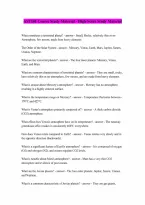
AST101 Course Study Material - High-Score Study Material
AST101 Course Study Material - High-Score Study Material What constitutes a terrestrial planet? - answer - Small, Rocky, relatively thin or no Atmosphere, few moons, made from heavy elements The Order of the Solar System - answer - Mercury, Venus, Earth, Mars, Jupiter, Saturn, Uranus, Neptune What are the terrestrial planets? - answer - The four inner planets: Mercury, Venus, Earth, and Mars. What are common characteristics of terrestrial planets? - answer - They are small, rocky, have relatively thin or no atmosphere, few moons, and are made from heavy elements. What is unique about Mercury's atmosphere? - answer - Mercury has no atmosphere, resulting in a highly cratered surface. What is the temperature range on Mercury? - answer - Temperature fluctuates between -170°C and 425°C. What is Venus's atmosphere primarily composed of? - answer - A thick carbon dioxide (CO2) atmosphere. What effect does Venus's atmosphere have on its temperature? - answer - The runaway greenhouse effect makes it consistently 460°C everywhere. How does Venus rotate compared to Earth? - answer - Venus rotates very slowly and in the opposite direction (backwards). What is a significant feature of Earth's atmosphere? - answer - It is composed of oxygen (O2) and nitrogen (N2), and oceans regulate CO2 levels. What is notable about Mars's atmosphere? - answer - Mars has a very thin CO2 atmosphere and evidence of past oceans. What are the Jovian planets? - answer - The four outer planets: Jupiter, Saturn, Uranus, and Neptune. What is a common characteristic of Jovian planets? - answer - They are gas giants, significantly larger than terrestrial planets. What is the largest planet in the solar system? - answer - Jupiter What type of atmosphere surrounds Jupiter? - answer - Thick gaseous atmosphere surrounding a giant ball of liquid hydrogen How many moons does Jupiter have? - answer - More than 60 known moons What is Saturn known for? - answer - Its rings and being the second-largest planet in the solar system What is unique about Uranus's rotation? - answer - Its rotation axis is tilted 98 degrees What is Neptune's notable atmospheric feature? - answer - It has the strongest winds in the solar system, reaching up to 2,100 km/h What are the Galilean Moons? - answer - The four largest moons of Jupiter, which include Io, Europa, Ganymede, and Callisto What is the Asteroid Belt? - answer - A region between the orbits of Mars and Jupiter containing around a million asteroids larger than 1 km in diameter What is the Kuiper Belt? - answer - A vast collection of small icy bodies just beyond the orbit of Neptune What are comets known for? - answer - Their highly elliptical orbits and the tails they emit when close to the sun What was the purpose of the Voyager Probes? - answer - To visit all four Jovian planets using gravitational slingshots What defines a constellation? - answer - One of the 88 sectors into which the sky is divided What is the North Circumpolar Zone? - answer - A region where stars appear to rotate around one of the celestial poles without rising or setting What is the Celestial Sphere? - answer - A conceptual sphere of infinite radius centered on Earth with celestial objects projected onto its inner surface What is the Celestial Equator? - answer - The projection of Earth's equator onto the celestial sphere What is the Zodiac? - answer - An 18-degree-wide belt centered on the ecliptic where planets, the Sun, and the Moon are found What is the Ecliptic? - answer - The great circle of the Sun's path around the celestial sphere each year How does the Sun's position change daily? - answer - It rises about 4 minutes later each day with respect to the stars What is the angle of the Earth's axis of rotation? - answer - 23 degrees between the North and South Pole. How does the angle of sunlight affect temperature on Earth? - answer - Less heat reaches the ground due to the shallower angle of sunlight. What happens to the
Información del documento
- Subido en
- 10 de noviembre de 2026
- Número de páginas
- 12
- Escrito en
- 2026/2027
- Tipo
- Examen
- Contiene
- Preguntas y respuestas

