

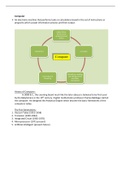
Computer
An electronic machine that performs tasks or calculations based in the set of instructions or
programs which accept information process and then output.
makes three-
dimensional
animations and
videos
calculations runs apps
Computer
formatting, creating,
searching and and editing articles
browsing and other
homeworks
History of Computer:
In 3000 B.C., the counting board much like the later abacus is believed to be first used
by the Babylonians in the 19th century. English mathematics professor Charles Babbage started
the computer. He designed the Analytical Engine which become the basic frameworks of the
computers today.
The Five Generations:
1. Vaccum Tubes (1951-1958)
2. Transistor (1959-1964)
3. Integrated Circuit (1965-1970)
4. Microprocessor (1971-present)
5. Artificial Intelligent (present-future)
, Computer Evolution:
Abacus
Pascaline by Blaise Pascal
Developed Pascaline by Gottfried Wilhelm Lebniz
Silk Loom by Joseph Marie Jacquard
Analytical Engine by Charles Babbage “Father of Modern Computer”
Created Set of Instructions for Analytical Engine Augusta Ada Byron “First Computer
Programmer”
Developed Tabulating Machine by Herman Hollerith
General Purpose Computer by Konrad Zuse
Atanasoff-Berry Computer by John Atanasoff and Clifford E. Berry
Developed Mark 1 by Howard Aiken
Electronic Numerical Integrator And Computer (ENIAC) by John Mauchly and John Presper
Eckert
Electronic Discrete Variable Automatic Computer (EDVAC) by John Von Neumann
Universal Automatic Computer (UnivAC) by John Mandy and john Eckert Jr.
First Transistor Computer by Bell Laboratories
Altair 8800, 1st modern personal computer
Apple 1 by Stephen Wozniak and Steve Jobs
Operating System by Paul Allen and Bill Gates
Osborne 1 by Adam Osborne
Xerox, Star Computer
Lisa by Macintosh and Steve Jobs
Newton 1st Personal Digital Assistant by Apple
Deep Blue, defeated Garry Kasparov in a chess match
Quantum Computers, the robotics ----future
An electronic machine that performs tasks or calculations based in the set of instructions or
programs which accept information process and then output.
makes three-
dimensional
animations and
videos
calculations runs apps
Computer
formatting, creating,
searching and and editing articles
browsing and other
homeworks
History of Computer:
In 3000 B.C., the counting board much like the later abacus is believed to be first used
by the Babylonians in the 19th century. English mathematics professor Charles Babbage started
the computer. He designed the Analytical Engine which become the basic frameworks of the
computers today.
The Five Generations:
1. Vaccum Tubes (1951-1958)
2. Transistor (1959-1964)
3. Integrated Circuit (1965-1970)
4. Microprocessor (1971-present)
5. Artificial Intelligent (present-future)
, Computer Evolution:
Abacus
Pascaline by Blaise Pascal
Developed Pascaline by Gottfried Wilhelm Lebniz
Silk Loom by Joseph Marie Jacquard
Analytical Engine by Charles Babbage “Father of Modern Computer”
Created Set of Instructions for Analytical Engine Augusta Ada Byron “First Computer
Programmer”
Developed Tabulating Machine by Herman Hollerith
General Purpose Computer by Konrad Zuse
Atanasoff-Berry Computer by John Atanasoff and Clifford E. Berry
Developed Mark 1 by Howard Aiken
Electronic Numerical Integrator And Computer (ENIAC) by John Mauchly and John Presper
Eckert
Electronic Discrete Variable Automatic Computer (EDVAC) by John Von Neumann
Universal Automatic Computer (UnivAC) by John Mandy and john Eckert Jr.
First Transistor Computer by Bell Laboratories
Altair 8800, 1st modern personal computer
Apple 1 by Stephen Wozniak and Steve Jobs
Operating System by Paul Allen and Bill Gates
Osborne 1 by Adam Osborne
Xerox, Star Computer
Lisa by Macintosh and Steve Jobs
Newton 1st Personal Digital Assistant by Apple
Deep Blue, defeated Garry Kasparov in a chess match
Quantum Computers, the robotics ----future

