
Nurse Aide Certification: Key Concepts and Procedures
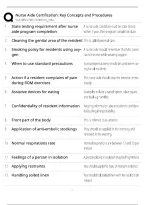
The Nurse Aide Certification Exam (typically the NNAAP or state-specific equivalent) consists of two parts: a written (or oral) examination and a clinical skills evaluation. The written exam is generally 70 multiple-choice questions covering Activities of Daily Living (22%), Basic Nursing Skills (35%), Psychosocial Care Skills (10%), and the Role of the Nurse Aide (26%), with passing thresholds typically around 70%–75% depending on the state . The clinical skills evaluation requires candidates to demonstrate a set of randomly selected procedures on a simulated client, with hand hygiene always included as a mandatory skill and at least one measurement skill (blood pressure, pulse, respirations, weight, or urinary output) . Critical safety steps—such as locking bed wheels before transfers, verifying water temperature, maintaining a clean-to-dirty sequence during perineal care, and ensuring the call signal is within reach—are scored as "critical elements" that must be performed correctly to pass . Core procedures include hand hygiene, perineal care, bed-to-wheelchair transfers with a gait belt, applying elastic stockings, mouth/denture care, measuring vital signs, and assisting with ambulation .
Información del documento
- Subido en
- 1 de noviembre de 2026
- Número de páginas
- 3
- Escrito en
- 2026/2027
- Tipo
- Examen
- Contiene
- Preguntas y respuestas

