

Year 11 Geography Study Notes: Global Interactions:
Section 1: Biophysical interactions:
Chapter 1: Biophysical interactions an introduction:
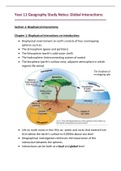
• Biophysical environment on earth consists of four overlapping
spheres such as:
• The atmosphere (gases and particles)
• The lithosphere (earth’s solid outer shell)
• The hydrosphere (interconnecting system of water)
• The biosphere (earth’s surface zone, adjacent atmosphere in which
organic life exists)
• Life on earth exists in thin film air, water and rocks that extend from
61m below the earth’s surface to 61000m above sea level
• Geographical investigation reinforces the importance of the
interaction between the spheres
• Interactions can be both at a local and global level
, • Geographers are keen observers when confronted with problems
concerning the planet
• Loss of flora and fauna due to human impacts including increasing
proportion to technological development and population size
• Land degradation arises due to humans believing that resources of
the biophysical environment can be readily exploited
• The water we drink, the air we breathe and the food we eat are all
modified and impacted by human activity
• Humans have the capacity to better manage environments and
protect the global ecosystem
• Sustainable development is achieved by enabling people’s
economic and social wellbeing while also maintaining and
protecting the quality of the biophysical environment
• Principles that guide sustainable development:
• Improvements in healthcare, education and social wellbeing
(reduce birth rates in developing countries and stabilize world
population)
• Earth’s renewable resources should only be used in a way that does
not reduce their usefulness for future generations
• Decisions made today should not affect future biophysical
environments
• People should be involved in decisions that affect their lives
• Priority should be given to new technologies that help the
environment not damage them
• Steps should be taken to prevent further degradation of land and
biophysical resources
• Benefits of economic growth should be more evenly distributed
• Sustainable development and good environmental management go
hand in hand
2
,Chapter 2: The atmosphere:
Unit 2.1: Composition and structure of the atmosphere:
Composition of the atmosphere:
• Massive volcanic eruptions released gases
• As gases cooled the atmosphere developed
• Oxygen & nitrogen make up 90% of the atmospheric volume
Structure of the atmosphere:
The Earth’s atmosphere has a layered structure:
1. Troposphere – contains all the weather systems that produce
precipitation, surface winds and the other climatic variables that
impact on living things. From ground level to 10kms
2. Stratosphere – temperatures increase with altitude – 10 -50kms
above the earth’s surface
3. Mesosphere - 80kms above earth’s surface. Temp fall rapidly with
elevation because there is no water vapour, cloud or dust to absorb
incoming radiation
4. Thermosphere – the air becomes thinner with elevation (e.g., in an
aeroplane) the air isn’t as dense. This is due to increasing
concentrations of atomic oxygen in the atmosphere which like
ozone, absorbs incoming UV radiation.
3
, DEFINTIONS:
WEATHER: the day-to-day condition of the atmosphere at a particular
place =- changes in temp, wind, sunshine – What BOM tells you
CLIMATE: refers to the long-term weather pattern for a place or region.
Unit 2.2: Atmospheric processes:
Energy in the atmosphere:
• The sun is the earth’s main source of energy
• Solar radiation controls the planets weather and water cycle
4
Section 1: Biophysical interactions:
Chapter 1: Biophysical interactions an introduction:
• Biophysical environment on earth consists of four overlapping
spheres such as:
• The atmosphere (gases and particles)
• The lithosphere (earth’s solid outer shell)
• The hydrosphere (interconnecting system of water)
• The biosphere (earth’s surface zone, adjacent atmosphere in which
organic life exists)
• Life on earth exists in thin film air, water and rocks that extend from
61m below the earth’s surface to 61000m above sea level
• Geographical investigation reinforces the importance of the
interaction between the spheres
• Interactions can be both at a local and global level
, • Geographers are keen observers when confronted with problems
concerning the planet
• Loss of flora and fauna due to human impacts including increasing
proportion to technological development and population size
• Land degradation arises due to humans believing that resources of
the biophysical environment can be readily exploited
• The water we drink, the air we breathe and the food we eat are all
modified and impacted by human activity
• Humans have the capacity to better manage environments and
protect the global ecosystem
• Sustainable development is achieved by enabling people’s
economic and social wellbeing while also maintaining and
protecting the quality of the biophysical environment
• Principles that guide sustainable development:
• Improvements in healthcare, education and social wellbeing
(reduce birth rates in developing countries and stabilize world
population)
• Earth’s renewable resources should only be used in a way that does
not reduce their usefulness for future generations
• Decisions made today should not affect future biophysical
environments
• People should be involved in decisions that affect their lives
• Priority should be given to new technologies that help the
environment not damage them
• Steps should be taken to prevent further degradation of land and
biophysical resources
• Benefits of economic growth should be more evenly distributed
• Sustainable development and good environmental management go
hand in hand
2
,Chapter 2: The atmosphere:
Unit 2.1: Composition and structure of the atmosphere:
Composition of the atmosphere:
• Massive volcanic eruptions released gases
• As gases cooled the atmosphere developed
• Oxygen & nitrogen make up 90% of the atmospheric volume
Structure of the atmosphere:
The Earth’s atmosphere has a layered structure:
1. Troposphere – contains all the weather systems that produce
precipitation, surface winds and the other climatic variables that
impact on living things. From ground level to 10kms
2. Stratosphere – temperatures increase with altitude – 10 -50kms
above the earth’s surface
3. Mesosphere - 80kms above earth’s surface. Temp fall rapidly with
elevation because there is no water vapour, cloud or dust to absorb
incoming radiation
4. Thermosphere – the air becomes thinner with elevation (e.g., in an
aeroplane) the air isn’t as dense. This is due to increasing
concentrations of atomic oxygen in the atmosphere which like
ozone, absorbs incoming UV radiation.
3
, DEFINTIONS:
WEATHER: the day-to-day condition of the atmosphere at a particular
place =- changes in temp, wind, sunshine – What BOM tells you
CLIMATE: refers to the long-term weather pattern for a place or region.
Unit 2.2: Atmospheric processes:
Energy in the atmosphere:
• The sun is the earth’s main source of energy
• Solar radiation controls the planets weather and water cycle
4

