
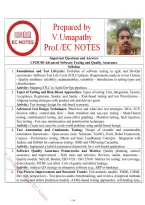
Important Questions and Answers
CP25C08-Advanced Software Testing and Quality Assurance
Syllabus
1. Foundations and Test Lifecycle: Evolution of software testing in agile and DevOps
ecosystems -Software Test Life Cycle (STLC) phases: Requirements analysis to test Closure
- Quality attributes: reliability, maintainability, testability - Introduction to testing types and
classifications.
Activity: Mapping STLC to Agile/DevOps pipelines.
2. Types of Testing and Risk-Based Approaches: Types of testing: Unit, Integration, System,
Acceptance, Regression, Smoke, and Sanity - Risk-based testing and test Prioritization -
Aligning testing strategies with product risk and delivery goals.
Activity: Test strategy design for risk-based scenarios.
3. Advanced Test Design Techniques: Black-box and white-box test strategies: BVA, ECP,
decision tables, control/data flow - State transition and use-case testing - Model-based
testing, combinatorial testing, and cause-effect graphing - Mutation testing, fault injection,
fuzz testing - Test case minimization and prioritization techniques.
Activity: Create test cases for a real-world problem using model-based design.
4. Test Automation and Continuous Testing: Design of reusable and maintainable
automation frameworks - Open-source tools: Selenium, TestNG, JUnit, Robot Framework,
Cypress - Performance testing: JMeter and basic LoadRunner Concepts - Integration with
Jenkins and GitHub for continuous testing - BDD and TDD using Cucumber.
Activity: Implement a hybrid automation framework for a web-based application.
5. Software Quality Assurance Frameworks and Metrics: Quality planning, control,
assurance, and improvement - SQA tools and activities: Reviews, audits, inspections -
V.
Quality models: McCall, Boehm, ISO 9126 / ISO 25010 -Metrics for testing: test coverage,
U
m
defect density, MTBF, test effort -Cost of quality and defect leakage.
ap
Activity: Analyze QA strategy in enterprise software (e.g., ERP or banking).
at
6. Test Process Improvement and Research Trends: Test maturity models: TMMi, CMMI-
hy
Dev (QA perspective) - Test process audits, benchmarking, and reviews -Empirical methods
,Pr
in testing and defect prediction models -AI/ML-based testing approaches: self-healing tests,
of
./
EC
N
ot
es
, anomaly detection -Testing trends: shift-left/right testing, visual and mobile testing.
Activity: Design a test improvement roadmap based on TMMi for a sample company.
S.No. Description
Unit-I
Foundations and Test Lifecycle
Basic Concepts
S.No. Basic Concept Definition / Key Points
Process of evaluating software to identify defects and verify that it meets
1 Software Testing
specified requirements.
Evolution of Testing evolved from traditional waterfall testing to Agile continuous
2
Testing testing and DevOps automation.
Testing is performed continuously in every sprint with close collaboration
3 Agile Testing
between developers and testers.
Integrates automated testing into CI/CD pipelines for faster and more
4 DevOps Testing
reliable software delivery.
Software Test Life Cycle is a systematic sequence of activities performed
5 STLC
during software testing.
Requirement Understand requirements, identify testable features, and clarify
6
Analysis ambiguities.
7 Test Planning Define testing scope, strategy, resources, schedule, tools, and effort.
Test Case
8 Prepare test cases, test data, test scripts, and expected results.
Development
Test Environment
9 Configure the required hardware, software, network, and testing tools.
Setup
Execute test cases, compare actual results with expected results, and report
10 Test Execution
defects.
Prepare test summary reports, evaluate coverage, document lessons
11 Test Closure
learned, and close testing activities.
Ability of software to operate without failure for a specified period under
12 Reliability
specified conditions.
13 Maintainability Ease of modifying, correcting, improving, and updating software.
Ease with which software can be tested to determine whether it meets
V.
14 Testability
U
requirements.
m
Testing Includes functional, non-functional, manual, automated, static, and
ap
15
Classification dynamic testing.
at
hy
Checks whether software functions meet the specified requirements.
16 Functional Testing
,
Examples: unit, integration, system, and acceptance testing.
Pr
of
17 Non-Functional Evaluates performance, security, usability, reliability, and scalability.
./
EC
N
ot
es
, Testing
Ensures that software changes have not affected previously working
18 Regression Testing
features.
Important Equations (Copy to Word)
1. Test Coverage (%)
Test Coverage = (Requirements Tested / Total Requirements) × 100
2. Test Pass Percentage (%)
Pass Percentage = (Passed Test Cases / Total Executed Test Cases) × 100
3. Defect Density
Defect Density = Total Defects / Software Size
4. Reliability
Reliability R(t) = e^(-λt)
where λ = failure rate and t = operating time, assuming a constant failure rate.
5. Mean Time Between Failures (MTBF)
MTBF = Total Operating Time / Number of Failures
Exam tip: Remember the STLC sequence: Requirement Analysis → Test Planning → Test Case
Development → Environment Setup → Test Execution → Test Closure.
Files, images, and data analysis are unavailable until usage resets at 4:17 PM. Continue chatting with
text only, or upgrade for more access.
V.
U
Multiple Choice QA
m
1. Which software development approach emphasizes continuous testing and integration?
ap
at
A) Waterfall
hy
, Pr
B) Agile and DevOps
of
./
EC
N
ot
es
, C) Big Bang Model
D) Prototype Model
Answer: B) Agile and DevOps
Reason: Agile and DevOps promote continuous integration, automated testing, rapid feedback, and
frequent software releases.
Equation (plain text):
Quality = Continuous Testing + Continuous Integration + Continuous Feedback
2. Which is the correct sequence of Software Test Life Cycle (STLC) phases?
A) Test Execution → Planning → Closure → Analysis
B) Requirements Analysis → Test Planning → Test Design → Environment Setup → Test Execution
→ Test Closure
C) Test Planning → Closure → Execution → Design
D) Coding → Deployment → Maintenance → Testing
Answer: B) Requirements Analysis → Test Planning → Test Design → Environment Setup → Test
Execution → Test Closure
Reason: STLC follows a systematic sequence, starting with understanding requirements and ending
with test closure, where test results and lessons learned are documented.
Equation (plain text):
STLC = Requirements Analysis + Test Planning + Test Design + Environment Setup + Test
Execution + Test Closure
V.
U
3. Which quality attribute measures the ability of software to operate without failure for a specified
m
ap
period?
at
hy
A) Maintainability
, Pr
of
./ EC
N
ot
es

