
GRADE 12
PHYSICAL SCIENCES
NEWTON’S LAWS OF MOTION
Study notes • Explanations • Diagrams • Worked examples • Exam practice
What you will learn
How forces affect motion, how to draw free-body diagrams, how to calculate acceleration using the net force,
and how Newton’s Third Law explains interactions between objects.
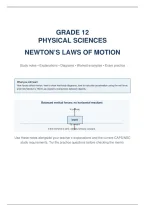
Balanced vertical forces; no horizontal resultant
N (normal)
block
Fg (weight)
If the net force is zero, velocity remains constant.
Use these notes alongside your teacher’s explanations and the current CAPS/NSC
study requirements. Try the practice questions before checking the memo.
, 1. The big idea: forces and motion
Newton’s laws describe how objects move when forces act on them. A force is a push or pull caused by an
interaction. Forces can change an object’s speed, direction or shape.
Important quantities
Quantity Symbol SI unit Meaning
Mass m kilogram (kg) Measure of inertia; how much matter an object has.
Force F newton (N) A push or pull; a vector with magnitude and direction.
Acceleration a m·s■² Rate of change of velocity; has direction.
Velocity v m·s■¹ Speed in a specified direction.
Weight Fg newton (N) Gravitational force acting on an object.
Resultant (net) force
The resultant force is the single force that has the same effect as all the forces acting together. Choose a
positive direction and add forces with signs. Forces in opposite directions subtract.
Forces to the right/up are often chosen as positive; left/down are then negative. The choice is yours, but keep
it consistent.
Key distinction
Mass is measured in kilograms (kg). Weight is a force measured in newtons (N). Do not use kg as the unit for
weight.
Grade 12 Physical Sciences • Newton's Laws of Motion Page 2

