
UNIT 6: THE URINARY SYSTEM fat against the posterior abdominal wall, partially protected by the 11th
and 12th ribs.
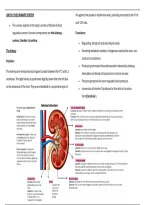
• The urinary system is the body's primary filtration & fluid
regulation centre. Its main components are the kidneys, Functions:
ureters, bladder & urethra.
• Regulating blood pH and electrolyte levels.
The kidney • Excreting metabolic wastes ( nitrogenous wastes like urea, uric
acids and creatinine ).
Position :
• Producing hormones like erythropoietin released by kidneys,
The kidneys are retroperitoneal organs located between the T12 and L3 stimulates red blood cell production in bone marrow.
vertebrae. The right kidney is positioned slightly lower than the left due • Producing enzyme like renin regulate blood pressure.
to the presence of the liver. They are embedded in a protective layer of • conversion of vitamin D produced in the skin to its active
form(Calcitriol ).
,Blood supply
• The kidneys have a rich blood supply, with about one-quarter of the body's total blood supply passing through them each minute.
• The renal artery supplies each kidney and divides into segmental arteries approaching the hilum.
• Segmental arteries branch into interlobar arteries, which traverse the renal columns to reach the cortex.
• At the cortex-medulla junction, interlobar arteries give rise to arcuate arteries that arch over the medullary pyramids.
• Small cortical radiate arteries branch from the arcuate arteries to supply the renal cortex.
• Venous blood drains in a reverse pathway: cortical radiate veins to arcuate veins, then to interlobar veins, and finally to the renal vein, which empties
into the inferior vena cava.
• There are no segmental veins in this system.
, Male vs female urinary systems
• While the internal urinary organs (kidneys, ureters, bladder) are largely the same, the urethra differs significantly.
Male Urethra: Longer and serves a dual
function (urinary and reproductive). It
passes through the prostate gland and
the penis.
Female Urethra: Shorter and
exclusively urinary. Its shorter length
makes females more susceptible to
urinary tract infections (UTIs).

