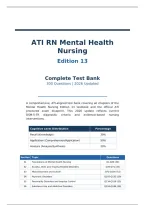
ATI RN Mental Health
Nursing
Edition 13
Complete Test Bank
300 Questions | 2026 Updated
A comprehensive, ATI-aligned test bank covering all chapters of the
Mental Health Nursing Edition 13 textbook and the official ATI
proctored exam blueprint. This 2026 update reflects current
DSM-5-TR diagnostic criteria and evidence-based nursing
interventions.
Cognitive Level Distribution Percentage
Recall (Knowledge) 30%
Application (Comprehension/Application) 50%
Analysis (Analysis/Synthesis) 20%
Section Topic Questions
S1 Foundations of Mental Health Nursing Q1-Q38 (38)
S2 Anxiety, OCD, and Trauma-Related Disorders Q39-Q71 (33)
S3 Mood Disorders and Suicide Q72-Q104 (33)
S4 Psychotic Disorders Q105-Q133 (29)
S5 Personality Disorders and Impulse Control Q134-Q158 (25)
S6 Substance Use and Addictive Disorders Q159-Q186 (28)
, S7 Eating and Neurocognitive Disorders Q187-Q211 (25)
S8 Child, Adolescent, and Geriatric Mental Health Q212-Q234 (23)
S9 Psychopharmacology and Adverse Effects Q235-Q264 (30)
S10 Crisis, Aggression, Restraints, and Abuse Q265-Q284 (20)
S11 Community Mental Health, Recovery, and Rehabili... Q285-Q300 (16)
Each question includes 4 options (A-D), correct answer, and detailed clinical rationale with ATI-style test-taking
strategy notes.
ATI RN Mental Health Nursing Edition 13 - Complete Test Bank (2026) | Page 2
, Section 1: Foundations of Mental Health
Nursing
Mental Status Examination | Therapeutic Communication | Nurse-Client Relationship |
Boundaries | Legal/Ethical Issues
Questions Q1-Q38 | 38 Questions
Q1. A nurse is completing a mental status examination on a client newly
admitted with major depressive disorder. Which assessment finding
should the nurse document under the "Affect" component?
A. The client reports feeling hopeless and worthless most of the time.
B. The client's facial expression is flat with no emotional variation during
the interview. [CORRECT]
C. The client correctly identifies today's date, month, and current U.S. president.
D. The client can repeat three objects after five minutes without prompting.
Correct Answer: B
Rationale: Affect refers to the observable, objective expression of emotion the
nurse witnesses during assessment (such as a flat, blunted, or appropriate facial
expression). Option A describes mood (the client's subjective self-report of
feeling), Options C and D describe orientation and recent memory respectively,
which are cognitive components rather than affective ones. Documenting affect
requires describing what the nurse objectively observes.
Q2. A psychiatric-mental health nurse is assessing a client's thought
process. Which documentation best reflects a derailment (loose
associations)?
A. The client states, "I feel like everyone is watching me and plotting to harm me."
B. The client says, "The weather is sunny. My mother used to bake bread.
Cars drive on roads." [CORRECT]
C. The client reports hearing voices telling them they are worthless when no one is
present.
D. The client firmly believes the government has implanted a chip in their brain
despite medical evidence to the contrary.
Correct Answer: B
Rationale: Derailment (loose associations) is a thought process disorder
characterized by speech that jumps between unrelated topics without logical
connection, as seen in Option B. Option A reflects persecutory delusions (content),
Option C reflects auditory hallucinations (perception), and Option D reflects a fixed
false belief (delusion, content of thought). Thought process describes HOW the
client thinks, not WHAT they think.
ATI RN Mental Health Nursing Edition 13 - Complete Test Bank (2026) | Page 3
, Q3. A nurse is conducting a mental status examination. The client is
asked to interpret the proverb "People in glass houses shouldn't throw
stones." The client responds, "Glass breaks easily." This response is most
consistent with which finding?
A. Concrete thinking [CORRECT]
B. Abstract thinking
C. Loose associations
D. Tangentiality
Correct Answer: A
Rationale: Concrete thinking is the literal interpretation of a proverb without
grasping its abstract or figurative meaning; the client's literal response about glass
breaking demonstrates this. Abstract thinking (Option B) would interpret the
metaphor (e.g., "don't criticize others when you have faults of your own"). Loose
associations (Option C) involve disconnected topics, and tangentiality (Option D)
involves wandering off-topic without returning. Concrete thinking is common in
schizophrenia, cognitive disorders, and intellectual disability.
Q4. A client states, "I'm just a burden to everyone. There's no point in
going on." Which response by the nurse is MOST therapeutic?
A. Why would you say that? Your family loves you very much.
B. Don't talk like that. Things will get better soon.
C. You sound like you're feeling overwhelmed. Tell me more about what's
been happening. [CORRECT]
D. I know exactly how you feel. Many clients have shared similar feelings with me.
Correct Answer: C
Rationale: Option C uses the therapeutic technique of reflecting and exploring,
acknowledging the client's emotional state without judgment and inviting further
communication. Option A asks "why" (nontherapeutic—puts the client on the
defensive) and offers false reassurance. Option B uses the nontherapeutic
technique of giving false reassurance and dismissing feelings. Option D uses false
empathy ("I know exactly how you feel") and overgeneralization rather than
focusing on this client's unique experience.
Q5. A client newly diagnosed with schizophrenia tells the nurse, "The CIA
is monitoring my thoughts through the television." Which response by the
nurse is MOST appropriate?
A. That's not true. The CIA has no reason to monitor you.
B. I understand you believe that, but I don't see any evidence of
monitoring. What shows are you watching? [CORRECT]
C. Tell me more about how the CIA is monitoring your thoughts.
D. You should stop watching so much television. It's making you paranoid.
Correct Answer: B
ATI RN Mental Health Nursing Edition 13 - Complete Test Bank (2026) | Page 4
Nursing
Edition 13
Complete Test Bank
300 Questions | 2026 Updated
A comprehensive, ATI-aligned test bank covering all chapters of the
Mental Health Nursing Edition 13 textbook and the official ATI
proctored exam blueprint. This 2026 update reflects current
DSM-5-TR diagnostic criteria and evidence-based nursing
interventions.
Cognitive Level Distribution Percentage
Recall (Knowledge) 30%
Application (Comprehension/Application) 50%
Analysis (Analysis/Synthesis) 20%
Section Topic Questions
S1 Foundations of Mental Health Nursing Q1-Q38 (38)
S2 Anxiety, OCD, and Trauma-Related Disorders Q39-Q71 (33)
S3 Mood Disorders and Suicide Q72-Q104 (33)
S4 Psychotic Disorders Q105-Q133 (29)
S5 Personality Disorders and Impulse Control Q134-Q158 (25)
S6 Substance Use and Addictive Disorders Q159-Q186 (28)
, S7 Eating and Neurocognitive Disorders Q187-Q211 (25)
S8 Child, Adolescent, and Geriatric Mental Health Q212-Q234 (23)
S9 Psychopharmacology and Adverse Effects Q235-Q264 (30)
S10 Crisis, Aggression, Restraints, and Abuse Q265-Q284 (20)
S11 Community Mental Health, Recovery, and Rehabili... Q285-Q300 (16)
Each question includes 4 options (A-D), correct answer, and detailed clinical rationale with ATI-style test-taking
strategy notes.
ATI RN Mental Health Nursing Edition 13 - Complete Test Bank (2026) | Page 2
, Section 1: Foundations of Mental Health
Nursing
Mental Status Examination | Therapeutic Communication | Nurse-Client Relationship |
Boundaries | Legal/Ethical Issues
Questions Q1-Q38 | 38 Questions
Q1. A nurse is completing a mental status examination on a client newly
admitted with major depressive disorder. Which assessment finding
should the nurse document under the "Affect" component?
A. The client reports feeling hopeless and worthless most of the time.
B. The client's facial expression is flat with no emotional variation during
the interview. [CORRECT]
C. The client correctly identifies today's date, month, and current U.S. president.
D. The client can repeat three objects after five minutes without prompting.
Correct Answer: B
Rationale: Affect refers to the observable, objective expression of emotion the
nurse witnesses during assessment (such as a flat, blunted, or appropriate facial
expression). Option A describes mood (the client's subjective self-report of
feeling), Options C and D describe orientation and recent memory respectively,
which are cognitive components rather than affective ones. Documenting affect
requires describing what the nurse objectively observes.
Q2. A psychiatric-mental health nurse is assessing a client's thought
process. Which documentation best reflects a derailment (loose
associations)?
A. The client states, "I feel like everyone is watching me and plotting to harm me."
B. The client says, "The weather is sunny. My mother used to bake bread.
Cars drive on roads." [CORRECT]
C. The client reports hearing voices telling them they are worthless when no one is
present.
D. The client firmly believes the government has implanted a chip in their brain
despite medical evidence to the contrary.
Correct Answer: B
Rationale: Derailment (loose associations) is a thought process disorder
characterized by speech that jumps between unrelated topics without logical
connection, as seen in Option B. Option A reflects persecutory delusions (content),
Option C reflects auditory hallucinations (perception), and Option D reflects a fixed
false belief (delusion, content of thought). Thought process describes HOW the
client thinks, not WHAT they think.
ATI RN Mental Health Nursing Edition 13 - Complete Test Bank (2026) | Page 3
, Q3. A nurse is conducting a mental status examination. The client is
asked to interpret the proverb "People in glass houses shouldn't throw
stones." The client responds, "Glass breaks easily." This response is most
consistent with which finding?
A. Concrete thinking [CORRECT]
B. Abstract thinking
C. Loose associations
D. Tangentiality
Correct Answer: A
Rationale: Concrete thinking is the literal interpretation of a proverb without
grasping its abstract or figurative meaning; the client's literal response about glass
breaking demonstrates this. Abstract thinking (Option B) would interpret the
metaphor (e.g., "don't criticize others when you have faults of your own"). Loose
associations (Option C) involve disconnected topics, and tangentiality (Option D)
involves wandering off-topic without returning. Concrete thinking is common in
schizophrenia, cognitive disorders, and intellectual disability.
Q4. A client states, "I'm just a burden to everyone. There's no point in
going on." Which response by the nurse is MOST therapeutic?
A. Why would you say that? Your family loves you very much.
B. Don't talk like that. Things will get better soon.
C. You sound like you're feeling overwhelmed. Tell me more about what's
been happening. [CORRECT]
D. I know exactly how you feel. Many clients have shared similar feelings with me.
Correct Answer: C
Rationale: Option C uses the therapeutic technique of reflecting and exploring,
acknowledging the client's emotional state without judgment and inviting further
communication. Option A asks "why" (nontherapeutic—puts the client on the
defensive) and offers false reassurance. Option B uses the nontherapeutic
technique of giving false reassurance and dismissing feelings. Option D uses false
empathy ("I know exactly how you feel") and overgeneralization rather than
focusing on this client's unique experience.
Q5. A client newly diagnosed with schizophrenia tells the nurse, "The CIA
is monitoring my thoughts through the television." Which response by the
nurse is MOST appropriate?
A. That's not true. The CIA has no reason to monitor you.
B. I understand you believe that, but I don't see any evidence of
monitoring. What shows are you watching? [CORRECT]
C. Tell me more about how the CIA is monitoring your thoughts.
D. You should stop watching so much television. It's making you paranoid.
Correct Answer: B
ATI RN Mental Health Nursing Edition 13 - Complete Test Bank (2026) | Page 4