
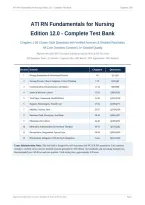
ATI RN Fundamentals for Nursing, Edition 12.0 - Complete Test Bank Chapters 1-58
ATI RN Fundamentals for Nursing
Edition 12.0 - Complete Test Bank
Chapters 1-58 | Exam-Style Questions with Verified Answers & Detailed Rationales
All Core Domains Covered | A+ Graded Quality
Aligned with 2026 ATI Curriculum Standards and the NCLEX-RN Test Plan
350 Questions Total | 12 Sections | Cognitive Mix: 30% Recall / 50% Application / 20% Analysis
Section Domain Chapters Questions
1 Nursing Foundations & Professional Practice 1-6 Q1-Q35
2 Nursing Process, Clinical Judgment, Critical Thinking 7-10 Q36-Q62
3 Communication, Documentation, Informatics 11-14 Q63-Q88
4 Safety & Infection Control 15-20 Q89-Q120
5 Vital Signs, Assessment, Health History 21-26 Q121-Q148
6 Hygiene, Skin Integrity, Wound Care 27-32 Q149-Q175
7 Mobility, Activity, Rest 33-37 Q176-Q199
8 Nutrition, Fluid, Electrolyte, Acid-Base 38-43 Q200-Q227
9 Elimination & Comfort 44-48 Q228-Q251
10 Medication Administration & Parenteral Therapies 49-53 Q252-Q282
11 Perioperative, Oxygenation, Special Care 54-58 Q283-Q320
12 Prioritization, Delegation, NCLEX-Style Integration Cross Q321-Q350
Exam Administration Notes: This test bank is designed for self-assessment and NCLEX-RN preparation. Each question
includes a verified correct answer, detailed rationale grounded in ATI Edition 12.0 standards, and test-taking strategy cues.
Recommended pace: 60-90 seconds per question. Total testing time: approximately 6-9 hours.
Aligned with 2026 ATI Curriculum Standards & NCLEX-RN Test Plan Page 1
,ATI RN Fundamentals for Nursing, Edition 12.0 - Complete Test Bank Chapters 1-58
Section 1: Nursing Foundations and Professional Practice
Chapters 1-6: Health Care Delivery, Nursing Roles, Ethics, Legal Issues, & Evidence-Based Practice (Q1-Q35)
Q1. A nurse is caring for a client in a facility that uses a primary nursing care delivery model.
Which statement by the nurse best describes this model?
A. The registered nurse assumes 24-hour accountability for the client's plan of care throughout the
hospitalization. [CORRECT]
B. A team leader directs the care provided by licensed practical nurses and unlicensed assistive personnel.
C. Care is divided among multiple staff members, with each member performing specific tasks for many
clients.
D. The charge nurse coordinates all client care and delegates each task to the appropriate team member.
Correct Answer: A
Rationale: Primary nursing assigns one registered nurse to assume 24-hour accountability for a client's care from
admission through discharge, even when other nurses provide direct care on different shifts. Team nursing (B) uses a
team leader model, modular nursing (C) divides tasks by function, and case management (D) coordinates care along a
critical pathway. The defining feature of primary nursing is continuity and accountability by a single RN.
Q2. A nurse manager is explaining the differences between licensure and certification to a
new graduate nurse. Which statement accurately describes certification?
A. Certification is a legal requirement enforced by the state to practice nursing.
B. Certification is a voluntary credential that recognizes additional expertise in a specialty area.
[CORRECT]
C. Certification is granted by the state board of nursing after passing NCLEX-RN.
D. Certification can only be obtained after working in a hospital setting for 10 years.
Correct Answer: B
Rationale: Certification is a voluntary process through which a nongovernmental agency grants recognition to an
individual who has met predetermined qualifications in a specialty area. Licensure (A) is mandatory and enforced by
the state. The NCLEX-RN (C) leads to licensure, not certification. While clinical experience is required for some
certifications, the 10-year requirement (D) is incorrect.
Q3. A nurse is caring for a client who refuses a prescribed blood transfusion due to religious
beliefs. Which ethical principle is the nurse upholding by respecting this decision?
A. Beneficence
B. Justice
C. Autonomy [CORRECT]
D. Nonmaleficence
Correct Answer: C
Rationale: Autonomy respects the client's right to self-determination and to make decisions about their own care,
even when those decisions conflict with the nurse's judgment. Beneficence (A) is acting in the client's best interest,
justice (B) is fair distribution of resources, and nonmaleficence (D) is the duty to do no harm. While refusing blood
may seem to conflict with beneficence, the ethical priority is the competent client's autonomous decision.
Aligned with 2026 ATI Curriculum Standards & NCLEX-RN Test Plan Page 2
,ATI RN Fundamentals for Nursing, Edition 12.0 - Complete Test Bank Chapters 1-58
Q4. A nurse administers the wrong dose of medication to a client due to a calculation error.
The client experiences no adverse effects. Which element must be present for this to be
considered malpractice?
A. Intent to cause harm to the client
B. A breach of duty that directly causes injury or damage [CORRECT]
C. A verbal complaint from the client or family
D. A written incident report filed within 24 hours
Correct Answer: B
Rationale: Malpractice requires four elements: duty (nurse-client relationship), breach of duty (failure to meet
standard of care), causation (the breach directly caused harm), and damages (actual injury occurred). Without injury
or damage, the elements of malpractice are not met. Intent (A) is not required for negligence. A complaint (C) and
incident report (D) are administrative actions, not legal elements.
Q5. A nurse is obtaining informed consent from a client prior to surgery. Which action by the
nurse is appropriate?
A. The nurse explains the surgical procedure, risks, and alternative treatments in detail.
B. The nurse witnesses the client's signature and verifies the client's understanding and voluntary
consent. [CORRECT]
C. The nurse signs the consent form as the responsible provider for the procedure.
D. The nurse asks the client to sign the form after sedation has been administered.
Correct Answer: B
Rationale: The nurse's role in informed consent is to witness the client's signature and verify that the client
understands the procedure, that consent is given voluntarily, and that the client is competent. The provider
(physician/advanced practice nurse) is responsible for explaining the procedure, risks, benefits, and alternatives (A).
The nurse does not perform the procedure (C) and consent must be obtained before sedation is given (D).
Q6. Which action by the nurse demonstrates the use of evidence-based practice (EBP)?
A. Performing oral care with chlorhexidine rinse for all ICU clients because that is the unit's tradition.
B. Implementing cluster care for mechanically ventilated clients after reviewing current research and
unit outcomes. [CORRECT]
C. Using a particular wound dressing because the charge nurse prefers it for all pressure injuries.
D. Following a procedure from a 2010 nursing textbook because it has always worked.
Correct Answer: B
Rationale: Evidence-based practice integrates the best available research evidence, clinical expertise, and client
values/preferences. Reviewing current research and unit outcomes (B) reflects EBP. Tradition (A), personal
preference (C), and outdated sources (D) do not reflect EBP. EBP requires continuous appraisal of current literature
and outcome data.
Aligned with 2026 ATI Curriculum Standards & NCLEX-RN Test Plan Page 3
, ATI RN Fundamentals for Nursing, Edition 12.0 - Complete Test Bank Chapters 1-58
Q7. A nurse is reviewing the Patient's Bill of Rights with a client. Which client statement
indicates understanding of these rights?
A. "I cannot see my medical record until after I am discharged."
B. "I have the right to refuse any treatment, and I will be informed of the consequences." [CORRECT]
C. "My family must make all decisions if I become unable to do so."
D. "I must accept all treatments the provider prescribes."
Correct Answer: B
Rationale: The Patient's Bill of Rights includes the right to refuse treatment to the extent permitted by law and to be
informed of the medical consequences of refusal. Clients also have the right to access their medical records (A). If the
client cannot make decisions and has no advance directive, state law determines the decision-maker (C). Clients are
not required to accept all prescribed treatments (D).
Q8. A nurse is caring for a client who is HIV-positive. The client's family member requests
information about the client's diagnosis. Which response by the nurse is most appropriate?
A. "I can share the diagnosis with you since you are a family member."
B. "I cannot discuss the client's condition without their written permission." [CORRECT]
C. "The client has HIV, but please do not tell anyone."
D. "You should ask the provider about the diagnosis."
Correct Answer: B
Rationale: Under HIPAA, protected health information cannot be shared without the client's written authorization,
even with family members. The nurse must protect client confidentiality (B). Sharing information without consent (A
and C) violates HIPAA. Deflecting to the provider (D) does not address the confidentiality requirement and may
imply the family can obtain information through another route.
Q9. A nurse is preparing to delegate a task to an unlicensed assistive personnel (UAP). Which
task is appropriate to delegate?
A. Teaching a client about a newly prescribed colostomy.
B. Assessing a client's surgical incision for signs of infection.
C. Ambulating a stable client who has been walking without difficulty for two days. [CORRECT]
D. Administering an oral analgesic to a client reporting pain.
Correct Answer: C
Rationale: Delegation to UAP is appropriate for routine, stable tasks that do not require nursing judgment, such as
ambulating a stable client. Teaching (A), assessment (B), and medication administration (D) are within the RN scope
of practice and cannot be delegated to UAP. The five rights of delegation include the right task, right circumstance,
right person, right direction, and right supervision.
Aligned with 2026 ATI Curriculum Standards & NCLEX-RN Test Plan Page 4

