
ATI RN FUNDAMENTALS ACTUAL EXAM 2026
Edition 12.0 Complete Test Bank | Chapters 1–58 | 300 Most Tested Questions
Verified Answers & Comprehensive Clinical Rationales
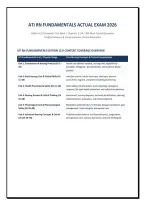
ATI RN FUNDAMENTALS EDITION 12.0 CONTENT COVERAGE OVERVIEW
ATI Fundamentals Unit / Chapter Range Core Nursing Concepts & Tested Competencies
Unit 1: Foundations of Nursing Practice (Ch 1– Health care delivery systems, nursing roles, legal/ethical
10) principles, delegation, documentation, and evidence-based
practice.
Unit 2: Basic Nursing Care & Clinical Skills (Ch Infection control, sterile technique, vital signs, physical
11–20) assessment, hygiene, and patient mobility/positioning.
Unit 3: Health Promotion & Safety (Ch 21–30) Client safety, fall prevention, error reporting, emergency
response, life span health promotion, and cultural competency.
Unit 4: Nursing Process & Critical Thinking (Ch Assessment, nursing diagnosis, outcome identification, planning,
31–38) implementation, evaluation, and clinical judgment.
Unit 5: Physiological Care & Pharmacological Medication administration, IV therapy, dosage calculations, pain
Safety (Ch 39–48) management, tissue integrity, and wound care.
Unit 6: Advanced Nursing Concepts & End-of- Fluid/electrolyte balance, acid-base dynamics, oxygenation,
Life (Ch 49–58) perioperative care, sensory alterations, and end-of-life/grief.
,Question 1
Item 1: [Unit 1: Foundations of Nursing Practice (Ch 1–10)] A nurse is delegating tasks to an Assistive
Personnel (AP). Which of the following tasks is appropriate for the nurse to delegate?
A. Reapplying a sterile dressing to a stage 3 pressure injury
B. Ambulating a client who is 1 day post-op and clinically stable
C. Assessing a client's response to initial pain medication
D. Teaching a client how to administer subcutaneous insulin
Verified Answer: B. Ambulating a client who is 1 day post-op and clinically stable
ATI RN Clinical Rationale: Ambulating stable clients is within the scope of practice for AP. Assessment, patient
teaching, and sterile dressing changes require clinical judgment and must be performed by the licensed nurse.
Question 2
Item 2: [Unit 2: Basic Nursing Care & Clinical Skills (Ch 11–20)] A nurse is preparing to insert an indwelling
urinary catheter for a female client. Which action should the nurse take to maintain sterile technique
during the procedure?
A. Cleanse the labia from back to front using a single cotton ball
B. Maintain a 1-inch border around the sterile field as unsterile
C. Turn back to the sterile field to retrieve additional supplies
D. Place sterile gloves on before opening the outer catheter package
Verified Answer: B. Maintain a 1-inch border around the sterile field as unsterile
ATI RN Clinical Rationale: The outer 1-inch border of a sterile field is considered contaminated. Cleansing must occur
front-to-back, the nurse must never turn their back on a sterile field, and outer packaging is opened prior to donning
sterile gloves.
Question 3
Item 3: [Unit 3: Health Promotion & Safety (Ch 21–30)] A nurse enters a client's room and discovers a small
fire in a trash can. According to the RACE protocol, which action should the nurse perform FIRST?
A. Activate the facility fire alarm system
B. Rescue and evacuate clients in immediate danger
C. Contain the fire by closing doors and windows
D. Extinguish the fire using a fire extinguisher
Verified Answer: B. Rescue and evacuate clients in immediate danger
ATI RN Clinical Rationale: The acronym RACE dictates the sequence of actions: Rescue/Remove clients in immediate
danger first, Activate alarm (Alarm), Contain fire (Contain), and Extinguish/Evacuate (Extinguish).
Question 4
Item 4: [Unit 4: Nursing Process & Critical Thinking (Ch 31–38)] A nurse is evaluating a client who is
receiving IV fluid therapy for dehydration. Which of the following findings indicates that fluid resuscitation
has been successful?
A. Urine output of 45 mL/hr with specific gravity 1.015
B. Heart rate of 118/min and blood pressure 88/54 mm Hg
C. Poor skin turgor with tenting on the forearm
D. Dry mucous membranes and dark amber urine
, Verified Answer: A. Urine output of 45 mL/hr with specific gravity 1.015
ATI RN Clinical Rationale: Urine output > 30 mL/hr and normal urine specific gravity (1.010–1.030) reflect restored
renal perfusion and adequate hydration status.
Question 5
Item 5: [Unit 5: Physiological Care & Pharmacological Safety (Ch 39–48)] A nurse is preparing to administer
an intramuscular (IM) injection to an adult client. Which site is the safest location to minimize the risk of
nerve or vascular injury?
A. Ventrogluteal site
B. Dorsogluteal site
C. Vastus lateralis site
D. Deltoid site
Verified Answer: A. Ventrogluteal site
ATI RN Clinical Rationale: The ventrogluteal site is the preferred and safest IM injection site for adults because it is
free of major nerves and large blood vessels and has a thick muscle mass.
Question 6
Item 6: [Unit 6: Advanced Nursing Concepts & End-of-Life (Ch 49–58)] A nurse is caring for a client who has
arterial blood gas (ABG) results: pH 7.28, PaCO2 52 mm Hg, HCO3- 24 mEq/L. The nurse interprets these
findings as which acid-base imbalance?
A. Respiratory Acidosis
B. Respiratory Alkalosis
C. Metabolic Acidosis
D. Metabolic Alkalosis
Verified Answer: A. Respiratory Acidosis
ATI RN Clinical Rationale: pH < 7.35 indicates acidosis. PaCO2 > 45 mm Hg indicates respiratory origin. With normal
HCO3- (22–26 mEq/L), the uncompensated acid-base imbalance is Respiratory Acidosis.
Question 7
Item 7: [Unit 1: Foundations of Nursing Practice (Ch 1–10)] A nurse is delegating tasks to an Assistive
Personnel (AP). Which of the following tasks is appropriate for the nurse to delegate?
A. Reapplying a sterile dressing to a stage 3 pressure injury
B. Ambulating a client who is 1 day post-op and clinically stable
C. Assessing a client's response to initial pain medication
D. Teaching a client how to administer subcutaneous insulin
Verified Answer: B. Ambulating a client who is 1 day post-op and clinically stable
ATI RN Clinical Rationale: Ambulating stable clients is within the scope of practice for AP. Assessment, patient
teaching, and sterile dressing changes require clinical judgment and must be performed by the licensed nurse.
Question 8
Item 8: [Unit 2: Basic Nursing Care & Clinical Skills (Ch 11–20)] A nurse is preparing to insert an indwelling
urinary catheter for a female client. Which action should the nurse take to maintain sterile technique
during the procedure?
A. Cleanse the labia from back to front using a single cotton ball
, B. Maintain a 1-inch border around the sterile field as unsterile
C. Turn back to the sterile field to retrieve additional supplies
D. Place sterile gloves on before opening the outer catheter package
Verified Answer: B. Maintain a 1-inch border around the sterile field as unsterile
ATI RN Clinical Rationale: The outer 1-inch border of a sterile field is considered contaminated. Cleansing must occur
front-to-back, the nurse must never turn their back on a sterile field, and outer packaging is opened prior to donning
sterile gloves.
Question 9
Item 9: [Unit 3: Health Promotion & Safety (Ch 21–30)] A nurse enters a client's room and discovers a small
fire in a trash can. According to the RACE protocol, which action should the nurse perform FIRST?
A. Activate the facility fire alarm system
B. Rescue and evacuate clients in immediate danger
C. Contain the fire by closing doors and windows
D. Extinguish the fire using a fire extinguisher
Verified Answer: B. Rescue and evacuate clients in immediate danger
ATI RN Clinical Rationale: The acronym RACE dictates the sequence of actions: Rescue/Remove clients in immediate
danger first, Activate alarm (Alarm), Contain fire (Contain), and Extinguish/Evacuate (Extinguish).
Question 10
Item 10: [Unit 4: Nursing Process & Critical Thinking (Ch 31–38)] A nurse is evaluating a client who is
receiving IV fluid therapy for dehydration. Which of the following findings indicates that fluid resuscitation
has been successful?
A. Urine output of 45 mL/hr with specific gravity 1.015
B. Heart rate of 118/min and blood pressure 88/54 mm Hg
C. Poor skin turgor with tenting on the forearm
D. Dry mucous membranes and dark amber urine
Verified Answer: A. Urine output of 45 mL/hr with specific gravity 1.015
ATI RN Clinical Rationale: Urine output > 30 mL/hr and normal urine specific gravity (1.010–1.030) reflect restored
renal perfusion and adequate hydration status.
Question 11
Item 11: [Unit 5: Physiological Care & Pharmacological Safety (Ch 39–48)] A nurse is preparing to
administer an intramuscular (IM) injection to an adult client. Which site is the safest location to minimize
the risk of nerve or vascular injury?
A. Ventrogluteal site
B. Dorsogluteal site
C. Vastus lateralis site
D. Deltoid site
Verified Answer: A. Ventrogluteal site
ATI RN Clinical Rationale: The ventrogluteal site is the preferred and safest IM injection site for adults because it is
free of major nerves and large blood vessels and has a thick muscle mass.

