
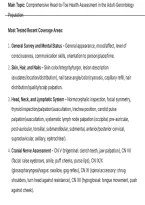
Main Topic: Comprehensive Head-to-Toe Health Assessment in the Adult-Gerontology
Population
Most Tested Recent Coverage Areas:
1. General Survey and Mental Status – General appearance, mood/affect, level of
consciousness, communication skills, orientation to person/place/time.
2. Skin, Hair, and Nails – Skin color/integrity/turgor, lesion description
(exudates/location/distribution), nail base angle/color/cyanosis, capillary refill, hair
distribution/quality/scalp palpation.
3. Head, Neck, and Lymphatic System – Normocephalic inspection, facial symmetry,
thyroid inspection/palpation/auscultation, trachea position, carotid pulse
palpation/auscultation, systematic lymph node palpation (occipital, pre-auricular,
post-auricular, tonsillar, submandibular, submental, anterior/posterior cervical,
supraclavicular, axillary, epitrochlear).
4. Cranial Nerve Assessment – CN V (trigeminal: clench teeth, jaw palpation), CN VII
(facial: raise eyebrows, smile, puff cheeks, purse lips), CN IX/X
(glossopharyngeal/vagus: swallow, gag reflex), CN XI (spinal accessory: shrug
shoulders, turn head against resistance), CN XII (hypoglossal: tongue movement, push
against cheek).
, 5. Eye Assessment – Corneal light reflection (symmetry at 30 cm), cover-uncover test
(no movement in uncovered eye), ophthalmoscope technique (red reflex, left hand/left
eye for left eye).
6. Chest and Respiratory – Chest landmark inspection/symmetry, respiratory
rate/pattern/movement, percussion anterior/posterior/lateral (resonance), auscultation
of breath sounds bilaterally (clear, no adventitious sounds).
7. Cardiovascular and Peripheral Vascular – Bilateral palpation of temporal, brachial,
radial, popliteal, posterior tibial, and dorsalis pedis pulses; carotid auscultation for
bruits.
8. Abdominal Assessment – Inspection (contour/color/symmetry/surface motion/venous
pattern), auscultation bowel sounds x4 quadrants and epigastric, percussion liver
span and spleen, CVA tenderness percussion, light and deep palpation x4 quadrants.
9. Musculoskeletal and Range of Motion – Gait/posture inspection, scoliosis screen,
active/passive ROM, ankle ROM (dorsiflexion 20°, plantarflexion 45°, inversion 30°,
eversion 20°), cervical spine ROM (flexion 45°, extension 45°, lateral bending 40°,
rotation 70°).
10. Neurological Assessment – Coordination (rapid alternating movements, finger-to-
nose), sensory (superficial touch, vibration upper/lower extremities), deep tendon
reflexes bilaterally (biceps, triceps, brachioradialis, patellar, Achilles, plantar).
,NURS 5120 Adult Gerontology Assessment Lab Practice
Questions and Answers
1. During the general survey portion of a comprehensive adult-gerontology
assessment, which set of findings should the examiner document as part of the mental
status evaluation?
A. Blood pressure 128/76, heart rate 72, respiratory rate 14, temperature 98.6°F
B. General appearance, mood and affect, level of consciousness, and communication
skills
C. Thyroid size, trachea position, carotid pulses, and lymph node tenderness
D. Bowel sounds in four quadrants, liver span, spleen percussion, and CVA tenderness
Answer: B
Rationale: The Module 3 comprehensive assessment grading form explicitly requires the
examiner to verbalize general appearance, mood and affect, level of consciousness, and
communication skills as the mental status component . Vital signs are separate, and
thyroid/lymph and abdominal findings belong to other systems. 4
, 2. When inspecting the skin and nails during a head-to-toe assessment, which
technique correctly evaluates capillary refill in an older adult patient?
A. Pressing the nail bed until it blanches, then releasing and timing color return
B. Measuring the angle between the nail base and the nail plate
C. Inspecting the nails for longitudinal ridges and yellow discoloration
D. Palpating the skin over the dorsum of the hand for temperature and moisture
Answer: A
Rationale: Capillary refill is assessed by blanching the nail bed and observing the time
for color to return, which reflects peripheral perfusion . Nail base angle evaluates
clubbing, and inspecting ridges addresses nail texture rather than capillary refill. 1
3. Which lymph node group should the examiner palpate bilaterally when assessing
the head and neck region in an adult patient?
A. Inguinal, femoral, popliteal, and posterior tibial
B. Occipital, pre-auricular, post-auricular, and tonsillar
C. Epitrochlear, axillary, supraclavicular, and subclavian
D. Mesenteric, iliac, lumbar, and retroperitoneal

