
PHYSICS NOTES 4U / DETAILED TOPIC SERIES
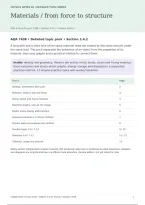
Materials / from force to structure
AQA A-level Physics 7408 • Section 3.4.2 • Review edition
AQA 7408 • Detailed topic pack • Section 3.4.2
A long wire and a short wire of the same material need not extend by the same amount under
the same load. This pack separates the behaviour of an object from the properties of its
material, then uses graphs and a practical method to connect them.
Inside: density and geometry; Hooke's law and its limits; stress, strain and Young modulus;
force–extension and stress–strain graphs; energy storage and dissipation; a supported
practical method; 12 original practice tasks with worked solutions.
Find it Page
Density, dimensions and scale 2
Stiffness, Hooke's law and limits 3
Stress, strain and Young modulus 4
Read the graphs, not just the shape 5
Elastic strain energy and transfers 6
Required practical 4: a simple method 7
Process data and evaluate the method 8
Practice tasks 1––12
Solutions 1––12
Checklist, scope and sources 13
Newly written independent revision material. Not produced, approved or endorsed by AQA. Questions, datasets
and diagrams are original and have no official mark allocation. Review edition: not yet listed for sale.
Independent revision notes • Edition 1.0 for review • October 2026 1
, PHYSICS NOTES 4U / DETAILED TOPIC SERIES
Density / distinguish mass and volume
AQA A-level Physics 7408 • Section 3.4.2 • Review edition
ρ = m/V
Density ρ is mass m per unit volume V. In SI units use kg and m³, giving kg m−3. Mass is the
amount of matter measured in kg; weight is the gravitational force mg, measured in N. A larger
object can have greater mass without greater density.
Shape or measurement Volume
Rectangular block V = length × width × height
Cylinder, diameter d and length L V = πd²L/4
Sphere, radius r V = 4πr³/3
Fully submerged irregular solid Volume displaced, provided liquid does not react or soak
in
Worked example: a block measures 4.0 cm × 2.0 cm × 1.5 cm and has mass 96 g. V = 12
cm³ = 1.2 × 10⁻⁵ m³; m = 0.096 kg.
ρ = 0.096/(1.2 × 10−5) = 8.0 × 10³ kg m−3.
Equivalently 8.0 g cm−3. Since 1 g cm−3 = 1000 kg m−3, the two agree.
Choose a measurement that fits the object
A micrometer can resolve a small wire diameter more finely than a ruler. Check its zero and
measure in different positions and orientations to test whether the wire is uniform. Do not
squash a soft wire with excessive closing force. A balance needs an appropriate range and
resolution; a large maximum load is not itself evidence of a better mass measurement.
Displacement volume requires complete immersion and no trapped bubbles. A floating sample
needs a different method or a carefully accounted-for sinker. Read a liquid scale at eye level and
account for the initial and final volume readings.
Estimate: a roughly spherical stone of diameter 5 cm has V ≈ 6.5 × 10⁻⁵ m³. If mass is
about 0.17 kg, density is about 2.6 × 10³ kg m−3. The non-spherical shape limits the
estimate; extra calculator digits do not fix it.
Independent revision notes • Edition 1.0 for review • October 2026 2

