[STUDY GUIDE] • HIGH-YIELD PRACTICE & REVIEW EDITION
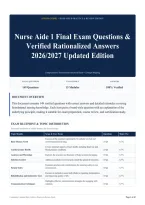
Nurse Aide 1 Final Exam Questions &
Verified Rationalized Answers
2026/2027 Updated Edition
Comprehensive Examination Question Bank • Concept Mapping
TOTAL QUESTIONS EXAM TOPICS ANSWERS
149 Questions 15 Modules 100% Verified
DOCUMENT OVERVIEW
This document contains 149 verified questions with correct answers and detailed rationales covering
foundational nursing knowledge. Each item pairs a board-style question with an explanation of the
underlying principle, making it suitable for exam preparation, course review, and certification study.
EXAM BLUEPRINT & TOPIC DISTRIBUTION
Systematic breakdown of subject domains and exam coverage.
Topic Module Scope & Core Focus Questions Share (%)
Focuses on the essential requirements for cellular survival and
Basic Human Needs overall human functioning. 10 Qs 6.7%
Covers important aspects of heart health, including heart rate and
Cardiovascular Health blood pressure conditions. 10 Qs 6.7%
Anatomy and Physiology Explores the structure and functions of body systems and organs. 10 Qs 6.7%
Infection Control Addresses methods to prevent and control the spread of infections. 10 Qs 6.7%
Examines practices and considerations for ensuring safety in care
Patient Safety environments. 10 Qs 6.7%
Focuses on methods to assist individuals in regaining independence
Rehabilitation and Restorative Care and improving quality of life. 10 Qs 6.7%
Highlights effective communication strategies for engaging with
Communication Techniques residents. 10 Qs 6.7%
Confidential • Student Study Edition • Practice & Review Guide Page 1 of 42
,STUDENT STUDY & MASTERY EDITION PRACTICE & REVIEW GUIDE
Covers the role of nutrition in health and the dietary needs of
Nutrition and Diet individuals. 10 Qs 6.7%
Discusses proper techniques for moving and positioning individuals
Mobility and Body Mechanics to prevent injury. 10 Qs 6.7%
Health Assessment Focuses on techniques and tools used for assessing health status. 10 Qs 6.7%
Explores the psychological aspects of care and the importance of
Mental and Emotional Health mental well-being. 10 Qs 6.7%
Addresses protocols and responses to emergencies within healthcare
Emergency Situations settings. 10 Qs 6.7%
Covers the laws and ethical considerations relevant to nursing
Regulatory and Ethical Standards practice. 10 Qs 6.7%
Focuses on the skills necessary for providing personal hygiene and
Personal Care Skills care. 10 Qs 6.7%
Examines safety protocols related to handling materials and
Material Safety and Handling chemicals in a healthcare environment. 9 Qs 6.0%
Total Exam Coverage 15 Integrated Topic Modules 149 Qs 100.0%
TOPIC 1: BASIC HUMAN NEEDS
10 Questions • 6.7% of Exam • Focuses on the essential requirements for cellular survival and overall human functioning.
QUESTION 1
What do cells need to live and function?
Answer: Food, water, oxygen.
Rationale: Cells require food, water, and oxygen to live and function because these essential resources provide the necessary energy,
building blocks, and metabolic support for cellular processes such as protein synthesis, energy production, and waste
removal. Without these fundamental elements, cells would be unable to carry out their basic biological functions, leading to cellular
dysfunction and ultimately, death.
Confidential • Student Study Edition • Practice & Review Guide Page 2 of 42
,STUDENT STUDY & MASTERY EDITION PRACTICE & REVIEW GUIDE
QUESTION 2
Rehabilitation and restorative nursing care focus on what?
Answer: The whole person.
Rationale: Rehabilitation and restorative nursing care focus on the whole person because they aim to address the physical, emotional,
social, and spiritual needs of individuals with disabilities or chronic illnesses, recognizing that health is not just the absence of disease
but a holistic experience. By taking a comprehensive approach, rehabilitation and restorative nursing care seek to improve the overall
well-being and quality of life of individuals, rather than just treating specific symptoms or conditions.
QUESTION 3
What do most pathogens need to grow?
Answer: Water, Oxygen, Nourishment.
Rationale: Most pathogens, such as bacteria and viruses, require a nutrient-rich environment to replicate and thrive. Specifically, they
need water to facilitate metabolic processes, oxygen to generate energy through cellular respiration, and nourishment in the form of
organic compounds and nutrients to synthesize new cellular components and sustain growth.
QUESTION 4
What should you do if co-workers are talking about other staff at the lunch table?
Answer: Remove yourself from the situation.
Rationale: When co-workers discuss other staff at the lunch table, it's essential to prioritize maintaining a professional and respectful
atmosphere, which is compromised when you engage in gossip or join in the conversation. By removing yourself from the situation, you
avoid contributing to the negative tone and show respect for the dignity of the staff being discussed, ultimately promoting a positive and
inclusive work environment.
QUESTION 5
What are ways that equipment could unsafe?
Answer: It is not used correctly, it is not working properly, the cord is frayed.
Rationale: The correct answer highlights the importance of equipment safety by identifying three specific ways in which equipment can
be unsafe, namely, incorrect usage, malfunction, and physical damage (frayed cord). By providing these concrete examples, the answer
emphasizes the need to ensure equipment is used properly, maintained regularly, and inspected for damage to prevent accidents and
ensure a safe working environment.
Confidential • Student Study Edition • Practice & Review Guide Page 3 of 42
, STUDENT STUDY & MASTERY EDITION PRACTICE & REVIEW GUIDE
QUESTION 6
The back lying position is called what?
Answer: Supine.
Rationale: The back lying position is called supine because it refers to the anatomical position where the individual's back is lying on a
flat surface, with their face upwards and their body in a horizontal position. This definition is rooted in the Latin word "supinus,"
meaning "lying on the back," which is used to describe this specific anatomical position.
QUESTION 7
When removing tape, what direction do you pull the tape?
Answer: Toward the wound.
Rationale: When removing tape, it's essential to pull it in the opposite direction of the wound or lift, as pulling in the same direction can
cause further irritation, stretching, or even tearing of the skin or underlying tissue. Therefore, "Toward the wound" is the correct
direction, as it reduces the likelihood of causing additional trauma and promotes a smoother, less painful removal process.
QUESTION 8
What is protein needed for?
Answer: Tissue growth and repair.
Rationale: Protein is essential for tissue growth and repair because it provides the building blocks for the synthesis of new cells, tissues,
and organs, allowing for the replacement of damaged or worn-out cells and tissues. This is crucial for maintaining tissue integrity,
recovering from injuries, and adapting to changes throughout the body's development and life.
QUESTION 9
How should you apply powder?
Answer: Sprinkle a small amount on your hand.
Rationale: Applying a small amount of powder to the hand allows for a controlled and even distribution of the product, preventing
excessive powder from being applied and reducing the likelihood of over-powdering the skin or clothing. By sprinkling a small amount
on the hand, it enables the user to gently pat or massage the powder onto the desired area, ensuring a smooth and even application.
Confidential • Student Study Edition • Practice & Review Guide Page 4 of 42