[STUDY GUIDE] • HIGH-YIELD PRACTICE & REVIEW EDITION
Nurse Aide Exam Questions & Detailed
Rationalized Answers 2026/2027
Exam-Ready Edition
Comprehensive Examination Question Bank • Concept Mapping
TOTAL QUESTIONS EXAM TOPICS ANSWERS
78 Questions 12 Modules 100% Verified
DOCUMENT OVERVIEW
This document contains 78 verified questions with detailed rationales covering nurse aide knowledge
essential for certification. Each item pairs a question with the correct answer and a concise explanation of
the underlying principle, making it suitable for exam preparation, course review, and skill enhancement.
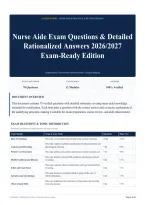
EXAM BLUEPRINT & TOPIC DISTRIBUTION
Systematic breakdown of subject domains and exam coverage.
Topic Module Scope & Core Focus Questions Share (%)
Basic Terminology This topic covers fundamental nursing terms and their meanings. 10 Qs 12.8%
This topic explores essential concepts related to human anatomy and
Anatomy and Physiology physiological functions. 7 Qs 9.0%
Patient Care Procedures This topic addresses procedures and practices related to patient care. 7 Qs 9.0%
This topic includes various health conditions and diseases relevant
Health Conditions and Diseases to nursing. 6 Qs 7.7%
This topic examines ethical considerations and legal responsibilities
Ethics and Legal Issues in nursing. 6 Qs 7.7%
This topic focuses on concepts related to aging and the care of
Geriatrics and Gerontology elderly individuals. 6 Qs 7.7%
This topic emphasizes the importance of observation and reporting
Observational Skills in nursing practice. 6 Qs 7.7%
Confidential • Student Study Edition • Practice & Review Guide Page 1 of 24
,STUDENT STUDY & MASTERY EDITION PRACTICE & REVIEW GUIDE
This topic covers common medical abbreviations and their
Medical Abbreviations meanings in nursing. 6 Qs 7.7%
This topic addresses various signs and symptoms related to health
Signs and Symptoms conditions. 6 Qs 7.7%
This topic examines the interpretation and significance of vital
Vital Signs signs. 6 Qs 7.7%
This topic explores practices for ensuring patient safety and
Patient Safety and Comfort comfort. 6 Qs 7.7%
This topic discusses concepts related to infection prevention and
Infection Control control. 6 Qs 7.7%
Total Exam Coverage 12 Integrated Topic Modules 78 Qs 100.0%
TOPIC 1: BASIC TERMINOLOGY
10 Questions • 12.8% of Exam • This topic covers fundamental nursing terms and their meanings.
QUESTION 1
Void
Answer: To urinate.
Rationale: The correct answer "to urinate" is because the verb "void" specifically means to eliminate waste or urine from the body,
making "to urinate" a direct and accurate translation. This definition is distinct from other possible meanings of "void", such as null or
invalidate, which are not related to bodily functions.
QUESTION 2
Trochanter roll
Answer: Pillow to keep hips from externally rotating.
Rationale: The trochanter roll, also known as the pillow roll, is a technique used to stabilize the pelvis and prevent excessive external
rotation of the femur, which can lead to poor posture, lower back pain, and other issues. By placing a pillow or towel between the knees,
the pelvis is forced to rotate inward, reducing excessive external rotation and promoting a more neutral position, which is why the
pillow is used to keep hips from externally rotating.
Confidential • Student Study Edition • Practice & Review Guide Page 2 of 24
, STUDENT STUDY & MASTERY EDITION PRACTICE & REVIEW GUIDE
QUESTION 3
Aphasia
Answer: No speech.
Rationale: Aphasia is a communication disorder that results from damage to the brain, typically caused by stroke, traumatic brain
injury, or neurodegenerative disease, which affects an individual's ability to process and produce language. Since "no speech" refers to
the absence of language production, which is a hallmark symptom of aphasia, it is the correct answer because it accurately describes the
fundamental communication impairment that individuals with aphasia typically experience.
QUESTION 4
Tachypnea
Answer: Rapid breathing.
Rationale: Tachypnea refers to an abnormally rapid respiratory rate, which is characterized by breathing patterns that are faster than
normal. Rapid breathing is the correct answer because it accurately describes the increased frequency of breaths per minute that occurs
in individuals with tachypnea, regardless of the underlying cause or severity of the condition.
QUESTION 5
Dysuria
Answer: Difficulty urinating.
Rationale: Dysuria refers to pain or discomfort during urination, which is often characterized by difficulty starting or stopping the flow
of urine, or a feeling of burning or stinging sensations while urinating. The term "difficulty urinating" accurately captures this concept,
as it encompasses the range of unpleasant experiences that individuals may encounter when attempting to urinate.
QUESTION 6
Atrophy
Answer: Lose muscle tone.
Rationale: Atrophy refers to the wasting away of tissues, including muscle, due to lack of use or stimulation. When a muscle atrophies, it
loses its normal tone and function, resulting in muscle tone loss, which is a gradual decrease in muscle strength and flexibility.
Confidential • Student Study Edition • Practice & Review Guide Page 3 of 24