FLORIDA TEACHER CERTIFICATION EXAMINATIONS | PRACTICE BANK
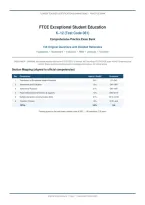
FTCE Exceptional Student Education
K–12 (Test Code 061)
Comprehensive Practice Exam Bank
158 Original Questions with Detailed Rationales
Foundations • Assessment • Instruction • PBIS • Literacies • Transition
DISCLAIMER – ORIGINAL educational practice resource for FTCE ESE K–12 themes. NOT an official FTCE/FLDOE exam and NOT proprietary test
content. Scope: reinforce special education knowledge and practices. Not official advice.
Section Mapping (aligned to official competencies)
Sec Competency Approx. Weight Questions
1 Foundations of Exceptional Student Education 23% Q1–Q40
2 Assessment and Evaluation 13% Q41–Q60
3 Instructional Practices 21% Q61–Q95
4 Positive Behavioral Interventions & Supports 12% Q96–Q115
5 Multiple Literacies & Communication Skills 21% Q116–Q150
6 Transition Process 10% Q151–end
TOTAL 100% 158
Passing score on the real exam: scaled score of 200 | ~80 questions, 2.5 hours
Original Study Resource | Page 1 | Generated October 2026
,FTCE ESE K–12 (061) Practice Bank | Exceptional Student Education PRACTICE ONLY
PRACTICE QUESTIONS WITH DETAILED RATIONALES
Each item is followed by the correct answer and a clinical/educational rationale. Questions are original and aligned with the six
FTCE ESE K–12 competencies.
COMPETENCY 1 — Foundations of Exceptional Student Education (≈23%)
1. Which federal law guarantees a Free Appropriate Public Education (FAPE) to eligible students with disabilities?
A. Section 504 only
B. The Individuals with Disabilities Education Act (IDEA)
C. FERPA exclusively
D. The Americans with Disabilities Act alone
Correct Answer: B [Foundations]
Rationale: IDEA is the primary federal special education law that mandates FAPE, LRE, procedural safeguards, and the IEP process for eligible
students.
2. The principle of Least Restrictive Environment (LRE) requires that students with disabilities be educated:
A. Only in separate schools
B. To the maximum extent appropriate with nondisabled peers
C. Exclusively in self-contained classrooms
D. Only after all general education options have failed permanently
Correct Answer: B [Foundations]
Rationale: LRE means students should be educated with nondisabled peers to the maximum extent appropriate, with removal only when the
nature or severity of the disability prevents satisfactory education in general education with supports.
3. How many disability categories are currently recognized under IDEA for eligibility?
A. 5
B. 10
C. 13
D. 20
Correct Answer: C [Foundations]
Rationale: IDEA recognizes 13 disability categories (including specific learning disability, autism, intellectual disability, emotional disturbance,
etc.).
4. An Individualized Education Program (IEP) must be reviewed at least:
A. Every three years only
B. Annually
C. Only when the parent requests
D. Every five years
Correct Answer: B [Foundations]
Rationale: IEPs must be reviewed at least once a year. A full reevaluation for continued eligibility occurs at least every three years unless the
team agrees otherwise.
5. Section 504 of the Rehabilitation Act primarily protects students who:
A. Only qualify under IDEA
B. Have a physical or mental impairment that substantially limits one or more major life activities
C. Need only gifted services
D. Have no documented impairment
Correct Answer: B [Foundations]
Rationale: Section 504 is a civil rights law that prohibits discrimination based on disability and requires reasonable accommodations for qualifying
students, including many who do not meet IDEA eligibility.
NOT an official FTCE/FLDOE exam | Educational use only Page 1
,FTCE ESE K–12 (061) Practice Bank | Exceptional Student Education PRACTICE ONLY
6. FERPA primarily governs:
A. Free lunch eligibility
B. Confidentiality and parental access rights regarding education records
C. Teacher certification requirements
D. School funding formulas
Correct Answer: B [Foundations]
Rationale: The Family Educational Rights and Privacy Act protects the privacy of student education records and gives parents (and eligible
students) rights to access and amend those records.
7. Which of the following is a required component of an IEP?
A. Only the student’s favorite activities
B. Present levels of academic achievement and functional performance, measurable annual goals, and a statement of special education
and related services
C. A complete medical diagnosis only
D. Teacher preference for classroom assignment
Correct Answer: B [Foundations]
Rationale: IEPs must include present levels, measurable annual goals, services, accommodations, participation in assessments, and other
required elements under IDEA.
8. Procedural safeguards under IDEA include the right of parents to:
A. Only receive report cards
B. Participate in meetings, examine records, obtain an independent educational evaluation, and pursue mediation or due process
C. Select any teacher they prefer without restriction
D. Determine the school’s entire curriculum
Correct Answer: B [Foundations]
Rationale: IDEA provides extensive procedural safeguards to protect the rights of parents and students throughout the special education process.
9. FAPE means that special education and related services are provided:
A. Only if the family can pay
B. At public expense, under public supervision, and without charge to the parents, meeting state standards
C. Only in private schools
D. Only after the student fails every general education intervention
Correct Answer: B [Foundations]
Rationale: FAPE is a cornerstone of IDEA: appropriate special education and related services provided at no cost to parents.
10. A manifestation determination review is required when:
A. A student with a disability is being considered for a change of placement due to a disciplinary removal that constitutes a pattern or
exceeds 10 school days
B. Any student receives a detention
C. A student earns a low grade
D. Only for gifted students
Correct Answer: A [Foundations]
Rationale: Under IDEA discipline rules, a manifestation determination examines whether the behavior was caused by, or had a direct and
substantial relationship to, the student’s disability or resulted from the school’s failure to implement the IEP.
NOT an official FTCE/FLDOE exam | Educational use only Page 2
, FTCE ESE K–12 (061) Practice Bank | Exceptional Student Education PRACTICE ONLY
11. Which placement is generally considered the least restrictive on the continuum?
A. Residential facility
B. General education classroom with supports and services
C. Separate special school
D. Homebound instruction
Correct Answer: B [Foundations]
Rationale: The general education classroom with appropriate supplementary aids and services is the least restrictive environment for most
students.
12. Child Find is the affirmative obligation of schools to:
A. Only enroll students who already have IEPs
B. Locate, identify, and evaluate children who may need special education and related services
C. Exclude students with disabilities from enrollment
D. Provide only gifted programming
Correct Answer: B [Foundations]
Rationale: Child Find requires public agencies to identify, locate, and evaluate all children with disabilities who may need special education.
13. An IEP team must include, at minimum:
A. Only the special education teacher
B. The parents, at least one general education teacher (if the student is or may be in general education), a special education teacher, a
representative of the local education agency, and someone who can interpret evaluation results
C. Only the school principal
D. Only related service providers
Correct Answer: B [Foundations]
Rationale: IDEA specifies required IEP team members to ensure comprehensive input and decision-making.
14. Which court case established that students with disabilities are entitled to a free appropriate public education?
A. Brown v. Board of Education only
B. Landmark cases such as PARC v. Pennsylvania and Mills v. Board of Education, which helped establish the right to education for
students with disabilities
C. Only Roe v. Wade
D. Marbury v. Madison
Correct Answer: B [Foundations]
Rationale: PARC and Mills were pivotal in establishing the right to education for children with disabilities and influenced the passage of federal
special education law.
15. Accommodations differ from modifications in that accommodations:
A. Change the learning expectations and standards
B. Provide access to the same curriculum and standards without fundamentally altering expectations
C. Always lower the difficulty of content
D. Are never allowed on statewide assessments
Correct Answer: B [Foundations]
Rationale: Accommodations change how a student learns or demonstrates learning; modifications change what the student is expected to learn.
NOT an official FTCE/FLDOE exam | Educational use only Page 3