
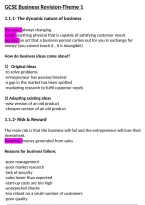
GCSE Business Revision-Theme 1
1.1.1- The dynamic nature of business
Dynamic: always changing
Good: anything physical that is capable of satisfying customer needs
Service: an act that a business person carries out for you in exchange for
money (you cannot touch it , it is intangible)
How do business ideas come about?
1) Original ideas
-to solve problems
-entrepreneur has passion/interest
-a gap in the market has been spotted
-marketing research to fulfil customer needs
2) Adapting existing ideas
-new version of an old product
-cheaper version of an old product
1.1.2- Risk & Reward
The main risk is that the business will fail and the entrepreneur will lose their
investment.
Revenue- money generated from sales
Reasons for business failure;
-poor management
-poor market research
-lack of security
-sales lower than expected
-start-up costs are too high
-unexpected shocks
-too reliant on a small number of customers
-poor quality
,Rewards for enterprise;
-profits
-capital gains
-self-esteem
-personal development
-independence
-satisfaction
-Invention- formulation of new ideas for products or processes
-Innovation- practical application of new inventions into marketable products
or services
If a business fails to plan for the future, it may risk losing out to competition.
1.1.3 The role of business enterprise
1) To produce goods and services
2) To meet customer needs
3) To add value: convenience, branding, quality, design, unique selling point
1.2.1 Customer needs
-price- right price for product
-quality- appropriate for price, satisfactory
-choice- businesses must produce a range
-convenience- being able to access what they want, how they want and when
they want
1.2.2 Market research
A business should use market research to help them identify what a customer
needs and how to meet and exceed that need.
A business will carry out market research to spot a gap in the market or a
potential business opportunity.
Primary research is original data gathered by the researcher. This is brand new
information which the researcher will find out about the business.
, 3 main primary research methods;
1) Surveys using questionnaires
- A good questionnaire needs a mix of opened and closed questions, they
must not ask leading questions
2) Focus groups
-Brings a group of potential customers together to talk about the proposed
new product or service idea
3) Observation
-A business may choose to gather data from buyer behaviour
Quantitative (quantity data);
-Involves gathering data and measuring responses
Qualitative data( quality information);
-Open questions, seeks to gather and explore feelings and thoughts about a
product from consumers
Secondary research;
It is also called desk research, this information already exists in some format,
someone has already collected the data
3 main secondary research methods;
1) Internet
-It’s a great place for market research to find information about the
competition
2) Market reports
-Mintel trends and reports- Mintel has a global team of trend analysts
constantly assessing change in culture, economy and society
Reports cost £1000-£3000

