
NUA 5950 Case Study 1 Questions With Answers Graded A+ Assured Success;
Rockhurst University
Case 1 Context
A 15-year-old male patient is brought to the clinic by his mother, complaining of a rash that started on his
abdomen about 3-4 days ago. He states that it started out just as a single spot on his abdomen, and then a few
days later, he noticed another spot under his left underarm. He states that the rash does itch but is not painful.
The current time of the year is spring, and he has no known environmental, food, or medication allergies.
Case 1 Questions
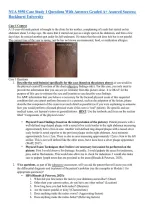
1. Describe the rash/lesion(s) specifically for this case (based on the picture above) as you would in
the physical exam (PE) section of the chart (objective findings only). For this case, you only need to
provide the information that you can see (or estimate) from this picture alone. It is OKAY for the
purpose of this case to estimate the size and location as you describe your findings.
For ANY information that you believe is necessary for the focused physical exam of this suspected
condition that you cannot perform (because it is a picture), such as the palpation of the lesion, please
describe that component of the exam in as much detail as possible (as if you were explaining to someone
how you would perform a focused physical exam if this were a "real" patient). Be specific and use
medical terms, not layman's terms or generalizations. HINT: Use the textbook and focus on the section
titled "Components of the physical exam."
• Physical Exam Findings (based on the interpretation of the picture): Patient presents with a
well-defined ring-shaped plaque with a raised silver scaly border to the right abdomen measuring
approximately 8cm x 8cm in size. Another well-defined ring-shaped plaque with a raised silver
scaly border is noted superior to the previous plaque on the right abdomen. Area measures
approximately 3cm x 2cm. There is also an area measuring approximately 12cm x 8cm to the left
axillae. This is not well defined like the other areas, but it does have a silver plaque appearance
(Wolff, 2017).
• Physical Exam Techniques that I believe are necessary but cannot be performed on the
picture: First I would observe for drainage. Secondly, I would palpate the areas for tenderness,
pain, and/or fluctuations. This would also allow me to check for induration. I would also make
sure to palpate lymph notes that are proximal to the areas (Rhoads & Petersen, 2025).
2. What questions, as part of the subjective assessment, will you ask the patient that will assist you with
the differential diagnosis and treatment of the patient's problem (see the examples in Module 1 for
appropriate questions)?
• HPI (Rhoads & Petersen, 2025):
1. When did you first notice the rash to your abdomen and axillae? (Onset)
2. Other than your current rashes, do you have any other rashes? (Location)
3. How long have you had both rashes? (Duration)
4. Are the rashes painful or itchy? (Characteristic)
5. Does anything make the rashes worse? (Aggravating factors)
6. Does anything make the rashes better? (Relieving factors)
, 7. Is there a certain time of day when the rash is worse? Have you been around with any
animals? (Timing)

