
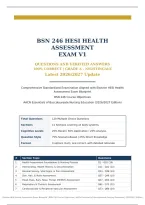
BSN 246 HESI HEALTH
ASSESSMENT
EXAM V1
QUESTIONS AND VERIFIED ANSWERS
100% CORRECT | GRADE A - NIGHTINGALE
Latest 2026/2027 Update
Comprehensive Standardized Examination Aligned with Elsevier HESI Health
Assessment Exam Blueprint
BSN 246 Course Objectives
AACN Essentials of Baccalaureate Nursing Education (2026/2027 Edition)
Total Questions 120 Multiple Choice Questions
Sections 11 Sections covering all body systems
Cognitive Levels 25% Recall | 50% Application | 25% Analysis
Question Style 75% Scenario-Based | 25% Direct Knowledge
Format 4 options (A-D), one correct, with detailed rationale
# Section Topic Questions
1 Health Assessment Foundations & Nursing Process Q1 - Q10 (10)
2 Interviewing, Health History, & Documentation Q11 - Q22 (12)
3 General Survey, Vital Signs, & Pain Assessment Q23 - Q36 (14)
4 Skin, Hair, & Nails Assessment Q37 - Q46 (10)
5 Head, Eyes, Ears, Nose, Throat (HEENT) Assessment Q47 - Q60 (14)
6 Respiratory & Thoracic Assessment Q61 - Q72 (12)
7 Cardiovascular & Peripheral Vascular Assessment Q73 - Q86 (14)
Elsevier HESI Health Assessment Exam Blueprint | BSN 246 Course Objectives | AACN Essentials of Baccalaureate Nursing Education | 2026/2027 Edition
, BSN 246 HESI Health Assessment Exam V1 | Latest 2026/2027 Update | Verified Answers | Grade A - Nightingale Page 2
8 Abdominal & Gastrointestinal Assessment Q87 - Q96 (10)
9 Musculoskeletal Assessment Q97 - Q104 (8)
10 Neurological & Mental Status Assessment Q105 - Q114 (10)
11 Lifespan, Cultural, & Special Population Considerations Q115 - Q120 (6)
Elsevier HESI Health Assessment Exam Blueprint | BSN 246 Course Objectives | AACN Essentials of Baccalaureate Nursing Education | 2026/2027 Edition
, BSN 246 HESI Health Assessment Exam V1 | Latest 2026/2027 Update | Verified Answers | Grade A - Nightingale Page 3
Examination Overview
This comprehensive standardized examination is designed to assess nursing student
knowledge, application, and analysis across the full breadth of the BSN 246 HESI Health
Assessment curriculum. The paper contains exactly 120 multiple-choice questions distributed
across eleven sections, each aligned with the Elsevier HESI Health Assessment Exam
Blueprint, BSN 246 Course Objectives, and AACN Essentials of Baccalaureate Nursing
Education (2026/2027 Edition).
The cognitive level distribution is calibrated to HESI examination standards: approximately
25% of questions assess recall of health assessment knowledge; 50% assess application of
knowledge to real-world patient assessment scenarios (vital sign interpretation, abnormal
finding recognition, prioritization of nursing actions); and 25% assess analysis including
clinical reasoning, interpretation of abnormal findings, and prioritization of nursing actions.
Approximately 75% of questions are scenario-based, requiring students to apply assessment
techniques, interpret findings, and prioritize care; 25% are direct knowledge questions.
Each question has four options (A-D) with exactly one correct answer. Distractors are
designed to reflect common assessment errors, misinterpretation of findings,
scope-of-practice confusion, and prioritization traps typical of student responses. Each
question includes a detailed rationale explaining why the correct answer is correct and why
the distractors are incorrect, with explicit reference to the HESI Health Assessment blueprint
and nursing assessment standards.
Students should use this examination both as a summative assessment and as a formative
learning tool. The rationales clarify assessment techniques, model clinical decision-making,
and reinforce the distinction between recall (knowledge), application (scenario-based
reasoning), and analysis (clinical reasoning, abnormal finding interpretation, and
prioritization) — distinctions central to success in the HESI Health Assessment exam and to
safe, effective nursing practice.
Section 1: Health Assessment Foundations & Nursing
Process
Q1: A nurse is preparing to perform a comprehensive health assessment on a
newly admitted patient. Which statement BEST describes the role of
assessment within the nursing process?
A. Assessment is performed only at admission; subsequent data collection occurs during
implementation.
B. Assessment is the first and ongoing step of the nursing process, involving
systematic collection, validation, and communication of patient data that
informs every other phase (diagnosis, planning, implementation, evaluation).
[CORRECT]
C. Assessment is the final step, used to evaluate outcomes.
D. Assessment is optional when the patient has a known diagnosis.
Correct Answer: B
Rationale: Assessment is both the first and ongoing step of the nursing process, providing the
database for diagnosis, planning, implementation, and evaluation (B). Option A is wrong —
Elsevier HESI Health Assessment Exam Blueprint | BSN 246 Course Objectives | AACN Essentials of Baccalaureate Nursing Education | 2026/2027 Edition
, BSN 246 HESI Health Assessment Exam V1 | Latest 2026/2027 Update | Verified Answers | Grade A - Nightingale Page 4
assessment continues throughout care. Option C confuses assessment with evaluation. Option D
is wrong — assessment is always required to individualize care.
Q2: A nurse collects a blood pressure reading of 152/94 mmHg from a patient
with no prior hypertension history. The nurse's BEST next action is to:
A. Document the finding and continue to the next assessment.
B. Validate the data by rechecking the blood pressure in the opposite arm
after the patient rests for 5 minutes, review prior readings, and confirm
correct cuff size and technique before documenting and reporting. [CORRECT]
C. Administer an antihypertensive immediately.
D. Discharge the patient home with lifestyle advice.
Correct Answer: B
Rationale: Validation confirms accuracy through re-measurement, technique review, and
historical comparison before action (B). Administering medication (C) requires provider orders and
confirmation. Documenting without validation (A) risks acting on erroneous data. Discharge (D) is
unsafe without evaluation.
Q3: Which of the following is an example of OBJECTIVE data?
A. The patient states, 'I have a headache.'
B. The patient's skin is pale, cool, and diaphoretic. [CORRECT]
C. The patient reports nausea.
D. The patient's mother says he has been tired.
Correct Answer: B
Rationale: Objective data are observable and measurable (signs) — pale, cool, diaphoretic skin is
observed by the nurse (B). Options A, C, and D are subjective data (symptoms) reported by the
patient or family and cannot be directly measured.
Q4: During the assessment phase, a nurse gathers both subjective and
objective data. The PRIMARY purpose of the database is to:
A. Satisfy institutional paperwork requirements.
B. Establish a baseline, identify actual and potential health problems, identify
strengths, and form the basis for nursing diagnoses and the plan of care.
[CORRECT]
C. Provide information for billing.
D. Replace the medical diagnosis.
Correct Answer: B
Rationale: The database establishes a baseline, identifies problems and strengths, and forms the
foundation for nursing diagnoses and care planning (B). Option A is wrong — paperwork is
secondary. Option C is wrong — billing uses medical coding. Option D is wrong — nursing
assessment complements, not replaces, the medical diagnosis.
Q5: A nurse performs a focused (problem-oriented) assessment rather than a
comprehensive assessment when:
A. The patient is being admitted for the first time to the hospital.
B. The patient presents with a specific complaint or change in status (e.g.,
new chest pain) that requires targeted data collection to evaluate the
identified problem. [CORRECT]
C. The patient is being discharged.
Elsevier HESI Health Assessment Exam Blueprint | BSN 246 Course Objectives | AACN Essentials of Baccalaureate Nursing Education | 2026/2027 Edition

