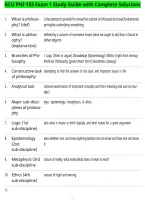
GCU PHI-103 Exam 1 Study Guide with Complete Solutions
1. What is philoso- is the attempt to provide for oneself an outlook on life based on broad fundamental
phy? (def) principles underlying everything
2. What is philos- defined by a concern of normative issues (what we ought to do) than is found in
ophy? other objects
(explana-tion)
3. Branches of Phi- 1 Logic (think or argue) 2Knowledge (Epistemology) 3Ethics (right from wrong)
losophy 4Political Philosophy (government form) 5Aesthetics (beauty)
4. Constructive task attempting to find the answers to the basic and important issues in life
of philosophy
5. Analytical task rational examination of important concepts and their meaning and use (ex;mur-
der)
6. Major sub-disci- logic, epistemology, metaphysics, & ethics
plines of philoso-
phy
7. Logic (1st asks what it means to think logically, and what makes for a good arguement
sub-discipline)
8. Epistemology asks whether one can know anything &what one can know and how one can know
(2nd it
sub-discipline)
9. Metaphysic (3rd nature of reality; what exists/what does it mean to exist?
sub-discipline
10. Ethics (4th nature of right and wrong
sub-discipline)
11.
1/7
, 3 primary Laws of 1-Law of identity
Logic 2- Law of non-contradiction
3- Law of exclude middle
(all reinforce each other, however if you just study the law of non-contradiction you
can understand all)
12. Components of -it is formally &informally valid
a - it has true premises
"sound"/"good" -leads us to a sound conclusion which means it is true/valid
deductive argu-
ment
the premise guarantee the truth of their conclusion
13. Deductive argu-
ment (def)
1Modus Ponens
14. 5 Types of
valid logical argu- 2Modus Tollens
ments 17.
15. Modus Ponens
(MP)
16. Modus Tollens
(MT)
2/9