
TEST BANK · 2026/2027 · ADVANCED A+ VERIFIED ★
EXAM BANK · VERIFIED A+ CONTENT
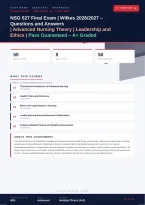
NSG 527 Final Exam | Wilkes 2026/2027 –
Questions and Answers
| Advanced Nursing Theory | Leadership and
Ethics | Pass Guaranteed – A+ Graded
50 5 50
QUESTIONS SECTIONS R AT I O N A L E S
W H AT T H I S C O V E R S
5 sections · 50 original application/analysis items
Theoretical Foundations of Advanced Nursing
01 10 questions
Health Policy and Advocacy
02 10 questions
Ethics and Legal Issues in Nursing
03 10 questions
Leadership and Interprofessional Collaboration
04 10 questions
Evidence-Based Practice and Quality Improvement
05 10 questions
ABOUT THIS ASSESSMENT
This assessment covers Theoretical Foundations of Advanced Nursing; Health Policy and Advocacy; Ethics and Legal Issues in Nursing;
Leadership and Interprofessional Collaboration; Evidence-Based Practice and Quality Improvement. Each item is an original,
application/analysis-level multiple-choice question mapped to a unique concept label in a master concept ledger to avoid duplication. The
answer key provides the correct option, a focused rationale, and a summary of the question count and passing score for self-assessment.
Use it to rehearse pathophysiologic reasoning, clinical interpretation, and decision-making across the listed domains.
S T U V I A A C T U A L E X A M
PA S S I N G S C O R E LEVEL F O R M AT
STUVIA
80% Advanced Multiple Choice (A-D)
, NSG 527 Final Exam | Wilkes 2026/2027 – Questions and Answers |
Advanced Nursing Theory | Leadership and Ethics – Pass Guaranteed – A+
Graded
Format: Multiple Choice (A-D) | Total Questions: 50 | Sections: 5 | Passing Score: 80%
| Difficulty: Advanced | Bloom's Level: Application/Analysis
Section 1. Theoretical Foundations of Advanced
Nursing
Grand and middle-range nursing theories and their application to advanced practice.
Q1. [Roy adaptation model]
A nurse practitioner applies the Roy Adaptation Model. The patient's report of
breathlessness during activity is best classified as:
A. A maladaptive response in the self-concept mode
B. An adaptive response in the interdependence mode
C. An adaptive response in the physiologic mode
D. A focal stimulus
Answer: C. An adaptive response in the physiologic mode
Rationale: Roy's model has four adaptive modes: physiologic, self-concept, role function, and
interdependence. Breathlessness is a physiologic-mode response; whether adaptive or
maladaptive depends on whether it supports or threatens integrity.
Q2. [Orem self-care deficit theory]
A patient post-stroke lacks the ability to safely self-administer warfarin. Per Orem, the
appropriate nursing system is:
A. Wholly compensatory
B. Supportive-educative with partial compensation
C. No nursing system needed
D. Purely supportive only
Answer: B. Supportive-educative with partial compensation
Rationale: Orem identifies wholly compensatory, partly compensatory, and supportive-educative
systems. A patient who can participate but needs oversight requires supportive-educative with
partial compensation, supporting autonomy while ensuring safety.
Q3. [Watson caring theory]
A nurse practitioner sits with a dying patient, holding her hand and listening to her life
story. This reflects Watson's:
A. Clinical judgment
B. Empirical knowing
C. Adaptation theory
NSG_527_Final_Exam_Wilkes_2026_2027.pdf | Stuvia Actual Exam | Page 1
, D. Caring-healing modalities and transpersonal caring
Answer: D. Caring-healing modalities and transpersonal caring
Rationale: Watson's theory centers on transpersonal caring through 10 caritas processes,
including being present authentically and creating healing environments. This caring moment
reflects the relational, spiritual core of her model.
Q4. [Carper's ways of knowing]
A nurse integrates research evidence, the patient's lived experience, ethical reasoning,
and personal insight to make a clinical decision. This integrates Carper's:
A. Empirics, esthetics, ethics, and personal knowing
B. Four adaptive modes
C. Three nursing systems
D. Caring-healing modalities
Answer: A. Empirics, esthetics, ethics, and personal knowing
Rationale: Carper identified four fundamental patterns of knowing: empirics (science), esthetics
(art/personal experience), ethics (moral), and personal (self-awareness). Advanced practice
integrates all four.
Q5. [Benner novice to expert]
A new NP graduate relies on rules and protocols to manage unfamiliar cases. Per Benner,
this NP is at which stage?
A. Novice
B. Competent
C. Proficient
D. Advanced beginner
Answer: D. Advanced beginner
Rationale: Benner's stages are novice, advanced beginner, competent, proficient, expert. New
graduates relying on rules with limited context-recognition are advanced beginners; competence
develops with experience and situational adaptability.
Q6. [Peplau interpersonal relations]
A nurse builds a therapeutic alliance through phases of orientation, working, and
termination with a patient with anxiety. This is the foundation of:
A. Peplau's interpersonal relations theory
B. Roy adaptation model
C. Orem self-care theory
D. Leininger cultural care theory
Answer: A. Peplau's interpersonal relations theory
Rationale: Peplau's Theory of Interpersonal Relations describes phases (orientation, working,
termination) and roles of the nurse-patient relationship, foundational to psychiatric and
therapeutic communication.
Q7. [Leininger cultural care diversity]
NSG_527_Final_Exam_Wilkes_2026_2027.pdf | Stuvia Actual Exam | Page 2
EXAM BANK · VERIFIED A+ CONTENT
NSG 527 Final Exam | Wilkes 2026/2027 –
Questions and Answers
| Advanced Nursing Theory | Leadership and
Ethics | Pass Guaranteed – A+ Graded
50 5 50
QUESTIONS SECTIONS R AT I O N A L E S
W H AT T H I S C O V E R S
5 sections · 50 original application/analysis items
Theoretical Foundations of Advanced Nursing
01 10 questions
Health Policy and Advocacy
02 10 questions
Ethics and Legal Issues in Nursing
03 10 questions
Leadership and Interprofessional Collaboration
04 10 questions
Evidence-Based Practice and Quality Improvement
05 10 questions
ABOUT THIS ASSESSMENT
This assessment covers Theoretical Foundations of Advanced Nursing; Health Policy and Advocacy; Ethics and Legal Issues in Nursing;
Leadership and Interprofessional Collaboration; Evidence-Based Practice and Quality Improvement. Each item is an original,
application/analysis-level multiple-choice question mapped to a unique concept label in a master concept ledger to avoid duplication. The
answer key provides the correct option, a focused rationale, and a summary of the question count and passing score for self-assessment.
Use it to rehearse pathophysiologic reasoning, clinical interpretation, and decision-making across the listed domains.
S T U V I A A C T U A L E X A M
PA S S I N G S C O R E LEVEL F O R M AT
STUVIA
80% Advanced Multiple Choice (A-D)
, NSG 527 Final Exam | Wilkes 2026/2027 – Questions and Answers |
Advanced Nursing Theory | Leadership and Ethics – Pass Guaranteed – A+
Graded
Format: Multiple Choice (A-D) | Total Questions: 50 | Sections: 5 | Passing Score: 80%
| Difficulty: Advanced | Bloom's Level: Application/Analysis
Section 1. Theoretical Foundations of Advanced
Nursing
Grand and middle-range nursing theories and their application to advanced practice.
Q1. [Roy adaptation model]
A nurse practitioner applies the Roy Adaptation Model. The patient's report of
breathlessness during activity is best classified as:
A. A maladaptive response in the self-concept mode
B. An adaptive response in the interdependence mode
C. An adaptive response in the physiologic mode
D. A focal stimulus
Answer: C. An adaptive response in the physiologic mode
Rationale: Roy's model has four adaptive modes: physiologic, self-concept, role function, and
interdependence. Breathlessness is a physiologic-mode response; whether adaptive or
maladaptive depends on whether it supports or threatens integrity.
Q2. [Orem self-care deficit theory]
A patient post-stroke lacks the ability to safely self-administer warfarin. Per Orem, the
appropriate nursing system is:
A. Wholly compensatory
B. Supportive-educative with partial compensation
C. No nursing system needed
D. Purely supportive only
Answer: B. Supportive-educative with partial compensation
Rationale: Orem identifies wholly compensatory, partly compensatory, and supportive-educative
systems. A patient who can participate but needs oversight requires supportive-educative with
partial compensation, supporting autonomy while ensuring safety.
Q3. [Watson caring theory]
A nurse practitioner sits with a dying patient, holding her hand and listening to her life
story. This reflects Watson's:
A. Clinical judgment
B. Empirical knowing
C. Adaptation theory
NSG_527_Final_Exam_Wilkes_2026_2027.pdf | Stuvia Actual Exam | Page 1
, D. Caring-healing modalities and transpersonal caring
Answer: D. Caring-healing modalities and transpersonal caring
Rationale: Watson's theory centers on transpersonal caring through 10 caritas processes,
including being present authentically and creating healing environments. This caring moment
reflects the relational, spiritual core of her model.
Q4. [Carper's ways of knowing]
A nurse integrates research evidence, the patient's lived experience, ethical reasoning,
and personal insight to make a clinical decision. This integrates Carper's:
A. Empirics, esthetics, ethics, and personal knowing
B. Four adaptive modes
C. Three nursing systems
D. Caring-healing modalities
Answer: A. Empirics, esthetics, ethics, and personal knowing
Rationale: Carper identified four fundamental patterns of knowing: empirics (science), esthetics
(art/personal experience), ethics (moral), and personal (self-awareness). Advanced practice
integrates all four.
Q5. [Benner novice to expert]
A new NP graduate relies on rules and protocols to manage unfamiliar cases. Per Benner,
this NP is at which stage?
A. Novice
B. Competent
C. Proficient
D. Advanced beginner
Answer: D. Advanced beginner
Rationale: Benner's stages are novice, advanced beginner, competent, proficient, expert. New
graduates relying on rules with limited context-recognition are advanced beginners; competence
develops with experience and situational adaptability.
Q6. [Peplau interpersonal relations]
A nurse builds a therapeutic alliance through phases of orientation, working, and
termination with a patient with anxiety. This is the foundation of:
A. Peplau's interpersonal relations theory
B. Roy adaptation model
C. Orem self-care theory
D. Leininger cultural care theory
Answer: A. Peplau's interpersonal relations theory
Rationale: Peplau's Theory of Interpersonal Relations describes phases (orientation, working,
termination) and roles of the nurse-patient relationship, foundational to psychiatric and
therapeutic communication.
Q7. [Leininger cultural care diversity]
NSG_527_Final_Exam_Wilkes_2026_2027.pdf | Stuvia Actual Exam | Page 2

