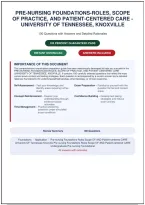
PRE-NURSING FOUNDATIONS-ROLES, SCOPE
OF PRACTICE, AND PATIENT-CENTERED CARE -
UNIVERSITY OF TENNESSEE, KNOXVILLE
100 Questions with Answers and Detailed Rationales
100 PERCENT GUARANTEED PASS
INSTANT DOWNLOAD ANSWERS INCLUDED
IMPORTANCE OF THIS DOCUMENT
This comprehensive examination preparation guide has been meticulously developed to help you succeed in the
PRE-NURSING FOUNDATIONS-ROLES, SCOPE OF PRACTICE, AND PATIENT-CENTERED CARE -
UNIVERSITY OF TENNESSEE, KNOXVILLE. It contains 100 carefully selected questions that reflect the most
current exam content and testing strategies. Each question is accompanied by a correct answer and a detailed
rationale that explains the underlying pathophysiology, pharmacology, or clinical reasoning.
Self-Assessment – Test your knowledge and Exam Preparation – Familiarize yourself with the
identify areas requiring further question format and content
study areas
Concept Reinforcement – Deepen your Confidence Building – Develop test-taking
understanding through strategies and reduce
evidence-based exam anxiety
rationales
Time Management – Practice answering
questions under simulated
exam conditions
Review Summary 100 Questions
Foundations - Application - Pre-nursing Foundations Roles Scope OF AND Patient-centered CARE
University OF Tennessee Knoxville Pre-nursing Foundations Roles Scope OF AND Patient-centered CARE
Undergraduate Pre-nursing Foundational
All answers with rationales
,Table of Contents
Content Area Questions Key Topics
Roles AND Scope OF IN 1-17 Prevention, Reflects, QSEN Competency, Patient-centered
Nursing CARE, Exemplifies
Patient-centered CARE 18-34 Exemplifies, Reflects, Demonstrates, Nursing, Competency
Principles
Nursing Process AND 35-51 Reflects, Level, Nursing, Notices, Colleague
Clinical Judgment
Safety AND Infection Control 52-68 Nursing, Patient-centered CARE, Demonstrates, Situation,
Clearly
Health Promotion AND 69-85 Scope, Reflects, Nursing, Barcode Scanner, Patient-centered
Maintenance CARE
Psychosocial Integrity 86-100 Reflects, Cultural, Interprofessional, Demonstrates, Collaboration
TOTAL 100 All questions include answers and detailed rationales
,Section A - Roles AND Scope OF IN Nursing
Q1.
Which statement best reflects the RN's role in delegation according to the NCSBN?
A. RNs may delegate any task to UAPs if B. RNs retain accountability for the
they are competent. delegated task's outcome.
C. Delegation transfers both responsibility D. UAPs can perform assessments if
and accountability to UAP. supervised by an RN.
Correct: B - RNs retain accountability for the delegated task's outcome.
Rationale:The RN remains accountable for the overall nursing process and outcome even
when delegating tasks. UAPs cannot perform assessments or receive transfer of
accountability. A and C are incorrect because accountability cannot be delegated; D is
incorrect because assessment is an RN responsibility.
Q2.
A nurse implements a new fall prevention protocol based on a recent RCT. Which QSEN
competency is demonstrated?
A. Patient-centered care B. Teamwork and collaboration
C. Evidence-based practice D. Quality improvement
Correct: C - Evidence-based practice
Rationale:Integrating best current evidence from RCTs into practice is the essence of
evidence-based practice. Patient-centered care focuses on patient preferences; teamwork
involves collaboration; quality improvement uses data to monitor outcomes.
Q3.
Which action by a nurse best exemplifies patient-centered care?
A. Educating the patient on the importance B. Tailoring discharge instructions to the
of medication adherence. patient's health literacy level.
C. Ensuring the patient attends all follow-up D. Administering medications as prescribed
appointments. by the provider.
Correct: B - Tailoring discharge instructions to the patient's health literacy level.
Rationale:Patient-centered care respects individual preferences, values, and needs,
including tailoring communication to health literacy. The other actions are important but do not
necessarily reflect the patient's individual context.
Page 3
, Section A - Roles AND Scope OF IN Nursing
Q4.
Which situation requires mandatory reporting by a nurse under state law?
A. A patient discloses past child abuse that B. A colleague arrives to work with alcohol
occurred years ago. on their breath.
C. A patient refuses a prescribed blood D. A family member asks about the patient's
transfusion. prognosis.
Correct: B - A colleague arrives to work with alcohol on their breath.
Rationale:Nurses are mandated reporters of impaired colleagues to protect patient safety.
Past child abuse may require reporting depending on state law, but current impairment is an
immediate safety issue. Refusing treatment and family inquiries are not mandatory reports.
Q5.
In an interprofessional team, which communication tool is designed to standardize
handoff?
A. SBAR B. SOAP
C. PIE D. DARE
Correct: A - SBAR
Rationale:SBAR (Situation, Background, Assessment, Recommendation) is a standardized
communication tool for handoffs. SOAP and PIE are documentation formats; DARE is a
decision-making model.
Q6.
Which primary prevention activity should a nurse prioritize in a community with low
vaccination rates?
A. Setting up a mobile vaccination clinic B. Screening for early signs of disease
C. Providing rehabilitation services D. Offering support groups for chronic
illness
Correct: A - Setting up a mobile vaccination clinic
Rationale:Primary prevention aims to prevent disease before it occurs; vaccination is a
classic example. Screening is secondary prevention; rehabilitation and support groups are
tertiary prevention.
Page 4