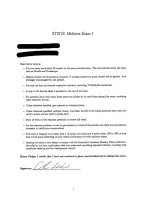
ST371E: Midterm Exam 1
_ -
]
Read before opening:
Put your name and student ID number in the space provided above. This name should match the name
used on Moodle and Gradescope.
Illegible answers will be graded as incorrect. If multiple answers are given, neither will be graded. It is
strongly encouraged to use pencil.
You may use any non-internet-connected calculator (including T1-83/84/89 calculators).
A copy of the formula sheet is provided at the end of the exam.
No materials other than those listed above are allowed to be used when taking this exam, including
other electronic devices.
Unless otherwise specified, give answers to 4 decimal places.
Unless otherwise specified, multiple choice, true/false, and fill in the blank questions have only one
correct answer and are worth 3 points each.
Show all work on free response questions to receive full credit.
For free response questions, be sure to give answers in context of the problem and check any assumptions
necessary to justify your computations.
This exam is designed to be taken with a 75 minute time limit and is worth either 15% or 20% of your
final overall grade depending on your overall performance on both midterm exams.
Opening this exam is your assent to comply with the University’s Academic Honesty Policy outlined in
the syllabus, and your confirmation that you understand everything stipulated therein, including what
constitutes cheating and the consequences thereof.
Honor Pledge: I certify that I have not received or given unauthroized aid in taking this exam.
P
Signature: / : %g el
, 1. Which of the following would best describe the sample space of flipping a coin 50 times consecutively
and recording the results?
{(a) The empty set /édfi]ncountably Infinite
Finite (e) Simple
Countably Infinite (f) Compound
27 W’él?,gf the following represents the associative property.of sets?
SNT={zlze Sandz e T} /(3)/§0(TUU)=(SDT)U(SOU)
B SUT=TUSor SNT=TNS 6 SUSc =0
@u(TuU):(SUT)UU /uj/smz:s
mj><" . Consider the experiment where we flip a fair coin four times. Which of the following constitutes a
simple event?
(a) The event that you flip four tails. (d) The event that you flip at least 1 heads.
(b) The event that you flip no more than 2 heads. The event that you don’t flip the coin.
(c) The event that you flip an equal number of (f) The event that you flip a heads on the first
heads and tails. toss.
. Let A; and A, be disjoint events from a sample space (2. Which of the following is true regarding the
events A; and A,7
/(sft P(A; U A;) > 1
P(A1 n Az) >0
P(A1 U A;) = P(A1) + P(Az) — P(A; N Ap) -
P If the sample space consists of n possible outcomes, which are all equally likely, then the probability of
any event A is given by
number of elements in A
P(A) = -
is describing which of the following?
the unconditional probability law he discrete uniform probability law
(b) the discrete probability law the additivity axiom
%he conditional probability law A statistically independent events
Let A, B, and C be events from a sample space 2. Which of the following describes the property that
haxled as the most useful property of probability in our framework?
l' (AU B) =P(A) + P(B) (d) PLAUC)+P(A°NC%) =1
b) 0<P(4) <1 ; P(AUBUC)
=P(A) +P(A°N B)
e
(AN B)UC)= P(AN
B) +P(C) +P(A°NnB°NC)
+P((ANnB)NC)
7. Let A and B be events from a sample space {2 such that A C B. Which of the following is true?
_lopAuB=4 & AnB=0
OAcuBc A A& 4° = B
) AANBc=Q AyQe =
_ -
]
Read before opening:
Put your name and student ID number in the space provided above. This name should match the name
used on Moodle and Gradescope.
Illegible answers will be graded as incorrect. If multiple answers are given, neither will be graded. It is
strongly encouraged to use pencil.
You may use any non-internet-connected calculator (including T1-83/84/89 calculators).
A copy of the formula sheet is provided at the end of the exam.
No materials other than those listed above are allowed to be used when taking this exam, including
other electronic devices.
Unless otherwise specified, give answers to 4 decimal places.
Unless otherwise specified, multiple choice, true/false, and fill in the blank questions have only one
correct answer and are worth 3 points each.
Show all work on free response questions to receive full credit.
For free response questions, be sure to give answers in context of the problem and check any assumptions
necessary to justify your computations.
This exam is designed to be taken with a 75 minute time limit and is worth either 15% or 20% of your
final overall grade depending on your overall performance on both midterm exams.
Opening this exam is your assent to comply with the University’s Academic Honesty Policy outlined in
the syllabus, and your confirmation that you understand everything stipulated therein, including what
constitutes cheating and the consequences thereof.
Honor Pledge: I certify that I have not received or given unauthroized aid in taking this exam.
P
Signature: / : %g el
, 1. Which of the following would best describe the sample space of flipping a coin 50 times consecutively
and recording the results?
{(a) The empty set /édfi]ncountably Infinite
Finite (e) Simple
Countably Infinite (f) Compound
27 W’él?,gf the following represents the associative property.of sets?
SNT={zlze Sandz e T} /(3)/§0(TUU)=(SDT)U(SOU)
B SUT=TUSor SNT=TNS 6 SUSc =0
@u(TuU):(SUT)UU /uj/smz:s
mj><" . Consider the experiment where we flip a fair coin four times. Which of the following constitutes a
simple event?
(a) The event that you flip four tails. (d) The event that you flip at least 1 heads.
(b) The event that you flip no more than 2 heads. The event that you don’t flip the coin.
(c) The event that you flip an equal number of (f) The event that you flip a heads on the first
heads and tails. toss.
. Let A; and A, be disjoint events from a sample space (2. Which of the following is true regarding the
events A; and A,7
/(sft P(A; U A;) > 1
P(A1 n Az) >0
P(A1 U A;) = P(A1) + P(Az) — P(A; N Ap) -
P If the sample space consists of n possible outcomes, which are all equally likely, then the probability of
any event A is given by
number of elements in A
P(A) = -
is describing which of the following?
the unconditional probability law he discrete uniform probability law
(b) the discrete probability law the additivity axiom
%he conditional probability law A statistically independent events
Let A, B, and C be events from a sample space 2. Which of the following describes the property that
haxled as the most useful property of probability in our framework?
l' (AU B) =P(A) + P(B) (d) PLAUC)+P(A°NC%) =1
b) 0<P(4) <1 ; P(AUBUC)
=P(A) +P(A°N B)
e
(AN B)UC)= P(AN
B) +P(C) +P(A°NnB°NC)
+P((ANnB)NC)
7. Let A and B be events from a sample space {2 such that A C B. Which of the following is true?
_lopAuB=4 & AnB=0
OAcuBc A A& 4° = B
) AANBc=Q AyQe =